


Three family members of a Taiwanese-born woman likely to be charged with murdering her three children in Espoo, Finland, will travel to Finland today, family sources said on Saturday.
The woman's father, uncle and brother will assist with her case and hire lawyers to defend the woman, identified only by her maiden name, Fu (
Local media and Finnish police have not revealed a possible motive for the killings or other details, but the online version of the Helsingin Sanomat daily yesterday cited Fu's lawyer and police as saying that she did not deny killing her children, twin girls aged eight and a boy almost two years of age.
The daily said the court would set Oct. 24 as the deadline for filing charges against Fu.
Fu's father said he was shocked by the tragedy, and that he could not believe that his daughter, who had pursued advanced studies in Britain, had committed any crime.
Her family said Fu worked at a post office and maintained close contact with her family in Kaohsiung City.
Fu's father said she often chatted with him by telephone.
"My daughter is a brave and strong-willed woman. She never mentioned any [of the challenges she faces] in her daily life. We didn't know about her distressing plight [alleged domestic violence] until a Finnish pastor contacted us after the tragedy," Fu's father said.
He said that Fu divorced her husband in March last year. Fu secured custody of their son, but custody of the twin daughters went to their father.
Sheng Pei-huang (
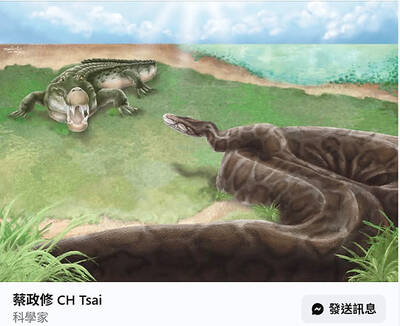
Taiwanese paleontologists have discovered fossil evidence that pythons up to 4m long inhabited Taiwan during the Pleistocene epoch, reporting their findings in the international scientific journal Historical Biology. National Taiwan University (NTU) Institute of Ecology and Evolutionary Biology associate professor Tsai Cheng-hsiu (蔡政修) led the team that discovered the largest snake fossil ever found in Taiwan. The single trunk vertebra was discovered in Tainan at the Chiting Formation, dated to between 400,000 and 800,000 years ago in the Middle Pleistocene, the paper said. The area also produced Taiwan’s first avian fossil, as well as crocodile, mammoth, saber-toothed cat and rhinoceros fossils, it said. Discoveries

Taiwanese paleontologists have discovered fossil evidence that pythons up to 4m long inhabited Taiwan during the Pleistocene epoch, reporting their findings in the international scientific journal Historical Biology. National Taiwan University (NTU) Institute of Ecology and Evolutionary Biology associate professor Tsai Cheng-hsiu (蔡政修) led the team that discovered the largest snake fossil ever found in Taiwan. A single trunk vertebra was discovered in Tainan at the Chiting Formation, dated to between 800,000 to 400,000 years ago in the Middle Pleistocene, the paper said. The area also produced Taiwan’s first avian fossil, as well as crocodile, mammoth, sabre-toothed cat and rhinoceros fossils, it said. Discoveries
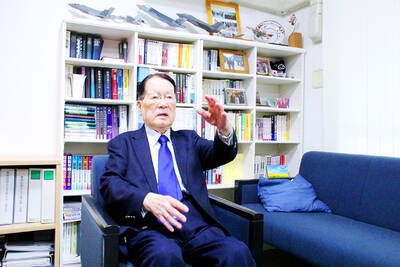
Whether Japan would help defend Taiwan in case of a cross-strait conflict would depend on the US and the extent to which Japan would be allowed to act under the US-Japan Security Treaty, former Japanese minister of defense Satoshi Morimoto said. As China has not given up on the idea of invading Taiwan by force, to what extent Japan could support US military action would hinge on Washington’s intention and its negotiation with Tokyo, Morimoto said in an interview with the Liberty Times (sister paper of the Taipei Times) yesterday. There has to be sufficient mutual recognition of how Japan could provide
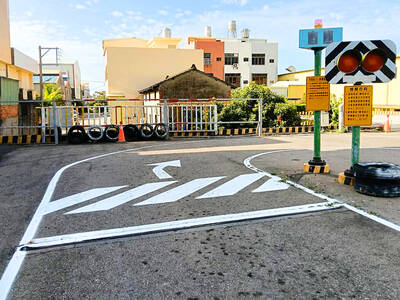
UPDATED TEST: The new rules aim to assess drivers’ awareness of risky behaviors and how they respond under certain circumstances, the Highway Bureau said Driver’s license applicants who fail to yield to pedestrians at intersections or to check blind spots, or omit pointing-and-calling procedures would fail the driving test, the Highway Bureau said yesterday. The change is set to be implemented at the end of the month, and is part of the bureau’s reform of the driving portion of the test, which has been criticized for failing to assess whether drivers can operate vehicles safely. Sedan drivers would be tested regarding yielding to pedestrians and turning their heads to check blind spots, while drivers of large vehicles would be tested on their familiarity with pointing-and-calling


 RSS
RSS