


District court judges yesterday rejected a request by the defendants' lawyers to summon President Chen Shui-bian (陳水扁) to a hearing of the "special state affairs fund" case.
"We decided that to summon the president would not be necessary because the evidence and statements from defendants are quite clear," said Tsai Shou-hsun (蔡守訓), presiding judge in the case.
First lady Wu Shu-jen (吳淑珍), former Presidential Office deputy secretary-general Ma Yung-cheng (馬永成), his successor Lin Teh-hsun (林德訓) and former Presidential Office treasurer Chen Cheng-hui (陳鎮慧) were indicted by prosecutors on charges of corruption and forgery for allegedly embezzling NT$14.8 million (US$449,600) from the "special state affairs fund."
Chen avoided indictment because of his presidential immunity.
Lawyers defending Ma and Lin asked the judges to summon the president during the previous hearing on July 27 to facilitate investigations and ensure a fair trial.
Ma and Lin face accusations of forgery involving funds set aside for the president's discretionary use.
"The president is the principal figure in the case, as Ma and Lin did not act of their own free will while carrying out requests from the president. We need the president to clarify things like that," said Lee Sheng-chen (李勝琛), Ma's defense counsel. "He [the president] is in a position to provide clarification on certain conflicting points in the case. I think what the judges have done is not quite fair to us."
Tsai began the first hearing of the case last December. Wu, as a defendant, attended the first hearing on Dec. 16 and has been on sick leave ever since.
On June 15, the Council of Grand Justices confirmed the president's constitutional right to decide what constitutes a state secret and his right to refuse disclosure.
The Council of Grand Justices ruled that the president enjoys immunity from criminal investigation and cannot be questioned by prosecutors during his tenure.
The council's unanimous decision was made at Chen's request, who refused to produce documents during the trial of his wife for alleged corruption at the Taipei District Court, claiming that doing so would undermine national security.
The council said the president, within the authority conferred upon him by the Constitution and its additional articles, has the right to keep secret classified information on national security, defense and diplomacy if he thinks that their disclosure would compromise national security and interests.
This privilege includes the right to refuse to give testimony and to produce evidence for that purpose in court.
This privilege will not exempt Chen from serving as a witness in the criminal trials of others, although he can be questioned only at places of his choosing, the council said.

LOUD AND PROUD Taiwan might have taken a drubbing against Australia and Japan, but you might not know it from the enthusiasm and numbers of the fans Taiwan might not be expected to win the World Baseball Classic (WBC) but their fans are making their presence felt in Tokyo, with tens of thousands decked out in the team’s blue, blowing horns and singing songs. Taiwanese fans have packed out the Tokyo Dome for all three of their games so far and even threatened to drown out home team supporters when their team played Japan on Friday. They blew trumpets, chanted for their favorite players and had their own cheerleading squad who dance on a stage during the game. The team struggled to match that exuberance on the field, with
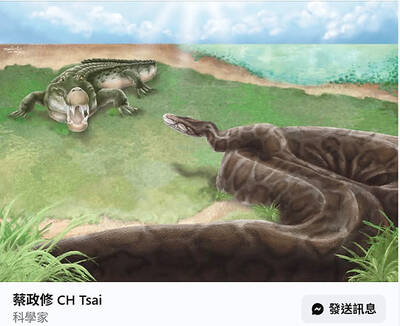
Taiwanese paleontologists have discovered fossil evidence that pythons up to 4m long inhabited Taiwan during the Pleistocene epoch, reporting their findings in the international scientific journal Historical Biology. National Taiwan University (NTU) Institute of Ecology and Evolutionary Biology associate professor Tsai Cheng-hsiu (蔡政修) led the team that discovered the largest snake fossil ever found in Taiwan. The single trunk vertebra was discovered in Tainan at the Chiting Formation, dated to between 400,000 and 800,000 years ago in the Middle Pleistocene, the paper said. The area also produced Taiwan’s first avian fossil, as well as crocodile, mammoth, saber-toothed cat and rhinoceros fossils, it said. Discoveries

Taiwanese paleontologists have discovered fossil evidence that pythons up to 4m long inhabited Taiwan during the Pleistocene epoch, reporting their findings in the international scientific journal Historical Biology. National Taiwan University (NTU) Institute of Ecology and Evolutionary Biology associate professor Tsai Cheng-hsiu (蔡政修) led the team that discovered the largest snake fossil ever found in Taiwan. A single trunk vertebra was discovered in Tainan at the Chiting Formation, dated to between 800,000 to 400,000 years ago in the Middle Pleistocene, the paper said. The area also produced Taiwan’s first avian fossil, as well as crocodile, mammoth, sabre-toothed cat and rhinoceros fossils, it said. Discoveries
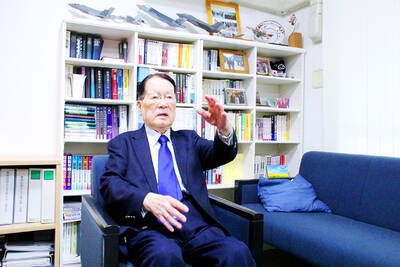
Whether Japan would help defend Taiwan in case of a cross-strait conflict would depend on the US and the extent to which Japan would be allowed to act under the US-Japan Security Treaty, former Japanese minister of defense Satoshi Morimoto said. As China has not given up on the idea of invading Taiwan by force, to what extent Japan could support US military action would hinge on Washington’s intention and its negotiation with Tokyo, Morimoto said in an interview with the Liberty Times (sister paper of the Taipei Times) yesterday. There has to be sufficient mutual recognition of how Japan could provide


 RSS
RSS