


US immigration authorities said they were "dismayed" after losing their second court decision against fugitive Rebar founder Wang You-theng (
Wang was provisionally freed from the San Pedro, California, facility south of Los Angeles after a Board of Immigration Appeal judge last Friday threw out the government case against Wang, who fled to the US from Taiwan in January and was arrested and detained after a failed attempt to flee prosecution in the US in February.
It was the second setback in the case for US immigration officials. On March 28, an immigration judge ruled against the government in its original bid to keep Wang in detention, US officials said. But at the US government's urging, he was kept at the facility while the government pursued its appeal.
Details of the case had been kept secret by a gag rule issued by the immigration judge. But now details are emerging as the do-not-disclose rule has apparently been lifted.
In both cases, the courts ruled that Wang had not technically left the US in February, when he flew to Singapore en route to Myanmar, only to be denied entry by Singaporean authorities and sent back to Los Angeles, said Virginia Kice, a spokesperson for the Immigration and Customs Enforcement (ICE) agency in Los Angeles.
In the first ruling. the court said that "even though he was out of the United States for several days," he "never legally departed the United States," she said.
The appeals board upheld that, saying "he never technically in the eye of the law left the United States," she said.
"Obviously, we are dismayed about the outcome and we are reviewing our legal options," Kice told the Taipei Times.
When Wang originally entered the US, he did so on a valid visa with his Taiwanese passport.
After he arrived in the US, Taiwan revoked his passport and his visa was considered to be void.
But, since he did not technically leave the US, as the appeals court decided, the government could not argue that he re-entered the country illegally.
Wang's movements will be closely monitored while the US government decides its next move, Kice said.
Kice would not go into details of the government's plan. But she said that although Wang was "no longer in ICE custody," the case "is still a matter for immigration courts at this point."
Wang's lawyer, R. Wayne McMillan of Pasadena, conceded that while Wang is free, "the case is still pending. It is still in litigation," although Wang has been "successful [in his case] before the Board of Immigration Appeal."
He said the court decision was signed last Friday, and that his office received notification on Monday, a day before Wang was released.
McMillan said his client would not try to leave the US while the case against him continues.
"He doesn't want to. He's perfectly happy here," McMillan said.
Taiwanese officials in Washington were still trying to find out details of the court decision on Wednesday, Stanley Kao (
Kao said that the Taipei Economic and Cultural Representative Office (TECRO) found out about Wang's release on Tuesday morning from Taiwan's Los Angeles office, and has been in touch with "various agencies" in charge of US law enforcement since then.
The first job for TECRO, Kao said, is to find out exactly what the immigration board judge said.
"Our government attaches great importance to the Wang You-theng case, so our authorities in Taipei have called for his return to Taiwan to face justice," Kao said.
US immigrations and customs authorities have told TECRO that the prosecutors "are going to appeal. So it's not over yet," Kao said.
In Taipei, Vice President Annette Lu (
"If he dared to do it in the first place, he should have the courage to accept the consequences of his own actions," she said. "It is the best thing for him."
Lu said she believed the US government would not shield criminals and that the Ministry of Foreign Affairs would hire legal experts to study the possibility of bringing Wang back to the country.
Lu emphasized that all people are equal before the law but all people must obey the law.
As several of his children are in custody in connection with the case, Lu said that Wang must find it difficult living as a fugitive in the US.
Additional reporting by Ko Shu-ling

The Ministry of Finance this afternoon announced the winning numbers for the March-April uniform invoice lottery. The winning number for the NT$10 million (US$318,060) special prize is 19531471, and the winning number for the NT$2 million grand prize is 85941329. Three numbers were drawn for the NT$200,000 first prize: 07225810, 20231230 and 83518781. Those with receipts matching the last seven digits of any of the first-prize numbers will win the NT$40,000 second prize, while those matching the last six digits will win the NT$10,000 third prize. Those whose receipts match the last five digits of the first-prize numbers can claim the NT$4,000 fourth prize,

SIX SUBSIDIES: The monthly allowance for older farmers is to increase to NT$10,000, and NT$5,000 is to be given to homemakers under the national pension system, Lai said The government is to implement major welfare policies for disadvantaged groups, including raising the monthly allowance for older farmers to NT$10,000 and providing homemakers with NT$5,000 per month, President William Lai (賴清德) said yesterday. Lai made the remarks during a visit to Wangling Temple in Chiayi County, saying that the planned increases were being introduced amid economic growth and an increase in tax revenue. Touting a policy, in which the government plans to provide a monthly allowance of NT$5,000 for every child under the age of 18 in a bid to address Taiwan’s low birthrate, Lai said that if received for the
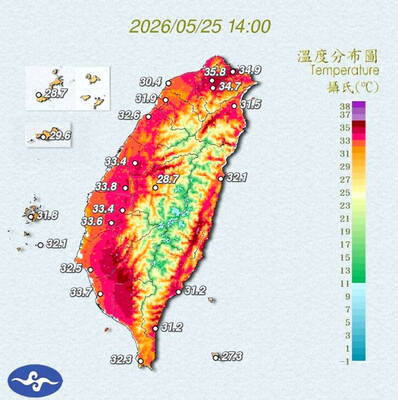
STAY COOL: The HPA recommended that people stay hydrated, use air-conditioning or fans while indoors, wear loose-fitting clothes and walk in the shade while outdoors Employers must implement measures such as installing cooling equipment, and providing drinking water and rest breaks for outdoor workers starting from Monday next week, the Taipei Department of Labor said on Sunday. Employers who fail to comply could face fines of NT$30,000 to NT$300,000 under the Occupational Safety and Health Act (職業安全衛生法), the department said. Businesses in Taipei employing fewer than 100 workers, as well as registered self-employed workers with labor insurance coverage, could receive on-site assessments and guidance from occupational safety consultants to help them apply for central government subsidies to implement or improve heat-protection measures, it said. Under the Ministry of
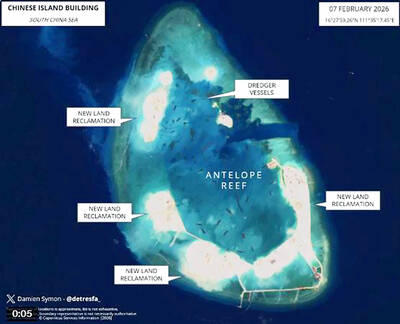
ISOLATION: The outposts would serve as support and backup bases, forcing US forces to either face China head-on or reroute, increasing travel time and operational costs China’s outposts in the South China Sea could be used to delay and constrain foreign forces during a conflict in the Taiwan Strait, giving Beijing a critical window to carry out amphibious landing and blockade operations, a report said. The Chinese Communist Party’s (CCP) forward operating bases on islands and reclaimed features in the South China Sea could delay foreign forces long enough for the Chinese People’s Liberation Army (PLA) to secure a key 48-to-72-hour window in the Taiwan Strait, a report commissioned by the Mainland Affairs Council found. The report, conducted by the Institute for National Defense and Security Research, examined


 RSS
RSS