


The results of the US presidential election are not expected to significantly affect the US government's arms sales policy toward Taiwan, a think tank academic said on Tuesday.
Michael Swaine, a senior researcher of the Carnegie Endowment for International Peace (CEIP), made the remarks after attending a CEIP-sponsored seminar on China's military modernization and Taiwan's security.
The latest edition of Defense News, a US weekly, indicates that Taiwan has reiterated its desire to order US-made F-16 C/D fighter jets but is now facing an obstacle in striking a deal with the US.
The reports quoted US sources as saying the administration of US President George W. Bush is likely to approve the sale after the US presidential election in November next year and that should the Democratic Party win, it will be less sympathetic toward Taiwan.
Nevertheless, Swaine said, no matter which party comes to power, US arms sales policy will be consistent in supplying Taiwan with sufficient defensive weapons.
Swaine also said the US government is not expected to link its sales of F-16s to President Chen Shui-bian's (陳水扁) plan to push for a referendum on Taiwan's bid to join the UN under the name "Taiwan" alongside next year's presidential election.
Responding to Chen's plan unveiled last month, US State Department Spokesman Sean McCormack said that "the United States opposes any initiative that appears designed to change Taiwan's status unilaterally. This would include a referendum on whether to apply to the United Nations under the name of 'Taiwan.'"
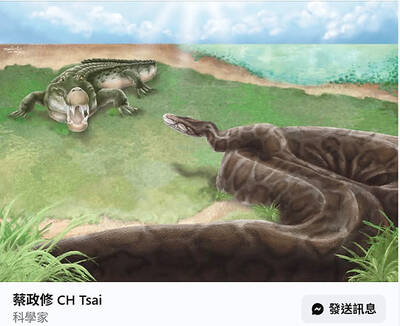
Taiwanese paleontologists have discovered fossil evidence that pythons up to 4m long inhabited Taiwan during the Pleistocene epoch, reporting their findings in the international scientific journal Historical Biology. National Taiwan University (NTU) Institute of Ecology and Evolutionary Biology associate professor Tsai Cheng-hsiu (蔡政修) led the team that discovered the largest snake fossil ever found in Taiwan. The single trunk vertebra was discovered in Tainan at the Chiting Formation, dated to between 400,000 and 800,000 years ago in the Middle Pleistocene, the paper said. The area also produced Taiwan’s first avian fossil, as well as crocodile, mammoth, saber-toothed cat and rhinoceros fossils, it said. Discoveries

Taiwanese paleontologists have discovered fossil evidence that pythons up to 4m long inhabited Taiwan during the Pleistocene epoch, reporting their findings in the international scientific journal Historical Biology. National Taiwan University (NTU) Institute of Ecology and Evolutionary Biology associate professor Tsai Cheng-hsiu (蔡政修) led the team that discovered the largest snake fossil ever found in Taiwan. A single trunk vertebra was discovered in Tainan at the Chiting Formation, dated to between 800,000 to 400,000 years ago in the Middle Pleistocene, the paper said. The area also produced Taiwan’s first avian fossil, as well as crocodile, mammoth, sabre-toothed cat and rhinoceros fossils, it said. Discoveries
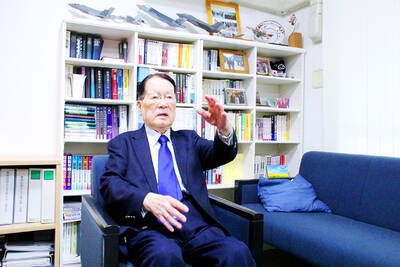
Whether Japan would help defend Taiwan in case of a cross-strait conflict would depend on the US and the extent to which Japan would be allowed to act under the US-Japan Security Treaty, former Japanese minister of defense Satoshi Morimoto said. As China has not given up on the idea of invading Taiwan by force, to what extent Japan could support US military action would hinge on Washington’s intention and its negotiation with Tokyo, Morimoto said in an interview with the Liberty Times (sister paper of the Taipei Times) yesterday. There has to be sufficient mutual recognition of how Japan could provide
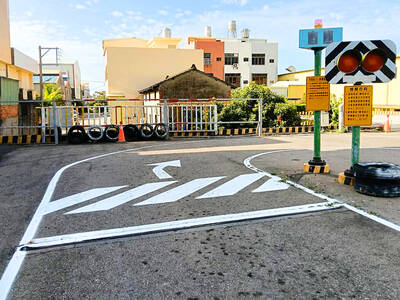
UPDATED TEST: The new rules aim to assess drivers’ awareness of risky behaviors and how they respond under certain circumstances, the Highway Bureau said Driver’s license applicants who fail to yield to pedestrians at intersections or to check blind spots, or omit pointing-and-calling procedures would fail the driving test, the Highway Bureau said yesterday. The change is set to be implemented at the end of the month, and is part of the bureau’s reform of the driving portion of the test, which has been criticized for failing to assess whether drivers can operate vehicles safely. Sedan drivers would be tested regarding yielding to pedestrians and turning their heads to check blind spots, while drivers of large vehicles would be tested on their familiarity with pointing-and-calling


 RSS
RSS