


The legislature yesterday passed an amendment to the Presidential and Vice Presidential Election and Recall Law (
If a political party has difficulty appointing a representative, the responsibility of assigning a representative to each polling station then falls on the party's presidential candidate, the amendment states.
The current regulation stipulates that poll inspectors in a national election be recommended by political parties on a pro rata basis.
Political parties then can decide which polling station they want their inspector to be stationed at. If the number of inspectors assigned by parties to a particular polling station is higher than what the station needs, the final list of representatives is decided through drawing.
Chinese Nationalist Party (KMT) Legislator Wu Yu-sheng (吳育昇) said that the amendment was aimed at preventing situations in which voting inspectors at some polling stations turn out to be members of the same political party.
"If a majority of inspectors at a polling station is from a specific party, it could influence the fairness of the elections," Wu said.
Wu said that the KMT introduced the amendment because most voting inspectors in the last presidential election in 2004 tended to favor the Democratic Progressive Party (DPP) and therefore counted "disputed ballots" as votes for the DPP.
In related news, lawmakers yesterday agreed to make a budget bill for this fiscal year concerning state-owned enterprises and governmental nonprofit funds and a special budget bill for public construction projects as the first two bills up for review in today's plenary session.
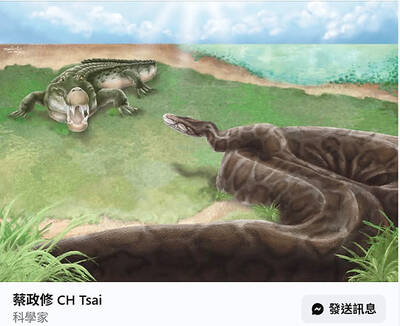
Taiwanese paleontologists have discovered fossil evidence that pythons up to 4m long inhabited Taiwan during the Pleistocene epoch, reporting their findings in the international scientific journal Historical Biology. National Taiwan University (NTU) Institute of Ecology and Evolutionary Biology associate professor Tsai Cheng-hsiu (蔡政修) led the team that discovered the largest snake fossil ever found in Taiwan. The single trunk vertebra was discovered in Tainan at the Chiting Formation, dated to between 400,000 and 800,000 years ago in the Middle Pleistocene, the paper said. The area also produced Taiwan’s first avian fossil, as well as crocodile, mammoth, saber-toothed cat and rhinoceros fossils, it said. Discoveries

Taiwanese paleontologists have discovered fossil evidence that pythons up to 4m long inhabited Taiwan during the Pleistocene epoch, reporting their findings in the international scientific journal Historical Biology. National Taiwan University (NTU) Institute of Ecology and Evolutionary Biology associate professor Tsai Cheng-hsiu (蔡政修) led the team that discovered the largest snake fossil ever found in Taiwan. A single trunk vertebra was discovered in Tainan at the Chiting Formation, dated to between 800,000 to 400,000 years ago in the Middle Pleistocene, the paper said. The area also produced Taiwan’s first avian fossil, as well as crocodile, mammoth, sabre-toothed cat and rhinoceros fossils, it said. Discoveries
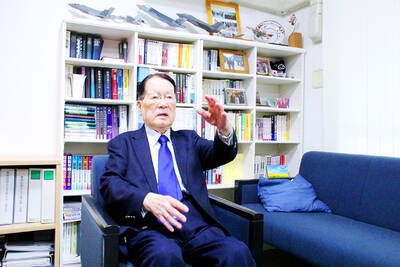
Whether Japan would help defend Taiwan in case of a cross-strait conflict would depend on the US and the extent to which Japan would be allowed to act under the US-Japan Security Treaty, former Japanese minister of defense Satoshi Morimoto said. As China has not given up on the idea of invading Taiwan by force, to what extent Japan could support US military action would hinge on Washington’s intention and its negotiation with Tokyo, Morimoto said in an interview with the Liberty Times (sister paper of the Taipei Times) yesterday. There has to be sufficient mutual recognition of how Japan could provide
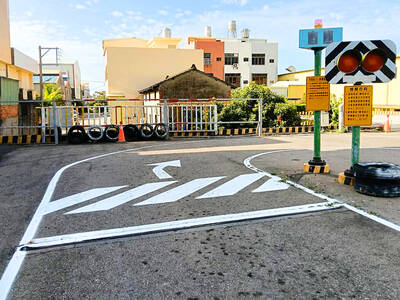
UPDATED TEST: The new rules aim to assess drivers’ awareness of risky behaviors and how they respond under certain circumstances, the Highway Bureau said Driver’s license applicants who fail to yield to pedestrians at intersections or to check blind spots, or omit pointing-and-calling procedures would fail the driving test, the Highway Bureau said yesterday. The change is set to be implemented at the end of the month, and is part of the bureau’s reform of the driving portion of the test, which has been criticized for failing to assess whether drivers can operate vehicles safely. Sedan drivers would be tested regarding yielding to pedestrians and turning their heads to check blind spots, while drivers of large vehicles would be tested on their familiarity with pointing-and-calling


 RSS
RSS