


A coalition of civic groups yesterday launched a multiculturalism campaign, urging schools to begin offering courses taught in other mother tongues besides Mandarin once a week.
Cheng Cheng-iok (鄭正煜), president of the Southern Taiwan Society, told the press conference that while 99 percent of the courses taught at kindergartens, elementary and high schools were in Mandarin, they would like them to be taught in other native tongues such as Hoklo (or Taiwanese), Hakka or Aboriginal languages.
As the Ministry of Education(MOE) has asked schools to designate one day of the week as the "Taiwan mother tongue day," Cheng said he hoped schools would take advantage of the occasion to teach native languages in accordance with the ethnicity of the school district.
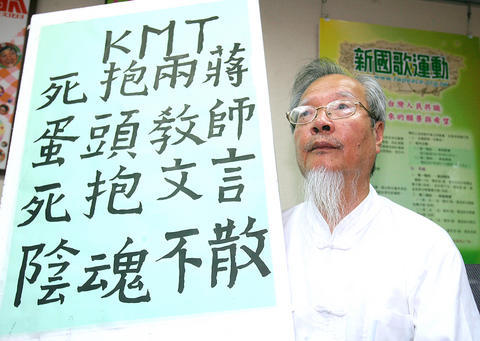
PHOTO: WANG YI-SUNG, TAIPEI TIMES
Cheng also called on schools to hire Chinese teachers who have training not only in Chinese literature but also in Taiwanese and world literature.
Michelle Wang (王美琇), vice president of the Northern Taiwan Society, said that political and educational reforms were key to the democratic campaign to turn Taiwan into a more "normal" country.
"Political reform is like the roof of a house and educational reform is the columns," she said. "Completing political reform is like putting a new roof on a house, but the columns are still rotten if educational reform is not yet complete."
Without a normal educational system, Wang said children would not develop into citizens with high awareness.
Democratic Progressive Party (DPP) Chairman Yu Shyi-kun, who also attended the press conference, said his party fully supports the teaching of native languages and will continue the campaign to strengthen Taiwan-centric consciousness.
Yu said he proposed bilingual teaching in junior high schools when he served as Taiwan provincial councilor 23 years ago. During his term as Ilan County commissioner, he promoted Taiwanese culture and languages. The DPP administration has also made efforts to advocate Taiwanese education. Among the achievements are the creation of Hakka and Aboriginal TV channels.
Tan Hong-hui (陳豐惠), director of the Taiwanese Romanization Association, urged the government to ditch the bopomofo phonetic system in favor of Romanization system suggested by the MOE in the teaching and writing of Mandarin and mother tongues.
With a little bit of training, it is easy to get used to Romanization, she said. She did not specify which Romanization system she was referring to. Tan said that Bibles translated into Romanized Aboriginal languages by missionaries were popular from 1885 and 1969 but unfortunately were banned by the Chinese Nationalist Party (KMT) administration in 1975.
"Now it takes extra effort to resurrect it and keep it alive," she said.

FUKUOKA SITUATION: Japanese media reported that the pathogen is expected to be identified by the summer, while the CDC downplayed the idea that it was hMPV A “mysterious cold-like illness” reported in Japan’s Fukuoka Prefecture does not seem to be a new disease, but Japanese authorities have been asked about the situation, the Centers for Disease Control (CDC) said yesterday. The Fukuoka Prefectural Medical Association on Wednesday told a news conference that a “mystery cold” that has become a hot topic on social media is “highly likely to be caused by some kind of viral infection,” Japan’s KBC News reported. “Many people are experiencing symptoms starting with a sore throat, followed by a runny nose, phlegm and a severe cough,” KBC News reported, citing association officials. Health authorities are

Nvidia Corp CEO Jensen Huang (黃仁勳) arrived in Taiwan yesterday ahead of upcoming AI and technology events, saying he plans to meet with clients and Taiwan Semiconductor Manufacturing Co Chairman C.C. Wei (魏哲家) during his visit. After landing at Taipei Songshan Airport, Huang posed for photos with fans and handed out Yakult drinks to reporters and supporters waiting at the scene, saying he has “a lot to do” during the trip. Asked about reports that Nvidia’s planned headquarters site in Taipei’s Beitou Shilin Technology Park could break ground on May 27, Huang said that if the company holds an event, he would

The Ministry of Finance this afternoon announced the winning numbers for the March-April uniform invoice lottery. The winning number for the NT$10 million (US$318,060) special prize is 19531471, and the winning number for the NT$2 million grand prize is 85941329. Three numbers were drawn for the NT$200,000 first prize: 07225810, 20231230 and 83518781. Those with receipts matching the last seven digits of any of the first-prize numbers will win the NT$40,000 second prize, while those matching the last six digits will win the NT$10,000 third prize. Those whose receipts match the last five digits of the first-prize numbers can claim the NT$4,000 fourth prize,
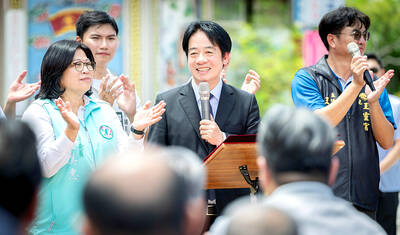
SIX SUBSIDIES: The monthly allowance for older farmers is to increase to NT$10,000, and NT$5,000 is to be given to homemakers under the national pension system, Lai said The government is to implement major welfare policies for disadvantaged groups, including raising the monthly allowance for older farmers to NT$10,000 and providing homemakers with NT$5,000 per month, President William Lai (賴清德) said yesterday. Lai made the remarks during a visit to Wangling Temple in Chiayi County, saying that the planned increases were being introduced amid economic growth and an increase in tax revenue. Touting a policy, in which the government plans to provide a monthly allowance of NT$5,000 for every child under the age of 18 in a bid to address Taiwan’s low birthrate, Lai said that if received for the


 RSS
RSS