


Prosecutors' offices prone to illegal press leaks and unsound ketamine drug-testing standards are undermining celebrities' rights amid a fresh wave of celebrity drug scandals, industry figures, lawyers and lawmakers said yesterday.
A legislative hearing presided over by Chinese Nationalist Party (KMT) Legislator Joanna Lei (
An anesthetic popular among youth, ketamine is classified as a Category-3 "minor" drug, meaning that possession, in small quantities, doesn't constitute a criminal offense.
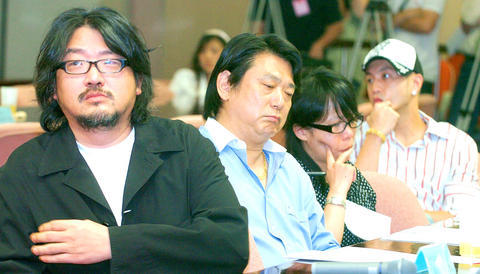
PHOTO: WANG MIN-WEI
A crackdown on drug-using celebs in May netted, among others, Tang and Chang, who both tested positive for ketamine.
Chang, a music producer and youth culture icon, claimed his test was flawed, while Channel V host Tang said that unsound ketamine drug-testing standards were behind his "false-positive" test result, a claim backed by an expert witness yesterday. Both celebs denied ever using drugs.
Although not criminally liable for using ketamine, Tang and Chang yesterday said the test results have damaged their reputations.
Also at issue was the media's reporting on the results before they were officially released by prosecutors -- a development that lawyers claimed underscores a culture of press leaks and haphazard operations in the justice system.
"Who is going to stand up and take responsibility for the damage caused to their reputations? Who is going to compensate them for lost work because of the scandals? Nobody," said Kang Kai (
"And what about the leaks? Just how did the media get their hands on the test results before their release?" he added.
Taipei Veterans General Hospital toxicology specialist Tsai Wei-chen (
"Taiwan is definitely behind the times when it comes to accurately testing for the ketamine," Tsai said, citing Hong Kong and Singapore as examples of governments boasting sound ketamine-testing standards.
In Singapore, he said, tests indicating trace amounts are considered invalid because of the high risk of false-positives.
Both Tang and Chang tested positive for trace amounts.
"Testing positive for ketamine doesn't necessarily indicate that one has used the drug," Tsai said. "In low amounts, it can be difficult to test for."
MOJ Bureau of Investigation official Hu Jen-hsiung (
The ketamine test itself, Hu said, merely seeks to determine if the drug is present in one's system, and if so, in what quantity.
Prosecutors don't use drug tests as a basis for determining how the substance in question entered one's system, be it through deliberate drug use or accidental entry -- through second-hand smoke, for example, he said.
Prosecutor Chou Huai-kang (
Lawmakers and two human rights lawyers present, however, were unconvinced.
"It doesn't matter what laws are in place to protect individual privacy rights," Democratic Progressive Party Legislator Tsai Chi-chang (
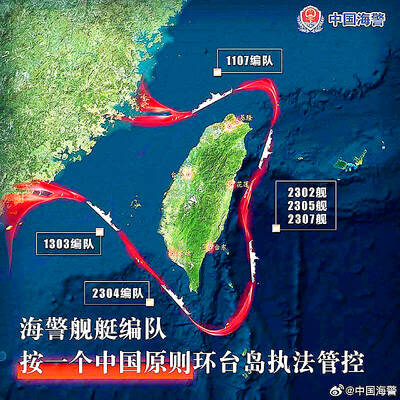
Taiwan would benefit from more integrated military strategies and deployments if the US and its allies treat the East China Sea, the Taiwan Strait and the South China Sea as a “single theater of operations,” a Taiwanese military expert said yesterday. Shen Ming-shih (沈明室), a researcher at the Institute for National Defense and Security Research, said he made the assessment after two Japanese military experts warned of emerging threats from China based on a drill conducted this month by the Chinese People’s Liberation Army’s (PLA) Eastern Theater Command. Japan Institute for National Fundamentals researcher Maki Nakagawa said the drill differed from the
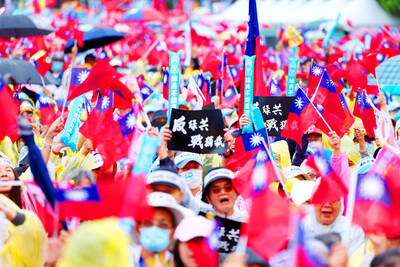
‘WORSE THAN COMMUNISTS’: President William Lai has cracked down on his political enemies and has attempted to exterminate all opposition forces, the chairman said The legislature would motion for a presidential recall after May 20, Chinese Nationalist Party (KMT) Chairman Eric Chu (朱立倫) said yesterday at a protest themed “against green communists and dictatorship” in Taipei. Taiwan is supposed to be a peaceful homeland where people are united, but President William Lai (賴清德) has been polarizing and tearing apart society since his inauguration, Chu said. Lai must show his commitment to his job, otherwise a referendum could be initiated to recall him, he said. Democracy means the rule of the people, not the rule of the Democratic Progressive Party (DPP), but Lai has failed to fulfill his

OFF-TARGET: More than 30,000 participants were expected to take part in the Games next month, but only 6,550 foreign and 19,400 Taiwanese athletes have registered Taipei city councilors yesterday blasted the organizers of next month’s World Masters Games over sudden timetable and venue changes, which they said have caused thousands of participants to back out of the international sporting event, among other organizational issues. They also cited visa delays and political interference by China as reasons many foreign athletes are requesting refunds for the event, to be held from May 17 to 30. Jointly organized by the Taipei and New Taipei City governments, the games have been rocked by numerous controversies since preparations began in 2020. Taipei City Councilor Lin Yen-feng (林延鳳) said yesterday that new measures by
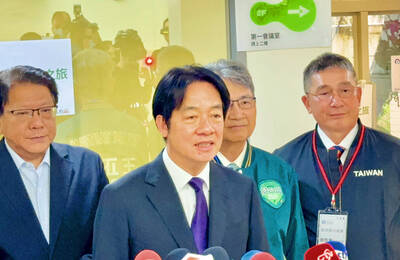
A rally held by opposition parties yesterday demonstrates that Taiwan is a democratic country, President William Lai (賴清德) said yesterday, adding that if opposition parties really want to fight dictatorship, they should fight it on Tiananmen Square in Beijing. The Chinese Nationalist Party (KMT) held a protest with the theme “against green communists and dictatorship,” and was joined by the Taiwan People’s Party. Lai said the opposition parties are against what they called the “green communists,” but do not fight against the “Chinese communists,” adding that if they really want to fight dictatorship, they should go to the right place and face


 RSS
RSS