


President Chen Shui-bian (
"The cross-strait common market is the `one China market' because it uses the market as a front to promote `one China,'" Chen said. "It is like the so-called `1992 consensus,' where they use the word consensus to promote the concept of `one China.'"
While the "1992 consensus" is the political "one China," Chen said the "cross-strait common market" is the economic "one China" and their ultimate goal was to ignore Taiwan's sovereignty and facilitate unification with China.
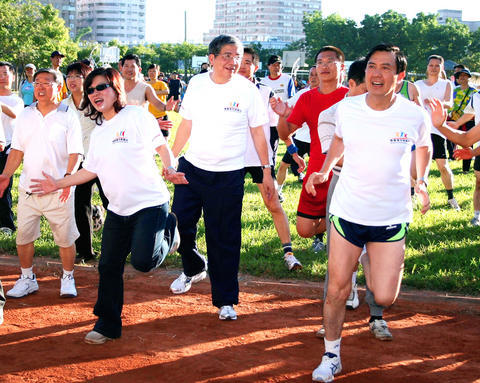
PHOTO: CNA
Chen made the remarks while addressing employees of a technology company owned by Formosa Plastics Group founder Wang Yung-ching (王永慶) in Taoyuan County yesterday morning.
Chen said that although "a [certain] political party" had said that the proposal was aimed at improving the economy rather than engaging in political competition with the Democratic Progressive Party (DPP), the essence of the proposal was to dance to the tune of China's strategy of using the economy to pressure Taiwan for unification.
Under the "one China market," Chen said that Chinese labor, products and capital could enter Taiwan without any restrictions and further hollow out local industries.
"It is not an inflammatory statement," he said. "The `one China market' will spell the beginning of disaster and our economy will completely be devoured by China."
Chen said the KMT had also proposed turning Taiwan into a "regional free trade zone" -- a proposition he described as "a serious mistake."
"Taiwan is an independent sovereignty, not a local government or a special administrative zone of China," he said. "Together, the one China market and the regional free trade zone will downgrade Taiwan to an outlying island of China and the 23 million people of Taiwan must guard against such an overture."
Besides, the establishment of a free trade zone involves the signing of bilateral or multilateral free trade agreements and should proceed gradually in a gradual and in a reciprocal manner, he said.
Unilaterally declaring Taiwan as a "regional free trade zone" will only unconditionally open the local market to the international community and Taiwan's economy is bound to suffer a deadly blow, he said.
"I urge the public to take a serious and responsible attitude," he said. "I am calling on you to vehemently denounce the proposal which is unrealistic and wishful."
Rather than fantasizing about a "one China market," Chen said the nation would benefit more from pragmatic policies to enhance its development.
In response to the criticism, Ma yesterday struck back and blamed the president for a sagging economy in the past seven years.
"President Chen has vowed to improve the economy but has done nothing but play with different slogans ... He is in no position to criticize the proposal," Ma said in Taipei.
Ma argued that he and his running mate, Vincent Siew (
Ma also lashed out at Chen for speaking "nonsense" by describing their common market proposal as a promotion of the "one China" policy.
"We have always opposed [China's] `one country, two systems' and have never proposed opening the job market to Chinese workers," Ma said while urging Chen to reflect on his own economic policies before criticizing his proposal.
As the nation's leader, Ma said Chen should tell the people how to improve the economy, especially after more and more Taiwanese companies had chosen to outsource and European and US companies had criticized the government's economic policies.
Additional reporting by Mo Yan-chih
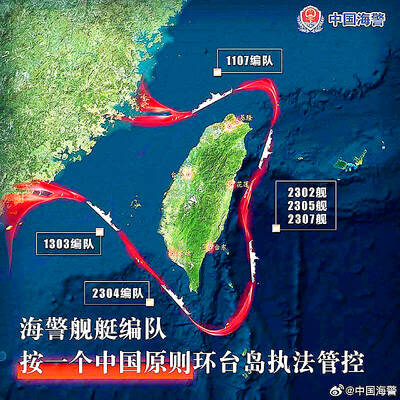
Taiwan would benefit from more integrated military strategies and deployments if the US and its allies treat the East China Sea, the Taiwan Strait and the South China Sea as a “single theater of operations,” a Taiwanese military expert said yesterday. Shen Ming-shih (沈明室), a researcher at the Institute for National Defense and Security Research, said he made the assessment after two Japanese military experts warned of emerging threats from China based on a drill conducted this month by the Chinese People’s Liberation Army’s (PLA) Eastern Theater Command. Japan Institute for National Fundamentals researcher Maki Nakagawa said the drill differed from the
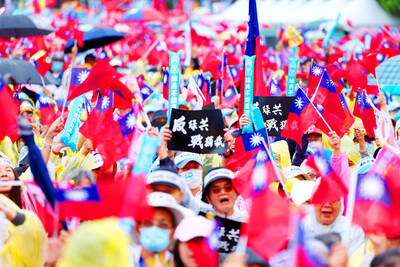
‘WORSE THAN COMMUNISTS’: President William Lai has cracked down on his political enemies and has attempted to exterminate all opposition forces, the chairman said The legislature would motion for a presidential recall after May 20, Chinese Nationalist Party (KMT) Chairman Eric Chu (朱立倫) said yesterday at a protest themed “against green communists and dictatorship” in Taipei. Taiwan is supposed to be a peaceful homeland where people are united, but President William Lai (賴清德) has been polarizing and tearing apart society since his inauguration, Chu said. Lai must show his commitment to his job, otherwise a referendum could be initiated to recall him, he said. Democracy means the rule of the people, not the rule of the Democratic Progressive Party (DPP), but Lai has failed to fulfill his
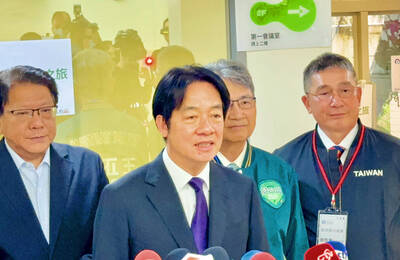
A rally held by opposition parties yesterday demonstrates that Taiwan is a democratic country, President William Lai (賴清德) said yesterday, adding that if opposition parties really want to fight dictatorship, they should fight it on Tiananmen Square in Beijing. The Chinese Nationalist Party (KMT) held a protest with the theme “against green communists and dictatorship,” and was joined by the Taiwan People’s Party. Lai said the opposition parties are against what they called the “green communists,” but do not fight against the “Chinese communists,” adding that if they really want to fight dictatorship, they should go to the right place and face
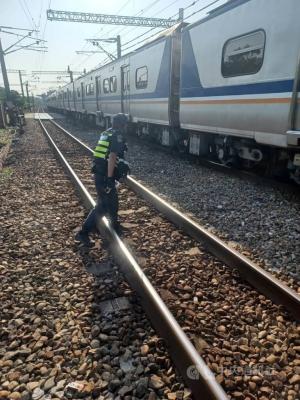
A 79-year-old woman died today after being struck by a train at a level crossing in Taoyuan, police said. The woman, identified by her surname Wang (王), crossed the tracks even though the barriers were down in Jhongli District’s (中壢) Neili (內壢) area, the Taoyuan Branch of the Railway Police Bureau said. Surveillance footage showed that the railway barriers were lowered when Wang entered the crossing, but why she ventured onto the track remains under investigation, the police said. Police said they received a report of an incident at 6:41am involving local train No. 2133 that was heading from Keelung to Chiayi City. Investigators


 RSS
RSS