


"Unemployed fat girl dies after burning charcoal," ran the headline of an Apple Daily article.
The body of 29-year-old Hsu Hang-yi (
"Maintaining a good appearance is part of a good work attitude," a vice general director at a job bank was quoted in the article as saying.
Chang Bai-hui (
"I also contemplated ending my life back when I was heavy," said the graduate student, who is studying public relations at Shih Hsin University. "And now, the thought of regaining the weight is my worst nightmare."
The 153cm-tall Chang was at her heaviest seven year ago, weighing in at 94kg. She now weighs 51kg.
Size discrimination, especially for women, is rife in the nation, both in the workplace and outside, Chang said.
"When I applied for jobs, I was often told that the position had been filled even though the `help wanted' sign was still in the window," she said.
Chang eventually found a job as a staffer for the Democratic Progressive Party, working on event coordination and press relations.
"People never noticed my work until after I became thin. Instead, they would make fun of my weight to my face, especially at meals," she said. "We `fatties' would have to pretend we didn't mind."
For a time, Chang ate as little as 800 calories a day and would force herself to throw up if work-related social occasions required her to eat lavish dinners.
"The pressure is not as intense for men because, first and foremost, they are judged on their work performance," she said. "For women, however, if you are fat, it does not matter if your work is good or not because you are a non-entity."
Even when she was not at work, Chang's weight was a source of pressure. When she met her current boyfriend, his parents disapproved of the relationship because of her size. At the time, she weighed 78kg.
Chang said her boyfriend never asked her to lose weight, but did relay his father's opinion on the matter.
"His father told him: `You would be better off getting a pretty mail-order bride,'" Chang said. "This devastated me -- my degree, my professional achievements, my good relationship with his son ... all these things did not count as much [for the father] as the fact that I was not thin."
At 51kg, Chang still does not think she is skinny enough. In order to be successful in the corporate public relations sector, Chang estimates she should still lose another 5kg.
"My boyfriend tells me my arms are still too chunky to go out in a sleeveless top," she said.
However, every additional kilogram lost is now taking a greater effort and could even be taking a toll on her health, she said.
Her periods have become irregular and she is no longer strong enough to move a scooter without assistance.
Despite her belief that discrimination against overweight people in the workplace is wrong, Chang's blog, World of Fattie, offers mainly diet tips and commiseration.
"Mung bean noodles is your friend," one entry reads.
"I really want to live in a world where people are judged by their performance in the workplace, not by their size," Chang said. "But I cannot change the world ... I can only change my body."
Efforts by individuals to change how their bodies look is not an adequate solution to workplace discrimination, said Tsen Chao-yuan (
"Women will never be able to adequately conform to societal expectations to the point where they are considered to be `pretty enough' to be considered an equal in the workplace," Tsen said. "If they are thin, they could always be thinner. If they're really thin, then there are other requirements for hair, skin, face and dress."
"The fundamental problem is that women are still more valued for their appearance than for their work," Tsen said.
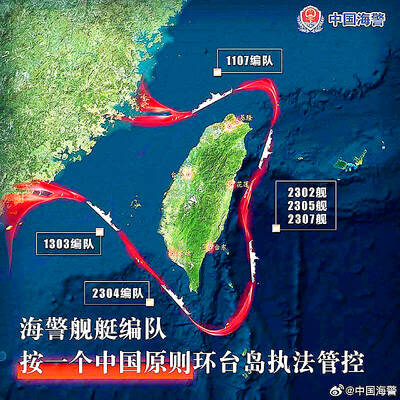
Taiwan would benefit from more integrated military strategies and deployments if the US and its allies treat the East China Sea, the Taiwan Strait and the South China Sea as a “single theater of operations,” a Taiwanese military expert said yesterday. Shen Ming-shih (沈明室), a researcher at the Institute for National Defense and Security Research, said he made the assessment after two Japanese military experts warned of emerging threats from China based on a drill conducted this month by the Chinese People’s Liberation Army’s (PLA) Eastern Theater Command. Japan Institute for National Fundamentals researcher Maki Nakagawa said the drill differed from the

‘WORSE THAN COMMUNISTS’: President William Lai has cracked down on his political enemies and has attempted to exterminate all opposition forces, the chairman said The legislature would motion for a presidential recall after May 20, Chinese Nationalist Party (KMT) Chairman Eric Chu (朱立倫) said yesterday at a protest themed “against green communists and dictatorship” in Taipei. Taiwan is supposed to be a peaceful homeland where people are united, but President William Lai (賴清德) has been polarizing and tearing apart society since his inauguration, Chu said. Lai must show his commitment to his job, otherwise a referendum could be initiated to recall him, he said. Democracy means the rule of the people, not the rule of the Democratic Progressive Party (DPP), but Lai has failed to fulfill his

A rally held by opposition parties yesterday demonstrates that Taiwan is a democratic country, President William Lai (賴清德) said yesterday, adding that if opposition parties really want to fight dictatorship, they should fight it on Tiananmen Square in Beijing. The Chinese Nationalist Party (KMT) held a protest with the theme “against green communists and dictatorship,” and was joined by the Taiwan People’s Party. Lai said the opposition parties are against what they called the “green communists,” but do not fight against the “Chinese communists,” adding that if they really want to fight dictatorship, they should go to the right place and face

A 79-year-old woman died today after being struck by a train at a level crossing in Taoyuan, police said. The woman, identified by her surname Wang (王), crossed the tracks even though the barriers were down in Jhongli District’s (中壢) Neili (內壢) area, the Taoyuan Branch of the Railway Police Bureau said. Surveillance footage showed that the railway barriers were lowered when Wang entered the crossing, but why she ventured onto the track remains under investigation, the police said. Police said they received a report of an incident at 6:41am involving local train No. 2133 that was heading from Keelung to Chiayi City. Investigators


 RSS
RSS