


Surgeons are urging fellow medical professionals to check for a pulse in the lower limbs of patients before taking drastic measures such as amputating a troubled limb, as they aim to spread information about a rather obscure condition, peripheral arterial disease (PAD).
Wang Shoei-shen (
"When a person experiences pain and fatigue after walking, they think they're getting old," Wang said. "They don't even consider that it could be Peripheral Arterial Disease."
PAD is a condition in which narrowed or blocked arteries impede blood flow to the extremities. It is often associated with diabetes or other cardiovascular conditions. In serious cases, it can cause extensive tissue necrosis, making amputation of the limb necessary. In other cases, it makes walking for extended distances extremely painful, because the inadequate supply of blood to the limb prevents enough oxygen from reaching leg muscles, a symptom called "claudication."
"I recall a patient who went to an orthopedist because he couldn't walk far without experiencing pain," Wang said. "The orthopedist found bone spurs, removed them and showed the fragments of bone to the patient, who recovered splendidly. Everybody was happy until he started to walk again and was no better."
Wang eventually performed an femoropopliteal bypass on the patient, in which an artificial blood vessel is used to bypass the blocked section of the artery.
"He is now walking around like a man in his salad days," Wang said.
In another case recounted by Wang, a patient with a lesion on his calf that refused to heal underwent a number of skin grafts, all of which refused to take.
"A cosmetic surgeon at National Taiwan University was about to apply yet another when he checked for a pulse in the leg and found none," Wang said.
"We hope that in the future we can encourage more doctors to check for abnormally low blood pressure in the lower limbs before taking more drastic action," Wang said. "Many unnecessary procedures, even amputations, can be avoided."
To Liau Chiau-suong (廖朝崧), chief of integrated diagnostics at the university hospital, misdiagnosis of PAD reflects a wider problem. People experiencing health problems usually go straight to a specialist for diagnosis without being referred there by a family doctor, Liau said.
"General practitioners have an overall view of all fields and can refer the patient to the correct specialist," Liau said. "Unfortunately, it is not a branch of medicine that is taken very seriously in this country."
Liao also said milder cases of PAD can be treated with "blood thinning" medication like aspirin, exercise and by quitting smoking.
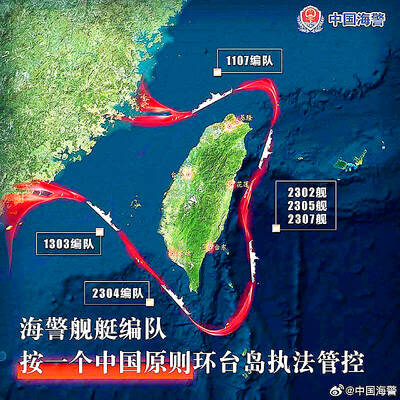
Taiwan would benefit from more integrated military strategies and deployments if the US and its allies treat the East China Sea, the Taiwan Strait and the South China Sea as a “single theater of operations,” a Taiwanese military expert said yesterday. Shen Ming-shih (沈明室), a researcher at the Institute for National Defense and Security Research, said he made the assessment after two Japanese military experts warned of emerging threats from China based on a drill conducted this month by the Chinese People’s Liberation Army’s (PLA) Eastern Theater Command. Japan Institute for National Fundamentals researcher Maki Nakagawa said the drill differed from the
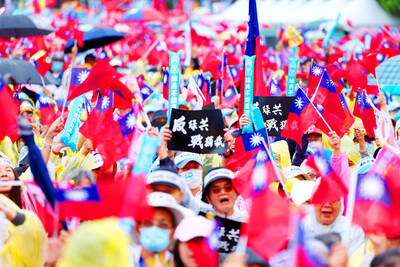
‘WORSE THAN COMMUNISTS’: President William Lai has cracked down on his political enemies and has attempted to exterminate all opposition forces, the chairman said The legislature would motion for a presidential recall after May 20, Chinese Nationalist Party (KMT) Chairman Eric Chu (朱立倫) said yesterday at a protest themed “against green communists and dictatorship” in Taipei. Taiwan is supposed to be a peaceful homeland where people are united, but President William Lai (賴清德) has been polarizing and tearing apart society since his inauguration, Chu said. Lai must show his commitment to his job, otherwise a referendum could be initiated to recall him, he said. Democracy means the rule of the people, not the rule of the Democratic Progressive Party (DPP), but Lai has failed to fulfill his

OFF-TARGET: More than 30,000 participants were expected to take part in the Games next month, but only 6,550 foreign and 19,400 Taiwanese athletes have registered Taipei city councilors yesterday blasted the organizers of next month’s World Masters Games over sudden timetable and venue changes, which they said have caused thousands of participants to back out of the international sporting event, among other organizational issues. They also cited visa delays and political interference by China as reasons many foreign athletes are requesting refunds for the event, to be held from May 17 to 30. Jointly organized by the Taipei and New Taipei City governments, the games have been rocked by numerous controversies since preparations began in 2020. Taipei City Councilor Lin Yen-feng (林延鳳) said yesterday that new measures by

A rally held by opposition parties yesterday demonstrates that Taiwan is a democratic country, President William Lai (賴清德) said yesterday, adding that if opposition parties really want to fight dictatorship, they should fight it on Tiananmen Square in Beijing. The Chinese Nationalist Party (KMT) held a protest with the theme “against green communists and dictatorship,” and was joined by the Taiwan People’s Party. Lai said the opposition parties are against what they called the “green communists,” but do not fight against the “Chinese communists,” adding that if they really want to fight dictatorship, they should go to the right place and face


 RSS
RSS