


Six months after the Kaohsiung mayoral election, the Kaohsiung District Court dropped a bombshell on the nation's politics with a ruling on Friday annulling Kaohsiung Mayor Chen Chu's (陳菊) victory in last December's Kaohsiung mayoral election.
The verdict was one of a kind as it was the first time in Taiwanese electoral history that the result of an election at the municipal level had been nullified.
The court said it made its decision on the grounds that the airing of a videotape by Chen's camp late on the eve of the election -- when all campaigning activities were supposed to have ended -- accusing Chinese Nationalist Party's (KMT) candidate Huang Chun-ying (黃俊英) of vote-buying violated election laws and cost Huang the election.
Huang filed two suits against Chen's camp after losing the election by 1,114 votes, asking the court to invalidate the election and annul Chen's victory.
The court on Friday rejected the first suit but upheld the second. While Chen said she will appeal the second case, Huang has decided to appeal the first case.
For Huang, who had resumed his teaching job at Kaohsiung's I-shou University, the ruling annulling Chen's victory came as great news.
For Chen, who was recently discharged from hospital after a 45-day stay for treatment of minor stroke, an appeal to the Taiwan High Court was an inevitable choice because it would be political suicide to accept the ruling.
The Public Official Election and Recall Law (公職人員選舉罷免法) states that a winning candidate who loses an annulment lawsuit under the scenarios that he or she coerced, threatened or resorted to illegal means to interfere with other parties' electoral campaigns or others' right to vote -- as in this case -- would be barred from running in a by-election.
Chen's Democratic Progressive Party (DPP) colleagues all threw their full support behind her decision, except DPP Legislator Kuan Bi-ling (
Kuan's suggestion raised eyebrows, with some wondering if she might not have made the remark out of a personal interest.
Kuan lost the primary to Chen by winning only 20.76 percent of the party's member votes and scoring 22.24 percent in the second-stage public survey.
Kuan, however, defended herself yesterday, saying that she was unaware of the fact that Chen would be barred from running in a by-election if she had not appealed.
"This regulation was amended by the pan-blue camp after the 319 shooting case in 2004," she said. "Most people were not aware of this fact until yesterday [Saturday]."
"When I made my statement [to suggest Chen give up the appeal], I made it very clear that she would win in a by-election by appealing to voters' sympathy," she said.
Whether Kuan meant what she said still remains to be determined, but one thing is for sure -- the district court's ruling may have put Chen in an unfavorable condition as the legitimacy of her mayorship may be challenged by the pan-blues, who dominate the Kaohsiung City Council.
There are still six months to go before the Taiwan High Court renders the final verdict following Chen's appeal, but Kaohsiung City Council Speaker Chuang Chi-wang (
"The effect of the annulment is the same as the two bullets [in the 319 shooting case]," said Shih Cheng-feng (施正鋒), a professor of public administration at Tamkang University, referring to the assassination attempt against President Chen Shui-bian (陳水扁) on the eve of the presidential election in 2004.
"The annulment could endanger the legitimacy of her victory and lead to a boycott by the pan-blue camp in the city council," Shih said.
"Chen Chu will not be able to smoothly manage the municipal administration within the next six months," he said.
Allen Houng (
The pan-blue camp should not be too happy about the annulment, as the ruling may bring positive influence on the DPP's prospects in next year's presidential and legislative elections, Shih said.
By law, a by-election has to be held within three months after the final ruling is made if the verdict disfavors the mayor.
This could mean a by-election held simultaneously with or closely to the presidential and legislative elections early next year.
Shih said the district court might have given the public a feeling that it "overinterpreted" the vote-buying accusation by Chen Chu's camp on the eve of the election.
"The ballot recount showed that Chen Chu won more votes than the original difference [between her and Huang]," Shih said.
"Plus, the judges seemed to have no obvious evidence to back their argument [that Chen Chu's campaign resorted to illegal means to interfere in Huang's electoral campaign and others' right to vote]," he said.
"There will surely be great discontent from the public," he said, adding that such ill will could further stimulate the deep-green support of the DPP in next year's elections, especially after they have been upset about the pan-blue camp's boycott in the legislature.

FUKUOKA SITUATION: Japanese media reported that the pathogen is expected to be identified by the summer, while the CDC downplayed the idea that it was hMPV A “mysterious cold-like illness” reported in Japan’s Fukuoka Prefecture does not seem to be a new disease, but Japanese authorities have been asked about the situation, the Centers for Disease Control (CDC) said yesterday. The Fukuoka Prefectural Medical Association on Wednesday told a news conference that a “mystery cold” that has become a hot topic on social media is “highly likely to be caused by some kind of viral infection,” Japan’s KBC News reported. “Many people are experiencing symptoms starting with a sore throat, followed by a runny nose, phlegm and a severe cough,” KBC News reported, citing association officials. Health authorities are

Nvidia Corp CEO Jensen Huang (黃仁勳) arrived in Taiwan yesterday ahead of upcoming AI and technology events, saying he plans to meet with clients and Taiwan Semiconductor Manufacturing Co Chairman C.C. Wei (魏哲家) during his visit. After landing at Taipei Songshan Airport, Huang posed for photos with fans and handed out Yakult drinks to reporters and supporters waiting at the scene, saying he has “a lot to do” during the trip. Asked about reports that Nvidia’s planned headquarters site in Taipei’s Beitou Shilin Technology Park could break ground on May 27, Huang said that if the company holds an event, he would

The Ministry of Finance this afternoon announced the winning numbers for the March-April uniform invoice lottery. The winning number for the NT$10 million (US$318,060) special prize is 19531471, and the winning number for the NT$2 million grand prize is 85941329. Three numbers were drawn for the NT$200,000 first prize: 07225810, 20231230 and 83518781. Those with receipts matching the last seven digits of any of the first-prize numbers will win the NT$40,000 second prize, while those matching the last six digits will win the NT$10,000 third prize. Those whose receipts match the last five digits of the first-prize numbers can claim the NT$4,000 fourth prize,
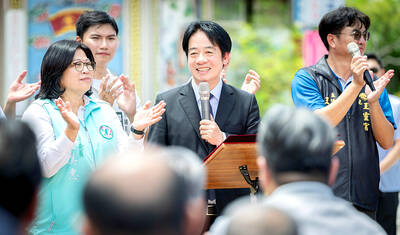
SIX SUBSIDIES: The monthly allowance for older farmers is to increase to NT$10,000, and NT$5,000 is to be given to homemakers under the national pension system, Lai said The government is to implement major welfare policies for disadvantaged groups, including raising the monthly allowance for older farmers to NT$10,000 and providing homemakers with NT$5,000 per month, President William Lai (賴清德) said yesterday. Lai made the remarks during a visit to Wangling Temple in Chiayi County, saying that the planned increases were being introduced amid economic growth and an increase in tax revenue. Touting a policy, in which the government plans to provide a monthly allowance of NT$5,000 for every child under the age of 18 in a bid to address Taiwan’s low birthrate, Lai said that if received for the


 RSS
RSS