


The Oral Cavity Healthcare Law (
The main focus of the law is stipulated in Article 3, which requires medical treatment of oral diseases to be included in the health insurance program.
The Taiwan Dental Association set out to push the legislation after it was rumored that the Executive Yuan, which was drawing up a second generation national health insurance plan, might exclude medical treatment of oral diseases from the program, a senior legislative aide said.
PRE-EMPTIVE STRIKE
Calling the association's promotion of the bill "a pre-emptive action," the aide, speaking on condition of anonymity, said that passage of the legislation had to do with the business of dentistry and sharing the financial resources of the health insurance program.
She said the government had considered removing certain items from the insurance program to resolve its massive financial problems before it was replaced by the Second Generation program, which has yet to be implemented.
WIDESPREAD SUPPORT
Then Democratic Progressive Party (DPP) Legislator Tsai Huang-liang (
When the bill was reviewed by the Sanitation and Environment and Social Welfare Committee on April 7, 2003, not every lawmaker was in favor of it.
DPP Legislator Hou Shui-sheng (
Hou said passage of the bill might result in requests to make laws for eye diseases, women's diseases, coronary artery disease and others.
Another supporter was Chinese Nationalist Party (KMT) Legislator Shyu Jonh-shyoung (
Shyu said the item should not be excluded because maintaining oral health was an essential part of preventative medicine.
GOVERNMENT DIVIDED
The government did not submit its own proposal about oral disease and even Department of Health officials were divided on the issue.
The then minister of the Department of Health Twu Shiing-jer (
But the vice director-general of the department, Yang Han-chuan, suggested that legislators consider incorporating the treatment of oral diseases into the national health insurance program when the second generation program was submitted to the legislature, instead of enacting a specific law to cover oral healthcare.
There was no mention at the time of the legislative debate over the oral cavity healthcare bill that inducements might have been offered to lawmakers to win passage of the bill.

LOUD AND PROUD Taiwan might have taken a drubbing against Australia and Japan, but you might not know it from the enthusiasm and numbers of the fans Taiwan might not be expected to win the World Baseball Classic (WBC) but their fans are making their presence felt in Tokyo, with tens of thousands decked out in the team’s blue, blowing horns and singing songs. Taiwanese fans have packed out the Tokyo Dome for all three of their games so far and even threatened to drown out home team supporters when their team played Japan on Friday. They blew trumpets, chanted for their favorite players and had their own cheerleading squad who dance on a stage during the game. The team struggled to match that exuberance on the field, with
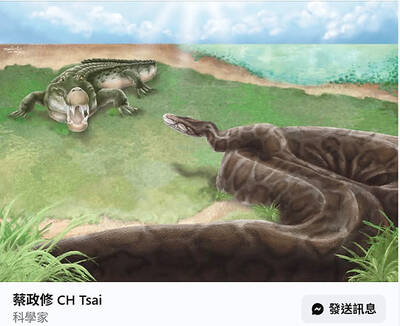
Taiwanese paleontologists have discovered fossil evidence that pythons up to 4m long inhabited Taiwan during the Pleistocene epoch, reporting their findings in the international scientific journal Historical Biology. National Taiwan University (NTU) Institute of Ecology and Evolutionary Biology associate professor Tsai Cheng-hsiu (蔡政修) led the team that discovered the largest snake fossil ever found in Taiwan. The single trunk vertebra was discovered in Tainan at the Chiting Formation, dated to between 400,000 and 800,000 years ago in the Middle Pleistocene, the paper said. The area also produced Taiwan’s first avian fossil, as well as crocodile, mammoth, saber-toothed cat and rhinoceros fossils, it said. Discoveries

Taiwanese paleontologists have discovered fossil evidence that pythons up to 4m long inhabited Taiwan during the Pleistocene epoch, reporting their findings in the international scientific journal Historical Biology. National Taiwan University (NTU) Institute of Ecology and Evolutionary Biology associate professor Tsai Cheng-hsiu (蔡政修) led the team that discovered the largest snake fossil ever found in Taiwan. A single trunk vertebra was discovered in Tainan at the Chiting Formation, dated to between 800,000 to 400,000 years ago in the Middle Pleistocene, the paper said. The area also produced Taiwan’s first avian fossil, as well as crocodile, mammoth, sabre-toothed cat and rhinoceros fossils, it said. Discoveries

Whether Japan would help defend Taiwan in case of a cross-strait conflict would depend on the US and the extent to which Japan would be allowed to act under the US-Japan Security Treaty, former Japanese minister of defense Satoshi Morimoto said. As China has not given up on the idea of invading Taiwan by force, to what extent Japan could support US military action would hinge on Washington’s intention and its negotiation with Tokyo, Morimoto said in an interview with the Liberty Times (sister paper of the Taipei Times) yesterday. There has to be sufficient mutual recognition of how Japan could provide


 RSS
RSS