


Hundreds of Tibetans, monks and supporters of Tibetan independence braved drizzly weather yesterday afternoon to recite Tibetan sutras and pray for world peace and the rights of Tibetans.
The prayers, organized by the Taiwan-Tibet Exchange Foundation and the Mongolian and Tibetan Affairs Commission, were held yesterday at the Taipei 228 Peace Park.
Several Buddhist monks from Tibet, Thailand, Cambodia and Japan also participated in the event.
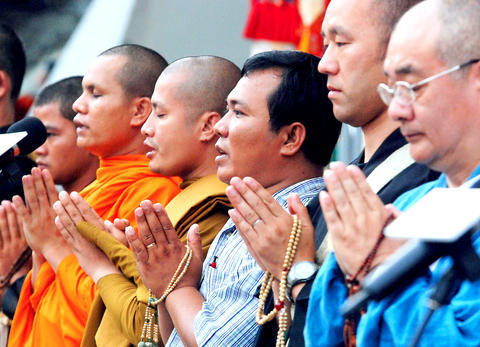
PHOTO: AP
collective call
The group called on China yesterday to stop killing Tibetans and suppressing the rights of the Tibetan diaspora.
Tibet was invaded by the People's Republic of China in 1950.
On March 10, 1959, frustration with the Chinese occupation led to an uprising that triggered violent repression by Chinese soldiers, during which tens of thousands of Tibetans were killed.
The crackdown also forced the flight of the spiritual and political leader, the Dalai Lama and his government.
China has ruled Tibet since 1951 and has violently suppressed a number of uprisings since then.
support
Despite the rain yesterday, many supporters wore T-shirts bearing the imprint "I am Taiwanese, I support Tibet's independence" and voiced their support for the Tibetan independence movement.
After the prayers and music, chief of the Dalai Lama Foundation Sonam Dorjee criticized Beijing for tramping on the UN Universal Declaration of Human Rights and its continued repression of Tibetans.
He urged the UN to sanction China for these violations so that the suffering of Tibetans could end as quickly as possible.
"Because of the leadership of the Dalai Lama, Tibetans do not fear the Chinese Communist Party's oppression," said former parliament member of the Tibetan government-in-exile Khedroob Thondup.
shared experience
Secretary-general of the Taiwan-Tibet Exchange Foundation, Liu Shih-fang (
Chou Mei-li (周美里), chairwoman of Taiwan's Friends of Tibet, said this year marked the 18th anniversary of the Tiananmen Square Massacre.
China, which relentlessly interferes in the affairs of its neighbors and persecutes their people, nevertheless claims it seeks to create a "harmonious world," she said.
proof
Footage last year exposing Chinese soldiers shooting Tibetans as they were attempting to flee shocked the world and demonstrated that China's outrages against innocent Tibetans continued, she said.
Chou also criticized the railway linking Qinghai and Tibet, opened last year, saying that it deepened Beijing's involvement in and plundering of every aspect of Tibetan life.
"How would you feel if China built a bridge that leads to Taiwan?" Chou asked, urging Taiwanese to empathize with the pain of exiled Tibetans.
After prayer, a movie about Tibet was screened at the Majestic Theater to help people gain a better understanding of Tibetan history.

LOUD AND PROUD Taiwan might have taken a drubbing against Australia and Japan, but you might not know it from the enthusiasm and numbers of the fans Taiwan might not be expected to win the World Baseball Classic (WBC) but their fans are making their presence felt in Tokyo, with tens of thousands decked out in the team’s blue, blowing horns and singing songs. Taiwanese fans have packed out the Tokyo Dome for all three of their games so far and even threatened to drown out home team supporters when their team played Japan on Friday. They blew trumpets, chanted for their favorite players and had their own cheerleading squad who dance on a stage during the game. The team struggled to match that exuberance on the field, with
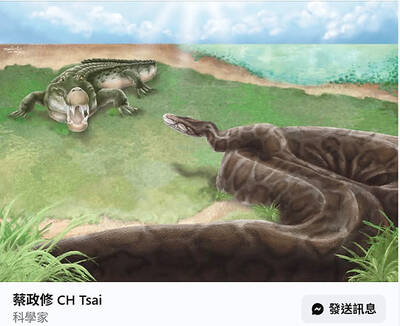
Taiwanese paleontologists have discovered fossil evidence that pythons up to 4m long inhabited Taiwan during the Pleistocene epoch, reporting their findings in the international scientific journal Historical Biology. National Taiwan University (NTU) Institute of Ecology and Evolutionary Biology associate professor Tsai Cheng-hsiu (蔡政修) led the team that discovered the largest snake fossil ever found in Taiwan. The single trunk vertebra was discovered in Tainan at the Chiting Formation, dated to between 400,000 and 800,000 years ago in the Middle Pleistocene, the paper said. The area also produced Taiwan’s first avian fossil, as well as crocodile, mammoth, saber-toothed cat and rhinoceros fossils, it said. Discoveries

Taiwanese paleontologists have discovered fossil evidence that pythons up to 4m long inhabited Taiwan during the Pleistocene epoch, reporting their findings in the international scientific journal Historical Biology. National Taiwan University (NTU) Institute of Ecology and Evolutionary Biology associate professor Tsai Cheng-hsiu (蔡政修) led the team that discovered the largest snake fossil ever found in Taiwan. A single trunk vertebra was discovered in Tainan at the Chiting Formation, dated to between 800,000 to 400,000 years ago in the Middle Pleistocene, the paper said. The area also produced Taiwan’s first avian fossil, as well as crocodile, mammoth, sabre-toothed cat and rhinoceros fossils, it said. Discoveries

Whether Japan would help defend Taiwan in case of a cross-strait conflict would depend on the US and the extent to which Japan would be allowed to act under the US-Japan Security Treaty, former Japanese minister of defense Satoshi Morimoto said. As China has not given up on the idea of invading Taiwan by force, to what extent Japan could support US military action would hinge on Washington’s intention and its negotiation with Tokyo, Morimoto said in an interview with the Liberty Times (sister paper of the Taipei Times) yesterday. There has to be sufficient mutual recognition of how Japan could provide


 RSS
RSS