


Advance ticket sales for the 2007 Taipei Film Festival are scheduled to begin today for the five venues where a total of 188 Taiwanese and foreign movies will be shown, the organizers said yesterday.
Advance tickets are NT$100 for weekday shows and NT$150 for weekend shows. Both prices represent a 16.7 percent discount compared to tickets bought during the festival, which runs from June 22 to July 9.
The annual film festival, which is organized by the Taipei City Government, is entering its ninth year. It is celebrated as one of the most important international cultural events in the nation, with the movies from more than 40 countries attracting some 100,000 moviegoers each year.
This year, 188 films were submitted for the festival's award competition in four categories. Nominated for the awards are 12 feature films, six documentaries, six experimental films and seven animated films.
prize
The winner of the International New Talent Award and the winner of the Taipei Grand Award will each receive a cash prize of NT$1 million (US$30,000).
The festival each year features one or two cities as a focus for its "city vision." This year, the city in focus is the Copenhagen.
Two Danish films from last year -- Clash of Egos, directed by Tomas Dillum Jensen, and After the Wedding, directed by Susanne Bier -- will be presented as the opening and closing films.
The Most Distant Course, a feature film directed by Taiwanese director Lin Jing-jie (
venues
The 188 films will be shown simultaneously at the Taipei Zhongshan Hall, the Metropolitan Hall, the In89 Digital Cinema, the Taipei County Art and Culture Center Auditorium and the Taipei Cinema Park.
Related activities will include an exhibition of posters and film stills from around the world from June 1 to July 9 and an exhibition of selected works from the 2007 Taipei Image Award Submission from June 5 to July 8.

Taiwanese paleontologists have discovered fossil evidence that pythons up to 4m long inhabited Taiwan during the Pleistocene epoch, reporting their findings in the international scientific journal Historical Biology. National Taiwan University (NTU) Institute of Ecology and Evolutionary Biology associate professor Tsai Cheng-hsiu (蔡政修) led the team that discovered the largest snake fossil ever found in Taiwan. The single trunk vertebra was discovered in Tainan at the Chiting Formation, dated to between 400,000 and 800,000 years ago in the Middle Pleistocene, the paper said. The area also produced Taiwan’s first avian fossil, as well as crocodile, mammoth, saber-toothed cat and rhinoceros fossils, it said. Discoveries

Taiwanese paleontologists have discovered fossil evidence that pythons up to 4m long inhabited Taiwan during the Pleistocene epoch, reporting their findings in the international scientific journal Historical Biology. National Taiwan University (NTU) Institute of Ecology and Evolutionary Biology associate professor Tsai Cheng-hsiu (蔡政修) led the team that discovered the largest snake fossil ever found in Taiwan. A single trunk vertebra was discovered in Tainan at the Chiting Formation, dated to between 800,000 to 400,000 years ago in the Middle Pleistocene, the paper said. The area also produced Taiwan’s first avian fossil, as well as crocodile, mammoth, sabre-toothed cat and rhinoceros fossils, it said. Discoveries

Whether Japan would help defend Taiwan in case of a cross-strait conflict would depend on the US and the extent to which Japan would be allowed to act under the US-Japan Security Treaty, former Japanese minister of defense Satoshi Morimoto said. As China has not given up on the idea of invading Taiwan by force, to what extent Japan could support US military action would hinge on Washington’s intention and its negotiation with Tokyo, Morimoto said in an interview with the Liberty Times (sister paper of the Taipei Times) yesterday. There has to be sufficient mutual recognition of how Japan could provide
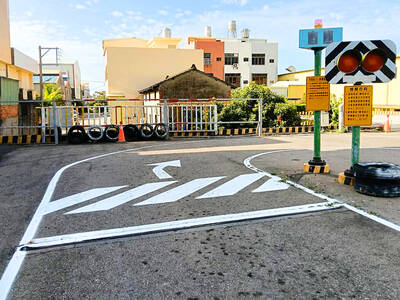
UPDATED TEST: The new rules aim to assess drivers’ awareness of risky behaviors and how they respond under certain circumstances, the Highway Bureau said Driver’s license applicants who fail to yield to pedestrians at intersections or to check blind spots, or omit pointing-and-calling procedures would fail the driving test, the Highway Bureau said yesterday. The change is set to be implemented at the end of the month, and is part of the bureau’s reform of the driving portion of the test, which has been criticized for failing to assess whether drivers can operate vehicles safely. Sedan drivers would be tested regarding yielding to pedestrians and turning their heads to check blind spots, while drivers of large vehicles would be tested on their familiarity with pointing-and-calling


 RSS
RSS