


The Ministry of Education (MOE) has neglected the needs of special needs children to disastrous effect in classrooms and homes, governing and opposition party lawmakers alleged yesterday.
Sitting beside parents of "severely developmentally challenged" children from Nantou County, Democratic Progressive Party (DPP) Legislator Lin Yun-sheng (林耘生) panned the official overseeing the schooling of such children in a press conference at the legislature.
Parents, he said, must transport their kids to and from a school in Taichung City each day because no schools are open to them in their own county.
"These parents can't find the time to make the drive. The Ministry of Education hasn't arranged for any transportation," Lin said. "This isn't right!"
The Nantou parents aren't the only ones facing such a predicament, he said.
Since the ministry implemented its "education placement" plan for children with special needs this year, parents nationwide are finding that nearby schools that used to offer placement to their children are now turning them away.
The few remaining "special schools" are, in many cases, hours away, Lin said.
Faced with difficult, or even impossible, commutes and little assistance from educational authorities, "Some parents are forced to cut their children's schooling short," Lin said. "These kids are denied their constitutionally protected right to an education."
Ministry representative Tsai Chi-ming (
Junior high school graduates with less severe disabilities, Tsai said, are being placed in local high school classes that help them develop job skills.
But the ministry would arrange for transportation and on-campus accommodation for those whose disabilities warrant placement in schools far from home such as those in Taichung and Changhua, he said, without giving a timetable for such arrangements.
Tsai left the press conference as soon as it ended and did not talk with either reporters or the parents present.
At a separate press conference, Chinese Nationalist Party (KMT) Legislator Diane Lee (李慶安) also slammed the ministry for "not addressing a huge number of children suffering from Attention Deficit Hyperactivity Disorder [ADHD]."
Children afflicted by the disorder appear normal, but lack the ability to focus and control their emotions, Lee said.
ADHD Education Foundation secretary-general Tsai Mei-hsing (
Every class, the foundation said, has at least one or two students who have ADHD.
Despite such staggering figures, the ministry has done little to prepare teachers for managing such students, and most ADHD students go undiagnosed, Lee said.
These students are usually ridiculed by their teachers for being undisciplined, she said, calling on the ministry to recognize the scope of the problem and provide professional services to ADHD students.
Fighting back tears at the conference, high school student Chin Yu-han (秦郁涵) recalled being ridiculed by teachers and classmates because of her ADHD. Her teachers called her "messy" and beat her, while classmates shunned her.
She was undiagnosed for years before a bout of depression forced her parents to look into her situation more closely.
"I would go to school and get beaten, and then I would go home and get beaten," Chin said. "Everybody beat me."
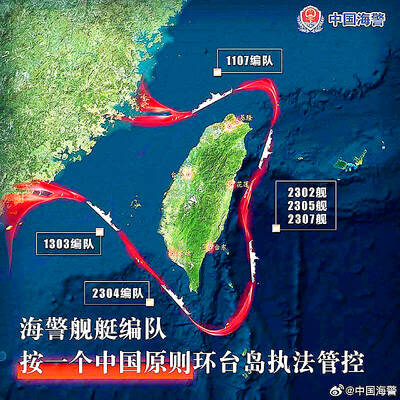
Taiwan would benefit from more integrated military strategies and deployments if the US and its allies treat the East China Sea, the Taiwan Strait and the South China Sea as a “single theater of operations,” a Taiwanese military expert said yesterday. Shen Ming-shih (沈明室), a researcher at the Institute for National Defense and Security Research, said he made the assessment after two Japanese military experts warned of emerging threats from China based on a drill conducted this month by the Chinese People’s Liberation Army’s (PLA) Eastern Theater Command. Japan Institute for National Fundamentals researcher Maki Nakagawa said the drill differed from the

‘WORSE THAN COMMUNISTS’: President William Lai has cracked down on his political enemies and has attempted to exterminate all opposition forces, the chairman said The legislature would motion for a presidential recall after May 20, Chinese Nationalist Party (KMT) Chairman Eric Chu (朱立倫) said yesterday at a protest themed “against green communists and dictatorship” in Taipei. Taiwan is supposed to be a peaceful homeland where people are united, but President William Lai (賴清德) has been polarizing and tearing apart society since his inauguration, Chu said. Lai must show his commitment to his job, otherwise a referendum could be initiated to recall him, he said. Democracy means the rule of the people, not the rule of the Democratic Progressive Party (DPP), but Lai has failed to fulfill his
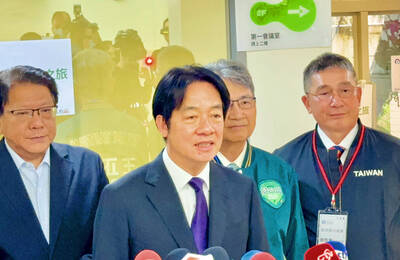
A rally held by opposition parties yesterday demonstrates that Taiwan is a democratic country, President William Lai (賴清德) said yesterday, adding that if opposition parties really want to fight dictatorship, they should fight it on Tiananmen Square in Beijing. The Chinese Nationalist Party (KMT) held a protest with the theme “against green communists and dictatorship,” and was joined by the Taiwan People’s Party. Lai said the opposition parties are against what they called the “green communists,” but do not fight against the “Chinese communists,” adding that if they really want to fight dictatorship, they should go to the right place and face
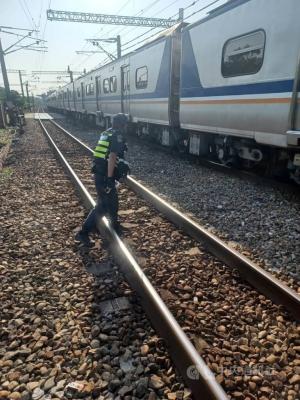
A 79-year-old woman died today after being struck by a train at a level crossing in Taoyuan, police said. The woman, identified by her surname Wang (王), crossed the tracks even though the barriers were down in Jhongli District’s (中壢) Neili (內壢) area, the Taoyuan Branch of the Railway Police Bureau said. Surveillance footage showed that the railway barriers were lowered when Wang entered the crossing, but why she ventured onto the track remains under investigation, the police said. Police said they received a report of an incident at 6:41am involving local train No. 2133 that was heading from Keelung to Chiayi City. Investigators


 RSS
RSS