

The Ministry of Foreign Affairs said it was confident about seeking support from the US and from other WHO members, despite the opposition from China and concerns about Taiwan's bid for membership.
Meetings held in the past between US Health and Human Services Secretary Mike Leavitt and Minister of the Department of Health Hou Sheng-mou (
The meeting -- or lack thereof -- is considered a gauge of the US' attitude towards Taiwan's efforts to participate in the WHO. It has previously been held one day after Taiwan had been denied observer status at the WHA.
Although Leavitt expressed his support for Taiwan's new approach -- to apply for WHO membership instead of WHA observer rights -- the two sides were not planning to meet this year, Hou said.
"We didn't talk about meeting with each other this year. It's not an important matter on the agenda, as Mr Leavitt already wrote a letter to support our efforts," Hou said on Saturday night in Geneva, Switzerland, dismissing concerns that the US decided to cancel the meeting as a sign of disapproval.
Government officials acknowledged that the decision to seek WHO membership under the name "Taiwan" had made it more difficult to win the support of WHO members, but said the decision was the correct one.
"It is the road we must take, but there are different strategies to reach the goal," Deputy Minister of Foreign Affairs Yang Tzu-pao (
"We are communicating a lot more with the US, Japan and the European Union this year," Yang said.
Despite the ministry's efforts, so far the US, Japan and the EU, which have voiced support for Taiwan's bid for observer status at previous WHA sessions, still only support "meaningful participation" in the WHO for Taiwan, Yang said, while declining to reveal details on the countries' responses.
Although WHO Director-General Margaret Chan (陳馮富珍) has said that Taiwan is ineligibile to apply for WHO membership, Yang said Taiwan's allies were still sending letters asking the WHA to place Taiwan's application on the agenda.
The nation's allies also said they would challenge the WHO secretariat's decision at the WHA, Yang said.
In addition to efforts to gain WHO membership, Hou said the government would not give up previous efforts to apply for WHA observer status and would continue to seek "meaningful participation" in WHO-related activities.
"A full membership in the WHO means 100 percent participation, but before we reach the goal, we can still push for meaningful participation. What qualifies as meaningful participation should be defined by us, not China," Hou said.
Hou said the government was focusing on meaningful participation in the Framework Convention on Tobacco Control, food safety and international health regulations, and efforts to curb influenza and tuberculosis.
Meanwhile, in response to former premier Su Tseng-chang's (蘇貞昌) unexpected resignation, both Hou and Yang assured that the government's efforts to push for membership would not be affected.
"There could be a caretaker Cabinet, but there won't be caretaking on national interests. There might be some emotions, but our duties to fight for the country's interests on the battle field will never be affected," Yang said.

The donation of offshore patrol vessel Kinmen to the Philippines includes provisions that protect Taiwanese fishers and facilitate security cooperation across the First Island Chain, officials said yesterday. The comment was made during the Cabinet’s comprehensive administrative report at the legislature after Chinese Nationalist Party (KMT) Legislator Hsu Yu-chen (許宇甄) expressed concerns about the decision to give a ship to a country whose coast guard had in 2013 fired on a Taiwanese trawler and killed its captain without provocation. The Cabinet should lay out the safeguards that have been established to prevent the Philippine government from using the Kinmen to harass, expel
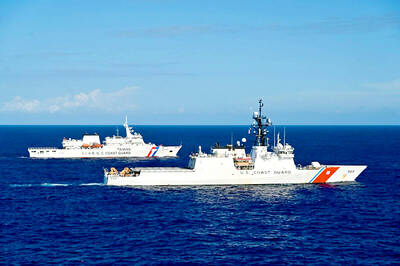
GROWING TIES: The CGA is planning a goodwill mission to the Philippines, in what would be the first time since 1975 a Taiwanese paramilitary vessel has visited the country The Coast Guard Administration (CGA) plans to significantly expand its participation in international security cooperative frameworks and its operational capabilities, a budget proposal for next year showed. The budget indicates a transformation of the CGA from a maritime law enforcement arm into a national defense and intelligence gathering entity capable of tackling larger regional security matters. The proposal showed that personnel from the coast guard’s Intelligence Division and Special Action Support Center are to participate in high-level national security talks with the US. As the CGA has dealt with China’s rising “gray zone” threats around Taiwan, it has become a valuable asset to
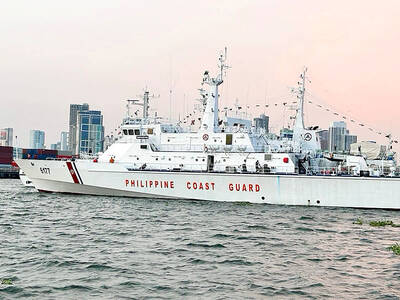
A patrol vessel donated by the Coast Guard Administration (CGA) to the Philippines was commissioned into the Philippine Coast Guard (PCG) on Friday, a Philippine non-governmental organization said. The CGA on Sept. 16 confirmed media reports that Taiwan had donated a retired 500-tonne patrol vessel to the Philippines. The Manila-based We Protect Our Seas (WPS) foundation, which served as an intermediary in the transfer, said that the vessel was formerly the CGA’s 500-tonne petrol vessel Kinmen (CG123). The WPS, in a statement issued on Friday, said the vessel, renamed as the BRP Sarangani, had been commissioned into the PCG the
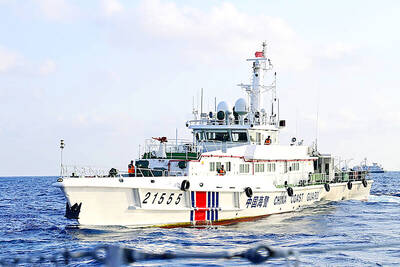
‘GRAY ZONE’ TACTICS: Beijing sent two China Coast Guard vessels to escort a ‘supposedly private research ship,’ a Philippine Coast Guard spokesman said The Coast Guard Administration (CGA) yesterday confirmed that it had recently deployed three patrol vessels to waters in Taiwan’s overlapping exclusive economic zone with the Philippines to monitor three Chinese vessels. CGA Deputy Director-General Hsieh Ching-chin (謝慶欽) said the agency regularly monitors Chinese vessels around Taiwan, and that the deployment south of Oluanpi (鵝鑾鼻), Taiwan proper’s southernmost point, was carried out in accordance with standard procedures. He added that the waters fall within the overlapping exclusive economic zones of Taiwan and the Philippines, which extend 200 nautical miles (370km) from their coastlines. Hsieh made the comments when asked about a


 RSS
RSS