


International cooperation and sharing data are necessary to manage ocean and sea resources. This was the message of a two-day international symposium on marine affairs that concluded yesterday in Taipei.
Ni I-hsun (
The satellites of different countries provide data on different parts of the world, he said. When combined, they can give us a complete picture and help fishermen locate appropriate fishing grounds.
"If we help our fellow countries with technical assistance on satellite technology instead of just funding, we will be helping them for generations to come," he said. "Our own fishing industry will also benefit from closer cooperation with other nations, near whose waters Taiwanese vessels may fish."
"Almost sixty percent of the fish we catch are caught in distant waters," he said. "There is no other country in the world with as many distant water fisheries proportionally than Taiwan."
More international cooperation would lead to smoother negotiations for fishing licenses and help avoid potential conflicts involving illegal fishing by Taiwanese vessels, he said.
In addition, international cooperation is necessary for scientific research, Liu Cho-teng (劉卓騰) said.
"Both the Ocean Models and Information Systems for the APEC Region (OMISAR) and the Satellite Application for Knowledge-based Economy (SAKE) projects were sponsored by Taiwan's Environmental Protection Agency," Liu said. "But all participating APEC countries, including China, shared their real-time data so that we could test our models."
Various other issues pertaining to the oceans and affecting Taiwan were discussed at the symposium. A roster of experts from Taiwan and across the globe discussed Taiwan's sizable fishing fleet, fragile coastline and coastal cities vulnerable to ocean level changes and maritime boundary disputes, symposium participants said.
Robert Kay, Director of Coastal Zone Management, an Australian company, told the symposium that Taiwan "may be particularly at risk" from global warming because of its densely populated coastal zone packed with valuable infrastructure.
International communication and collaboration is important for another reason -- avoiding misunderstandings, Ni said.
"Many conservation activists abroad were up in arms about Taiwan's shark fin trade because they thought we only took the fin," he said. "But at an international conference attended by both fishermen and conservationists, we were able to show them that no part of the shark is wasted."
Ni said that fishing boats entering the nation's ports with fins must also carry shark carcasses.
Although the fin fetches the handsomest price, the meat, skin and innards are also sold.

A group of Taiwanese-American and Tibetan-American students at Harvard University on Saturday disrupted Chinese Ambassador to the US Xie Feng’s (謝鋒) speech at the school, accusing him of being responsible for numerous human rights violations. Four students — two Taiwanese Americans and two from Tibet — held up banners inside a conference hall where Xie was delivering a speech at the opening ceremony of the Harvard Kennedy School China Conference 2024. In a video clip provided by the Coalition of Students Resisting the CCP (Chinese Communist Party), Taiwanese-American Cosette Wu (吳亭樺) and Tibetan-American Tsering Yangchen are seen holding banners that together read:

UNAWARE: Many people sit for long hours every day and eat unhealthy foods, putting them at greater risk of developing one of the ‘three highs,’ an expert said More than 30 percent of adults aged 40 or older who underwent a government-funded health exam were unaware they had at least one of the “three highs” — high blood pressure, high blood lipids or high blood sugar, the Health Promotion Administration (HPA) said yesterday. Among adults aged 40 or older who said they did not have any of the “three highs” before taking the health exam, more than 30 percent were found to have at least one of them, Adult Preventive Health Examination Service data from 2022 showed. People with long-term medical conditions such as hypertension or diabetes usually do not

POLICE INVESTIGATING: A man said he quit his job as a nurse at Taipei Tzu Chi Hospital as he had been ‘disgusted’ by the behavior of his colleagues A man yesterday morning wrote online that he had witnessed nurses taking photographs and touching anesthetized patients inappropriately in Taipei Tzu Chi Hospital’s operating theaters. The man surnamed Huang (黃) wrote on the Professional Technology Temple bulletin board that during his six-month stint as a nurse at the hospital, he had seen nurses taking pictures of patients, including of their private parts, after they were anesthetized. Some nurses had also touched patients inappropriately and children were among those photographed, he said. Huang said this “disgusted” him “so much” that “he felt the need to reveal these unethical acts in the operating theater
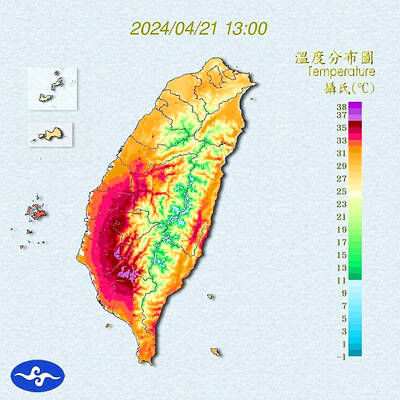
Heat advisories were in effect for nine administrative regions yesterday afternoon as warm southwesterly winds pushed temperatures above 38°C in parts of southern Taiwan, the Central Weather Administration (CWA) said. As of 3:30pm yesterday, Tainan’s Yujing District (玉井) had recorded the day’s highest temperature of 39.7°C, though the measurement will not be included in Taiwan’s official heat records since Yujing is an automatic rather than manually operated weather station, the CWA said. Highs recorded in other areas were 38.7°C in Kaohsiung’s Neimen District (內門), 38.2°C in Chiayi City and 38.1°C in Pingtung’s Sandimen Township (三地門), CWA data showed. The spell of scorching


 RSS
RSS