


The Democratic Progressive Party (DPP) has chosen its presidential candidate through a democratic -- albeit somewhat chaotic -- selection process.
The victory of former premier Frank Hsieh (
In the final days leading to the primary last Sunday, the two camps were engaged in a bitter war of words as accusations were hurled back and forth. Allegations of corruption against Hsieh relating to the Kaohsiung Rapid Transit Corp scandal gave rise to cries of foul play from the former Kaohsiung mayor's supporters and criticism that the party and the president were biased in favor of a certain candidate.
Worried about the heated campaign, President Chen Shui-bian (
Although the DPP looked as if it were about to split at the seams before the primary, the party has pulled itself together again after Hsieh was declared the winner in the first round of the primary, with the three other contenders falling behind and giving him their full support.
Lo Chi-cheng (
"One of the biggest differences between the DPP and the KMT [Chinese Nationalist Party] is that DPP members always unite together after a fierce election while the KMT always split," he said.
It was not a question of whether the party's four bigwigs wanted to cooperate with each other, but rather the awareness that the party could not afford to split, Lo said.
Lo, a Yu supporter, said that Hsieh must address the concern of those who did not vote for him or who did not come out to vote at all.
"He can easily lose the presidential election if he fails to win the backing of the 49 percent of DPP members who support Su and Yu and have doubts about his [Hsieh's] more conciliatory path," he said.
Lo said he expected Hsieh's opponents, either from within the party or from independence supporters, to voice their concern and demand a satisfactory answer.
Former presidential adviser Wu Li-pei (吳澧培), speaking before the results of the primary vote came out, said he harbored doubts about Hsieh's China policy.
Although Hsieh is now the DPP's candidate, Wu said he still has questions about Hsieh's alleged role in the Kaohsiung rapid transit scandal when he was Kaohsiung mayor and investigations into his -- ?and other government officials' -- use of their special allowance fund.
Nonetheless, Wu said that he and other independence supporters would still be happy to see Hsieh resume talks with Beijing, barring a compromise or surrender to Chinese authorities.
Given Hsieh's more conciliatory stance, Wu said he expected China would be more willing to hold dialogue with Hsieh if he were elected president.
It may take a while for both sides to reach a consensus on highly sensitive issues such as independence or unification, but they can at least talk about economic cooperation or even map out a peace treaty, he said.
It is important, however, to have a third party, preferably a powerful country, involved to supervise the peace process.
Acknowledging that Hsieh faces many challenges ahead, Wu said that he hoped Hsieh would solicit opinions from different groups in order to strike a balance.
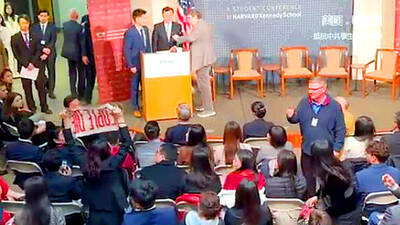
A group of Taiwanese-American and Tibetan-American students at Harvard University on Saturday disrupted Chinese Ambassador to the US Xie Feng’s (謝鋒) speech at the school, accusing him of being responsible for numerous human rights violations. Four students — two Taiwanese Americans and two from Tibet — held up banners inside a conference hall where Xie was delivering a speech at the opening ceremony of the Harvard Kennedy School China Conference 2024. In a video clip provided by the Coalition of Students Resisting the CCP (Chinese Communist Party), Taiwanese-American Cosette Wu (吳亭樺) and Tibetan-American Tsering Yangchen are seen holding banners that together read:

UNAWARE: Many people sit for long hours every day and eat unhealthy foods, putting them at greater risk of developing one of the ‘three highs,’ an expert said More than 30 percent of adults aged 40 or older who underwent a government-funded health exam were unaware they had at least one of the “three highs” — high blood pressure, high blood lipids or high blood sugar, the Health Promotion Administration (HPA) said yesterday. Among adults aged 40 or older who said they did not have any of the “three highs” before taking the health exam, more than 30 percent were found to have at least one of them, Adult Preventive Health Examination Service data from 2022 showed. People with long-term medical conditions such as hypertension or diabetes usually do not
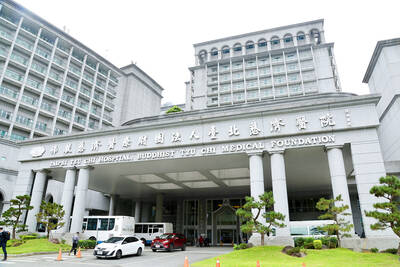
POLICE INVESTIGATING: A man said he quit his job as a nurse at Taipei Tzu Chi Hospital as he had been ‘disgusted’ by the behavior of his colleagues A man yesterday morning wrote online that he had witnessed nurses taking photographs and touching anesthetized patients inappropriately in Taipei Tzu Chi Hospital’s operating theaters. The man surnamed Huang (黃) wrote on the Professional Technology Temple bulletin board that during his six-month stint as a nurse at the hospital, he had seen nurses taking pictures of patients, including of their private parts, after they were anesthetized. Some nurses had also touched patients inappropriately and children were among those photographed, he said. Huang said this “disgusted” him “so much” that “he felt the need to reveal these unethical acts in the operating theater
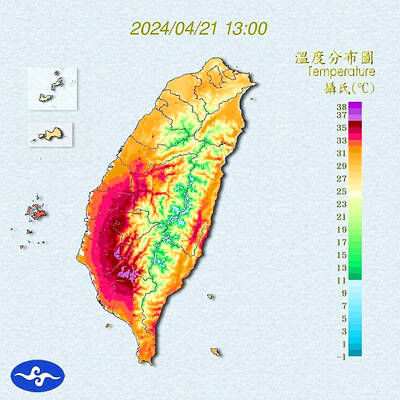
Heat advisories were in effect for nine administrative regions yesterday afternoon as warm southwesterly winds pushed temperatures above 38°C in parts of southern Taiwan, the Central Weather Administration (CWA) said. As of 3:30pm yesterday, Tainan’s Yujing District (玉井) had recorded the day’s highest temperature of 39.7°C, though the measurement will not be included in Taiwan’s official heat records since Yujing is an automatic rather than manually operated weather station, the CWA said. Highs recorded in other areas were 38.7°C in Kaohsiung’s Neimen District (內門), 38.2°C in Chiayi City and 38.1°C in Pingtung’s Sandimen Township (三地門), CWA data showed. The spell of scorching


 RSS
RSS