


Academics and Hakka groups yesterday gathered to brainstorm how to encourage a pluralistic, multicultural society and condemned past government policies that promoted a monolingual nation.
A forum held yesterday in Taipei by the Taiwan Society Hakka focused on reviewing past language policies and envisioning a more pluralistic Taiwan.
Taiwan is a multicultural and multilingual society with more than 15 languages, participants said.
"Languages are not just tools for communication; Behind every language there is a culture," said Chi Chun-chieh (
Language policies during the Japanese colonial rule and the Chinese Nationalist Party (KMT) regime were intended to create a single-language society, said Chen Chun-kai (陳君愷), a history professor at Fu-jen Catholic University.
"Both the Japanese and the KMT used punishment and humiliation to force people to stop speaking their mother tongues," he said.
Such measures included fines and being forced to carry humiliating plaques or to undergo public derision.
"It not only hurt the cultures, but also the self-esteem of an entire population," he said.
Reversing the damage will require coordination of educational, legislative and administrative efforts, participants argued.
Legislation should protect and promote cultural and linguistic pluralism, while administrative efforts develop policies that support the legislation in practice, said Chiu Jung-chu (
"To achieve true equality, we must admit we're different, learn to respect our differences and find a way to communicate with each other," President of the Association for Hakka Studies Chang Wei-an (
The use of various languages at the forum was offered as an example of promoting linguistic equality.
The organizer encouraged all speakers to speak in their languages of choice, while a team of volunteers provided simultaneous interpretation between Hakka, Hoklo (also known as Taiwanese) and Mandarin.
"We wanted to provide the service so that people can be free to talk in their language of choice," said Chuang Chen Yueh-hsiu (
Participants proposed ideas for the government to promote Taiwan's endangered languages.
"I think townships where Hakkas are the ethnic majority could be declared Hakka autonomous regions" Council for Hakka Affairs Chairman Lee Yung-te (李永得) said, adding that such an option could be voted on in referendums.
"In these autonomous regions, it would be encouraged to conduct everything from government administration to education to people's daily lives in Hakka, while Mandarin would be taught as a tool to communicate with people from other regions," Lee said. "The same thing would work for Hoklo or Aborigines as well."
"The government should provide the linguistic environment and motivation [necessary] for linguistic restoration," Chi said.
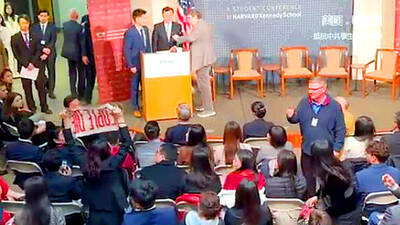
A group of Taiwanese-American and Tibetan-American students at Harvard University on Saturday disrupted Chinese Ambassador to the US Xie Feng’s (謝鋒) speech at the school, accusing him of being responsible for numerous human rights violations. Four students — two Taiwanese Americans and two from Tibet — held up banners inside a conference hall where Xie was delivering a speech at the opening ceremony of the Harvard Kennedy School China Conference 2024. In a video clip provided by the Coalition of Students Resisting the CCP (Chinese Communist Party), Taiwanese-American Cosette Wu (吳亭樺) and Tibetan-American Tsering Yangchen are seen holding banners that together read:

UNAWARE: Many people sit for long hours every day and eat unhealthy foods, putting them at greater risk of developing one of the ‘three highs,’ an expert said More than 30 percent of adults aged 40 or older who underwent a government-funded health exam were unaware they had at least one of the “three highs” — high blood pressure, high blood lipids or high blood sugar, the Health Promotion Administration (HPA) said yesterday. Among adults aged 40 or older who said they did not have any of the “three highs” before taking the health exam, more than 30 percent were found to have at least one of them, Adult Preventive Health Examination Service data from 2022 showed. People with long-term medical conditions such as hypertension or diabetes usually do not
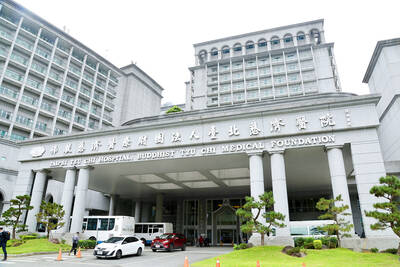
POLICE INVESTIGATING: A man said he quit his job as a nurse at Taipei Tzu Chi Hospital as he had been ‘disgusted’ by the behavior of his colleagues A man yesterday morning wrote online that he had witnessed nurses taking photographs and touching anesthetized patients inappropriately in Taipei Tzu Chi Hospital’s operating theaters. The man surnamed Huang (黃) wrote on the Professional Technology Temple bulletin board that during his six-month stint as a nurse at the hospital, he had seen nurses taking pictures of patients, including of their private parts, after they were anesthetized. Some nurses had also touched patients inappropriately and children were among those photographed, he said. Huang said this “disgusted” him “so much” that “he felt the need to reveal these unethical acts in the operating theater
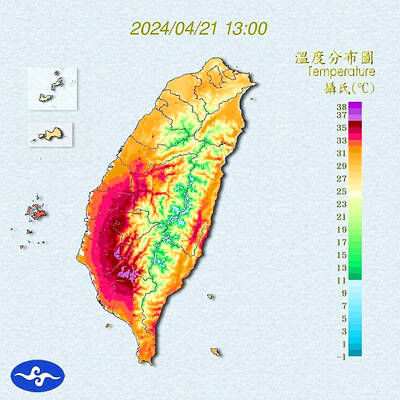
Heat advisories were in effect for nine administrative regions yesterday afternoon as warm southwesterly winds pushed temperatures above 38°C in parts of southern Taiwan, the Central Weather Administration (CWA) said. As of 3:30pm yesterday, Tainan’s Yujing District (玉井) had recorded the day’s highest temperature of 39.7°C, though the measurement will not be included in Taiwan’s official heat records since Yujing is an automatic rather than manually operated weather station, the CWA said. Highs recorded in other areas were 38.7°C in Kaohsiung’s Neimen District (內門), 38.2°C in Chiayi City and 38.1°C in Pingtung’s Sandimen Township (三地門), CWA data showed. The spell of scorching


 RSS
RSS