


In an effort to adopt an integrated circuit (IC) ticketing system for the MRT system, Taipei Rapid Transit Corp will begin selling IC tokens at four MRT stations starting on Tuesday with the aim of eventually replacing the existing MRT cards.
The tokens with IC cards inside, resemble a NT$50 coin and will be sold at the MRT CKS Memorial Hall, Guting, Jiantan and Taipei City Hall stations starting on Tuesday, and will be rolled out to all other MRT stations by August, the corporation said.
"The magnetic cards are easily worn, whereas the IC tokens can be used more than 30,000 times. Besides, it's hard to forge, and will save passengers time when passing through the gates," said Lee Yuan-hsiang (
The corporation has adopted the tokens in order to operate the new-style Automatic Fare Collection gates that open like a door. The gates were introduced last year to replace the existing turnstile types of gates.
Passengers who purchase the new IC tokens will be required to enter and exit the stations through the new gates, although the existing magnetic cards can still be purchased and used, Lee said.
Meanwhile, Taipei Smart Card Corp said yesterday that the EasyCard, which is currently used in Taipei MRT stations and on buses, could be used on the Taiwan High Speed Rail system within three years.
According to General Manager Jason Lin (
"Using the current EasyCard system could save the corporation the time and money of setting up a new system, and it's convenient for passengers to travel around with only one card," Lin said yesterday at Taipei City Hall.
As the Ministry of Transportation has thrown its support behind the integration of the nation's ticketing systems, Lin said the plan is very likely to be carried out within three years, adding that the company is in discussions with the Taiwan Railway Administration regarding the use of the EasyCard system on their network.
Lin said that Taipei Zoo will allow visitors to use the EasyCard to pay its entrance fee beginning in June.

The military has spotted two Chinese warships operating in waters near Penghu County in the Taiwan Strait and sent its own naval and air forces to monitor the vessels, the Ministry of National Defense (MND) said. Beijing sends warships and warplanes into the waters and skies around Taiwan on an almost daily basis, drawing condemnation from Taipei. While the ministry offers daily updates on the locations of Chinese military aircraft, it only rarely gives details of where Chinese warships are operating, generally only when it detects aircraft carriers, as happened last week. A Chinese destroyer and a frigate entered waters to the southwest

A magnitude 6.1 earthquake struck off the coast of Yilan County at 8:39pm tonight, the Central Weather Administration (CWA) said, with no immediate reports of damage or injuries. The epicenter was 38.7km east-northeast of Yilan County Hall at a focal depth of 98.3km, the CWA’s Seismological Center said. The quake’s maximum intensity, which gauges the actual physical effect of a seismic event, was a level 4 on Taiwan’s 7-tier intensity scale, the center said. That intensity level was recorded in Yilan County’s Nanao Township (南澳), Hsinchu County’s Guansi Township (關西), Nantou County’s Hehuanshan (合歡山) and Hualien County’s Yanliao (鹽寮). An intensity of 3 was

Instead of focusing solely on the threat of a full-scale military invasion, the US and its allies must prepare for a potential Chinese “quarantine” of Taiwan enforced through customs inspections, Stanford University Hoover fellow Eyck Freymann said in a Foreign Affairs article published on Wednesday. China could use various “gray zone” tactics in “reconfiguring the regional and ultimately the global economic order without a war,” said Freymann, who is also a nonresident research fellow at the US Naval War College. China might seize control of Taiwan’s links to the outside world by requiring all flights and ships entering or leaving Taiwan
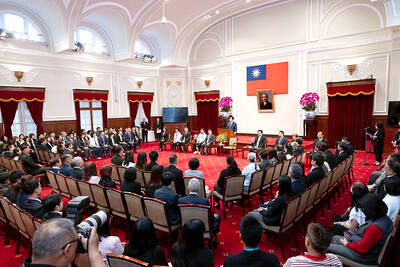
The next minimum wage hike is expected to exceed NT$30,000, President William Lai (賴清德) said yesterday during an award ceremony honoring “model workers,” including migrant workers, at the Presidential Office ahead of Workers’ Day today. Lai said he wished to thank the awardees on behalf of the nation and extend his most sincere respect for their hard work, on which Taiwan’s prosperity has been built. Lai specifically thanked 10 migrant workers selected for the award, saying that although they left their home countries to further their own goals, their efforts have benefited Taiwan as well. The nation’s industrial sector and small businesses lay


 RSS
RSS