


The legislative Sanitation, Environment and Social Welfare Committee yesterday passed an amendment to increase a welfare subsidy for the elderly, although lawmakers didn't reach a consensus on the terms.
The legislative committee was held to discuss 23 different versions of amendments to the Temporary Act for Welfare Subsidies to the Elderly (敬老福利生活津貼暫行條例).
The smallest proposed amendment bill suggested an increase to NT$4,000 per month for people over the age of 65, from the current NT$3,000, while as much as NT$10,000 was proposed.
Before lawmakers debated the proposed amendments, Co-chair Chu Chun-hsiao (朱俊曉) of the Chinese Nationalist Party (KMT), scheduled a vote that demanded the committee suspend discussion and send the bills directly to cross-party negotiations.
Seven pan-blue lawmakers favored the motion proposed by KMT Legislator Ho Tsai-feng (
Ho argued that referring the amendments to cross-party negotiations could get them through the legislature faster.
After the committee adjourned, DPP lawmakers Huang Sue-ying (黃淑英) and Wang Jung-chang (王榮璋), as well as representatives of civic groups devoted to the welfare of underprivileged people called a press conference condemning the pan-blue camp's move.
Representatives from social welfare organizations described the bills a day earlier as "money pits," accusing some politicians of attempting to "buy votes" through raising the stipends ahead of the year-end legislative elections and the 2008 presidential election.
Wang said the government budget would need to add an extra NT$9.5 billion if the NT$ 4,000 version was adopted, and NT$ 66.7 billion if the NT$ 10,000 version was used.
"We strongly oppose lawmakers deciding such an important policy in cross-party negotiation meetings which are held behind closed doors," he said.
It's "irresponsible" for lawmakers to increase subsidies without saying how they will pay for it and not debating the policy in public, he added.
Huang said that other proposals calling for an increase in subsidies for elderly farmers and elderly Aborigines will surely be brought up as well during the cross-party negotiation stage.
The cross-party negotiation stage is part of the statutory process of lawmaking, taking place before lawmakers submit bills when they can't reach a consensus during the preliminary review in the committee. Lawmakers can put a bill to a vote on the floor if they are still unable to reach a consensus within four months of the beginning of negotiations.
Additional reporting by CNA
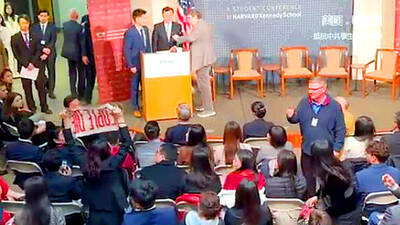
A group of Taiwanese-American and Tibetan-American students at Harvard University on Saturday disrupted Chinese Ambassador to the US Xie Feng’s (謝鋒) speech at the school, accusing him of being responsible for numerous human rights violations. Four students — two Taiwanese Americans and two from Tibet — held up banners inside a conference hall where Xie was delivering a speech at the opening ceremony of the Harvard Kennedy School China Conference 2024. In a video clip provided by the Coalition of Students Resisting the CCP (Chinese Communist Party), Taiwanese-American Cosette Wu (吳亭樺) and Tibetan-American Tsering Yangchen are seen holding banners that together read:

UNAWARE: Many people sit for long hours every day and eat unhealthy foods, putting them at greater risk of developing one of the ‘three highs,’ an expert said More than 30 percent of adults aged 40 or older who underwent a government-funded health exam were unaware they had at least one of the “three highs” — high blood pressure, high blood lipids or high blood sugar, the Health Promotion Administration (HPA) said yesterday. Among adults aged 40 or older who said they did not have any of the “three highs” before taking the health exam, more than 30 percent were found to have at least one of them, Adult Preventive Health Examination Service data from 2022 showed. People with long-term medical conditions such as hypertension or diabetes usually do not
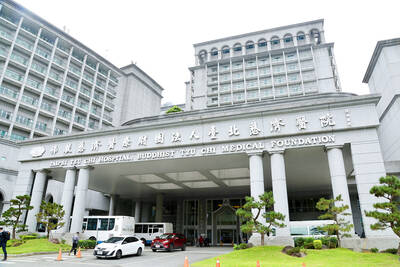
POLICE INVESTIGATING: A man said he quit his job as a nurse at Taipei Tzu Chi Hospital as he had been ‘disgusted’ by the behavior of his colleagues A man yesterday morning wrote online that he had witnessed nurses taking photographs and touching anesthetized patients inappropriately in Taipei Tzu Chi Hospital’s operating theaters. The man surnamed Huang (黃) wrote on the Professional Technology Temple bulletin board that during his six-month stint as a nurse at the hospital, he had seen nurses taking pictures of patients, including of their private parts, after they were anesthetized. Some nurses had also touched patients inappropriately and children were among those photographed, he said. Huang said this “disgusted” him “so much” that “he felt the need to reveal these unethical acts in the operating theater
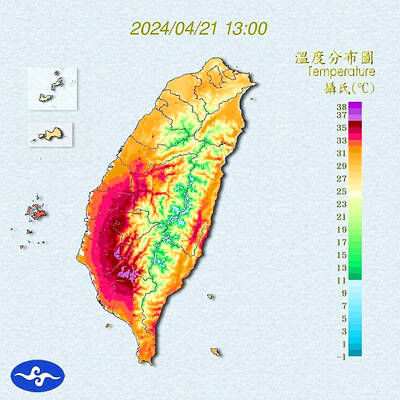
Heat advisories were in effect for nine administrative regions yesterday afternoon as warm southwesterly winds pushed temperatures above 38°C in parts of southern Taiwan, the Central Weather Administration (CWA) said. As of 3:30pm yesterday, Tainan’s Yujing District (玉井) had recorded the day’s highest temperature of 39.7°C, though the measurement will not be included in Taiwan’s official heat records since Yujing is an automatic rather than manually operated weather station, the CWA said. Highs recorded in other areas were 38.7°C in Kaohsiung’s Neimen District (內門), 38.2°C in Chiayi City and 38.1°C in Pingtung’s Sandimen Township (三地門), CWA data showed. The spell of scorching


 RSS
RSS