


The four Democratic Progressive Party (DPP) presidential aspirants continued their pre-primary wrangling yesterday, this time with a spat over the relationship between the Constitution and the "one China" framework.
In an interview with the Chinese-language daily China Times published yesterday, Premier Su Tseng-chang (
Su said that there was no "one China" relationship between Taiwan and China, adding that no one should confuse "[Taiwan and China as] the same country."
He said that bringing up such issues only confused people about Taiwan's national identity.
The premier said that people wouldn't be "speaking out" against Hsieh if his remarks didn't carry influence, making them worry about the issue.
Hsieh quickly responded to the premier's remarks.
"When I said there is a `one China' framework in the Constitution, I didn't mean that was my platform. Instead, what I want is to make reforms," Hsieh said at a press conference in the legislature yesterday.
Asserting that he was the first premier to stress the need to change the Constitution, Hsieh said "How could it be possible that I stand for a constitution based on a one-China principle?"
Hsieh said his comments were being misrepresented because of the approaching presidential primary, saying he had only meant to describe the Constitution.
Vice President Annette Lu (
"I don't know whether Hsieh has made himself clear on this, but I don't get it," Lu said when asked to comment on the spat.
Meanwhile, another would-be presidential contender joined the fray by dredging up remarks made by Hsieh more than six years ago, when he said that unification with China should not be a ruled out as an option for Taiwan.
"Hsieh's argument that the Constitution endorses the `one China' policy and that unification with China is an option deviates from the party's basic values," DPP Chairman Yu Shyi-kun said when approached by reporters about the kerfuffle.
Yu was referring to the DPP's official platform, which states that Taiwan and China are two different countries and that the party will pursue formal independence from China.
On Sept. 6, 2000, when Hsieh was serving as DPP chairman, he said in a radio interview that the party did not exclude unification with China as a future option.
Hsieh said that the DPP's 1999 "Resolution on Taiwan's Future" (
"After the resolution was made, the DPP recognized that Taiwan is an already independent country whose name is `Republic of China.' The party's goal is to maintain the status-quo. The party takes a cautious approach in determining whether Taiwan will unify with China, but that is not excluded as an option," Hsieh said at the time.
Still, Yu took great pains to say he felt sorry for what he called the "infighting between Hsieh and Su," saying the DPP's primary mechanism was a model of democracy for ethnic Chinese communities.
The DPP primary consists of an "opinion poll" that counts toward 70 percent of a decision as to who will be nominated as the party's candidate.
A vote by party members counts for 30 percent of the decision.
In an interview with Happy Radio early yesterday, Yu also said that the DPP's "Resolution on Taiwan's Future" should be replaced by a resolution concerning "normalization" of the country.
The 1999 resolution recognizes the nation's title as "Republic of China," while emphasizing Taiwan's sovereignty.
Saying that the resolution and Chen's "four noes" pledge are all "products of a specific time and space," Yu said the nation would not pay a big price for pursuing independence.
"This is because Taiwan's most important ally, the US, and its Congress will understand that the 23 million people in Taiwan favor independence and support the nation's normalization," he said.
"The US' `one-China' policy will eventually break down and be relaxed," he added.
He said that it would be impossible for China to to attack Taiwan right after he, if elected president, declared independence, because such an action would not be "legitimate."
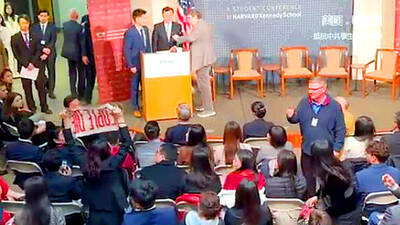
A group of Taiwanese-American and Tibetan-American students at Harvard University on Saturday disrupted Chinese Ambassador to the US Xie Feng’s (謝鋒) speech at the school, accusing him of being responsible for numerous human rights violations. Four students — two Taiwanese Americans and two from Tibet — held up banners inside a conference hall where Xie was delivering a speech at the opening ceremony of the Harvard Kennedy School China Conference 2024. In a video clip provided by the Coalition of Students Resisting the CCP (Chinese Communist Party), Taiwanese-American Cosette Wu (吳亭樺) and Tibetan-American Tsering Yangchen are seen holding banners that together read:

UNAWARE: Many people sit for long hours every day and eat unhealthy foods, putting them at greater risk of developing one of the ‘three highs,’ an expert said More than 30 percent of adults aged 40 or older who underwent a government-funded health exam were unaware they had at least one of the “three highs” — high blood pressure, high blood lipids or high blood sugar, the Health Promotion Administration (HPA) said yesterday. Among adults aged 40 or older who said they did not have any of the “three highs” before taking the health exam, more than 30 percent were found to have at least one of them, Adult Preventive Health Examination Service data from 2022 showed. People with long-term medical conditions such as hypertension or diabetes usually do not
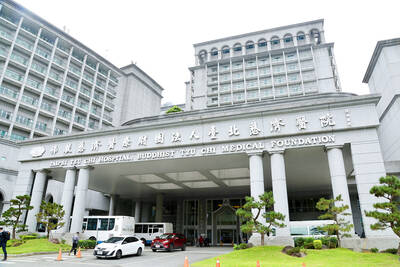
POLICE INVESTIGATING: A man said he quit his job as a nurse at Taipei Tzu Chi Hospital as he had been ‘disgusted’ by the behavior of his colleagues A man yesterday morning wrote online that he had witnessed nurses taking photographs and touching anesthetized patients inappropriately in Taipei Tzu Chi Hospital’s operating theaters. The man surnamed Huang (黃) wrote on the Professional Technology Temple bulletin board that during his six-month stint as a nurse at the hospital, he had seen nurses taking pictures of patients, including of their private parts, after they were anesthetized. Some nurses had also touched patients inappropriately and children were among those photographed, he said. Huang said this “disgusted” him “so much” that “he felt the need to reveal these unethical acts in the operating theater
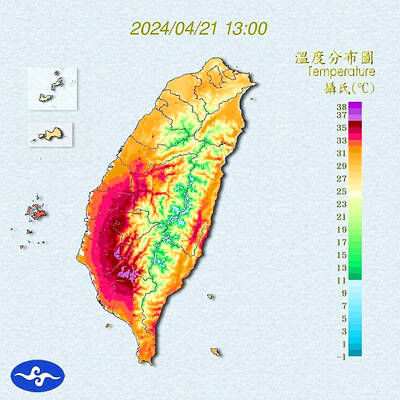
Heat advisories were in effect for nine administrative regions yesterday afternoon as warm southwesterly winds pushed temperatures above 38°C in parts of southern Taiwan, the Central Weather Administration (CWA) said. As of 3:30pm yesterday, Tainan’s Yujing District (玉井) had recorded the day’s highest temperature of 39.7°C, though the measurement will not be included in Taiwan’s official heat records since Yujing is an automatic rather than manually operated weather station, the CWA said. Highs recorded in other areas were 38.7°C in Kaohsiung’s Neimen District (內門), 38.2°C in Chiayi City and 38.1°C in Pingtung’s Sandimen Township (三地門), CWA data showed. The spell of scorching


 RSS
RSS