


Confronted with China's growing cultural and linguistic influence on the world stage amid a global Mandarin learning craze, the Ministry of Education yesterday said it was stepping up its efforts to train and certify more Chinese language instructors overseas.
Chang Chin-sheng (張欽勝), director of the education ministry's Bureau of International Cultural and Educational Relations, told the Taipei Times that his bureau was establishing a long-distance education curriculum to train Chinese-language instructors through Tamkang University and teacher training programs in the US.
"Yes, such programs are part of the government's attempt to capitalize on the popularity of Mandarin Chinese worldwide," Chang said, referring to a Chinese instructor certification test that his bureau unveiled last November.
The test, he added, would be administered in Thailand and Vietnam, as well as locally, this summer to accredit Mandarin teachers according to Taiwanese linguistic and cultural standards.
Asked if he was concerned about China's aggressive global deployment of Chinese language teachers, Chang said: "We're just going our own way; we don't care what China does."
A shortage of Chinese-language teachers in US elementary and junior high schools, Chang added, has created opportunities for Taiwanese who have US citizenship to fill in that gap and promote Mandarin as it is used in Taiwan.
Taipei and economic cultural offices (TECOs) in the US, Taiwan's de facto diplomatic missions, have already established Chinese-language teaching programs for Taiwanese in the US through their "cultural divisions," but demand for such programs is rising, said bureau official Chou Hui-yi (周慧宜), who directly oversees the programs.
Conducted in local schools, the programs not only train aspiring Chinese instructors but also help them to prepare for government-administered teacher certification tests, Chou said by phone yesterday.
They need not take and pass the ministry's own Chinese teacher certification exam because US state governments have their own certification methods, Chang said.
Los Angeles, which has a large population of Taiwanese Americans, is home to three such programs churning out Chinese instructors, while Washington and San Francisco have one each, Chou said, adding that the TECO "cultural divisions" funding the programs are staffed by education ministry officials.
The Tamkang University program, meanwhile, focuses on training overseas Taiwanese via the Internet to become Chinese-language teachers, Chang said.
The program will start in June, he said, and summer classes that can be attended in person will also be up and running by that time. Whether via long-distance education or classroom instruction, the Tamkang University program seeks to give overseas Taiwanese the necessary training for teaching Mandarin abroad, Chang added.
"The Tamkang and US programs are complementary," Chou said. "The former gives them the academic training they need, while the US programs help them to pass state government-administered teacher certification tests."
For more information on the Tamkang University program, go to www.dce.tku.edu.tw.
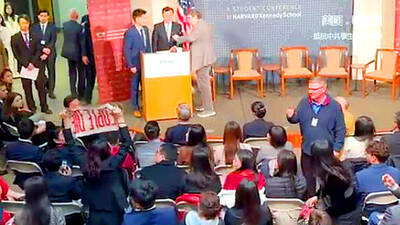
A group of Taiwanese-American and Tibetan-American students at Harvard University on Saturday disrupted Chinese Ambassador to the US Xie Feng’s (謝鋒) speech at the school, accusing him of being responsible for numerous human rights violations. Four students — two Taiwanese Americans and two from Tibet — held up banners inside a conference hall where Xie was delivering a speech at the opening ceremony of the Harvard Kennedy School China Conference 2024. In a video clip provided by the Coalition of Students Resisting the CCP (Chinese Communist Party), Taiwanese-American Cosette Wu (吳亭樺) and Tibetan-American Tsering Yangchen are seen holding banners that together read:

UNAWARE: Many people sit for long hours every day and eat unhealthy foods, putting them at greater risk of developing one of the ‘three highs,’ an expert said More than 30 percent of adults aged 40 or older who underwent a government-funded health exam were unaware they had at least one of the “three highs” — high blood pressure, high blood lipids or high blood sugar, the Health Promotion Administration (HPA) said yesterday. Among adults aged 40 or older who said they did not have any of the “three highs” before taking the health exam, more than 30 percent were found to have at least one of them, Adult Preventive Health Examination Service data from 2022 showed. People with long-term medical conditions such as hypertension or diabetes usually do not
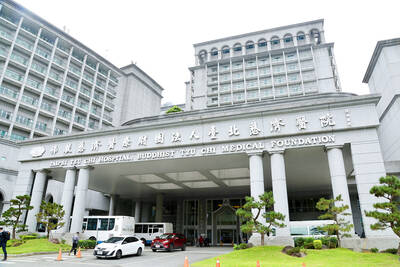
POLICE INVESTIGATING: A man said he quit his job as a nurse at Taipei Tzu Chi Hospital as he had been ‘disgusted’ by the behavior of his colleagues A man yesterday morning wrote online that he had witnessed nurses taking photographs and touching anesthetized patients inappropriately in Taipei Tzu Chi Hospital’s operating theaters. The man surnamed Huang (黃) wrote on the Professional Technology Temple bulletin board that during his six-month stint as a nurse at the hospital, he had seen nurses taking pictures of patients, including of their private parts, after they were anesthetized. Some nurses had also touched patients inappropriately and children were among those photographed, he said. Huang said this “disgusted” him “so much” that “he felt the need to reveal these unethical acts in the operating theater
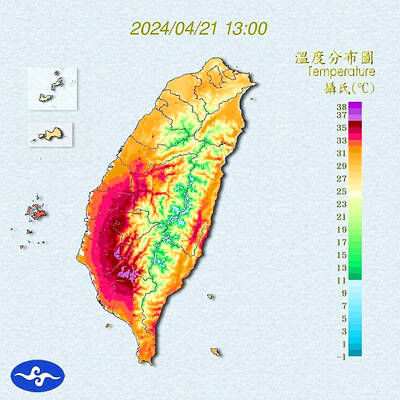
Heat advisories were in effect for nine administrative regions yesterday afternoon as warm southwesterly winds pushed temperatures above 38°C in parts of southern Taiwan, the Central Weather Administration (CWA) said. As of 3:30pm yesterday, Tainan’s Yujing District (玉井) had recorded the day’s highest temperature of 39.7°C, though the measurement will not be included in Taiwan’s official heat records since Yujing is an automatic rather than manually operated weather station, the CWA said. Highs recorded in other areas were 38.7°C in Kaohsiung’s Neimen District (內門), 38.2°C in Chiayi City and 38.1°C in Pingtung’s Sandimen Township (三地門), CWA data showed. The spell of scorching


 RSS
RSS