


Premier Su Tseng-chang (蘇貞昌) yesterday approved Government Information Office Minister Cheng Wen-tsang's (鄭文燦) resignation over accusations by the Fuji Television Network that he tried to influence a Japanese company's sale of shares in Taiwan Television Enterprise (TTV).
Su said he accepted Cheng's resignation after carefully reading the report of Vice Premier Tsai Ing-wen's (蔡英文) investigation into the issue.
"Although he did not intervene in the Japanese company's sale of shares, Cheng's participation in the lunch was inappropriate," said Su, referring to a lunch hosted by Cheng on Jan. 17 attended by Minister of Economic Affairs Steve Chen (陳瑞隆), Fuji official Sumio Hasegawa and Liberty Times Group (the parent company of the Taipei Times) officials.
Cheng came under attack from opposition lawmakers after Hasegawa last week claimed that Cheng and Chen had arranged the lunch to "suggest" Fuji Television Network transfer its TTV shares to the Liberty Times Group.
"It was difficult for me to make the decision to let him [Cheng] go but I have to," Su added.
Su also said he had nothing to do with the whole episode.
"I never told him [Cheng] to get involved in this [Fuji's selling of TTV shares,]" Su said. "I had no idea he was having such a lunch."
The key that led to the Cheng's resignation was Tsai's investigation report.
In it, Tsai said that although there was no element of personal interest involved, Cheng's behavior was "extremely inappropriate."
Although Cheng's involvement did not cause any damage or change Fuji's mind, he, as a Cabinet spokesman, should take responsibility because his behavior has seriously damaged the Cabinet's credibility after its promise that the government would not interfere with the media, the report said.
"All things can be distorted and politicized under particular political circumstances," Cheng said last night, adding that he resigned to reduce the burden on the Cabinet.
Cheng's post will be temporarily filled by Deputy GIO Minister William Yih (易榮宗).
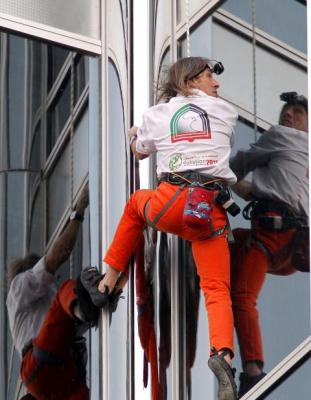
Alain Robert, known as the "French Spider-Man," praised Alex Honnold as exceptionally well-prepared after the US climber completed a free solo ascent of Taipei 101 yesterday. Robert said Honnold's ascent of the 508m-tall skyscraper in just more than one-and-a-half hours without using safety ropes or equipment was a remarkable achievement. "This is my life," he said in an interview conducted in French, adding that he liked the feeling of being "on the edge of danger." The 63-year-old Frenchman climbed Taipei 101 using ropes in December 2004, taking about four hours to reach the top. On a one-to-10 scale of difficulty, Robert said Taipei 101
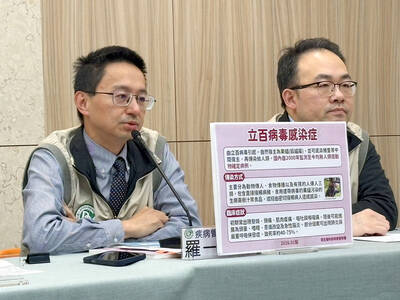
Nipah virus infection is to be officially listed as a category 5 notifiable infectious disease in Taiwan in March, while clinical treatment guidelines are being formulated, the Centers for Disease Control (CDC) said yesterday. With Nipah infections being reported in other countries and considering its relatively high fatality rate, the centers on Jan. 16 announced that it would be listed as a notifiable infectious disease to bolster the nation’s systematic early warning system and increase public awareness, the CDC said. Bangladesh reported four fatal cases last year in separate districts, with three linked to raw date palm sap consumption, CDC Epidemic Intelligence

Taiwanese and US defense groups are collaborating to introduce deployable, semi-autonomous manufacturing systems for drones and components in a boost to the nation’s supply chain resilience. Taiwan’s G-Tech Optroelectronics Corp subsidiary GTOC and the US’ Aerkomm Inc on Friday announced an agreement with fellow US-based Firestorm Lab to adopt the latter’s xCell, a technology featuring 3D printers fitted in 6.1m container units. The systems enable aerial platforms and parts to be produced in high volumes from dispersed nodes capable of rapid redeployment, to minimize the risk of enemy strikes and to meet field requirements, they said. Firestorm chief technology officer Ian Muceus said
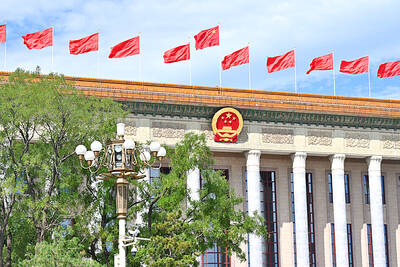
MORE FALL: An investigation into one of Xi’s key cronies, part of a broader ‘anti-corruption’ drive, indicates that he might have a deep distrust in the military, an expert said China’s latest military purge underscores systemic risks in its shift from collective leadership to sole rule under Chinese President Xi Jinping (習近平), and could disrupt its chain of command and military capabilities, a national security official said yesterday. If decisionmaking within the Chinese Communist Party has become “irrational” under one-man rule, the Taiwan Strait and the regional situation must be approached with extreme caution, given unforeseen risks, they added. The anonymous official made the remarks as China’s Central Military Commission Vice Chairman Zhang Youxia (張又俠) and Joint Staff Department Chief of Staff Liu Zhenli (劉振立) were reportedly being investigated for suspected “serious


 RSS
RSS