


The process of amending the Constitution should be made easier, a local think tank said yesterday, advocating a lowered legislative threshold as well as a public referendum on the issue.
The pro-independence Taiwan Thinktank yesterday published the second half of its draft "second republic" constitution, which covers the judicial system, powers of the central and local governments, fundamental national policies, welfare of Aborigines, constitutional amendments and implementation and transitional articles.
The draft was penned by Chen Ming-tong (
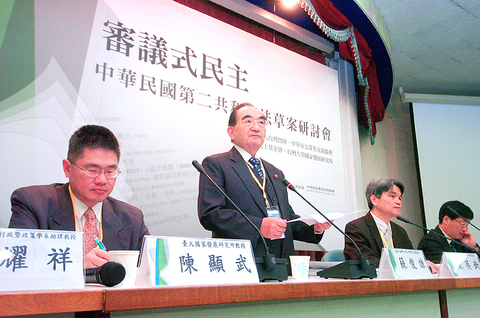
PHOTO: WANG MIN-WEI, TAIPEI TIMES
The project was inspired by former presidential adviser Koo Kwang-ming (辜寬敏), who has pushed for what he called a "second republic" constitution while leaving the document's details open to interpretation.
Koo's proposal elicited a response from President Chen Shui-bian (
Chen Ming-tong yesterday proposed procedures for constitutional revisions that would call upon direct democracy.
While constitutional amendments require the consent of three quarters of the legislators present and half the votes in a national referendum, the draft proposed to lower the legislative threshold to two thirds, pending a referendum.
The draft also proposed allowing the public to initiate constitutional amendments. At present, only legislators and the president can launch such revisions.
Clauses were also added to the draft to make a government transition from a semi-presidential system to a parliamentary system, as well as a five-branch government to a three-branch one, smoother.
If the "second republic" constitution were implemented next year, the draft would ban the next president from seeking a second term. Presidential powers would be highly reduced, but the term would be extended from four years to six years.
The premier appointed by the next president could hold on to the job until a new prime minister is chosen. The prime minister would be nominated by the president and would have to obtain the consent of half the legislators.
Chen In-chin, who wrote the chapter on the judicial system, proposed to establish a constitutional court to replace the Council of Grand Justices, which rules on the constitutionality of laws.
The draft states that half of the 15-member constitutional judges would be nominated by the prime minister every six years for a 12-year term. In order to appoint a nominee, two thirds of the legislators would have be present and two thirds of those present would have to approve the nomination.
To pass a ruling, two thirds of the judges would have to be present and half would have to agree.

Hong Kong singer Eason Chan’s (陳奕迅) concerts in Kaohsiung this weekend have been postponed after he was diagnosed with Covid-19 this morning, the organizer said today. Chan’s “FEAR and DREAMS” concert which was scheduled to be held in the coming three days at the Kaohsiung Arena would be rescheduled to May 29, 30 and 31, while the three shows scheduled over the next weekend, from May 23 to 25, would be held as usual, Universal Music said in a statement. Ticket holders can apply for a full refund or attend the postponed concerts with the same seating, the organizer said. Refund arrangements would

Taiwanese indie band Sunset Rollercoaster and South Korean outfit Hyukoh collectively received the most nominations at this year’s Golden Melody Awards, earning a total of seven nods from the jury on Wednesday. The bands collaborated on their 2024 album AAA, which received nominations for best band, best album producer, best album design and best vocal album recording. “Young Man,” a single from the album, earned nominations for song of the year and best music video, while another track, “Antenna,” also received a best music video nomination. Late Hong Kong-American singer Khalil Fong (方大同) was named the jury award winner for his 2024 album
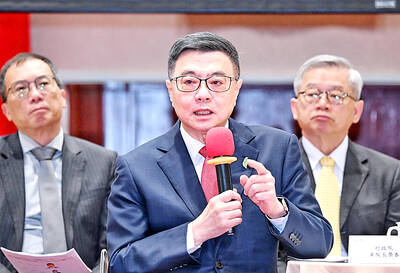
Premier Cho Jung-tai (卓榮泰) on Friday laid out the Cabinet’s updated policy agenda and recapped the government’s achievements ahead of the one-year anniversary of President William Lai’s (賴清德) inauguration. Cho said the government had made progress across a range of areas, including rebuilding Hualien, cracking down on fraud, improving pedestrian safety and promoting economic growth. “I hope the public will not have the impression that the Cabinet only asked the legislature to reconsider a bunch of legal amendments,” Cho said, calling the moves “necessary” to protect constitutional governance and the public’s interest. The Cabinet would work toward achieving its “1+7” plan, he said. The
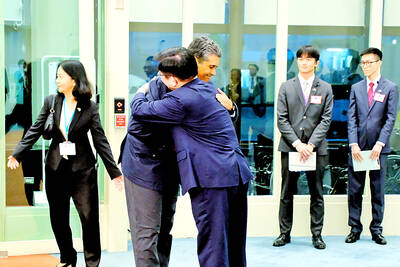
Palauan President Surangel Whipps Jr arrived in Taiwan last night to kick off his first visit to the country since beginning his second term earlier this year. After arriving at Taoyuan International Airport at around 6:30 pm, Whipps and his delegation were welcomed by Minister of Foreign Affairs Lin Chia-lung (林佳龍). Speaking to gathered media, the Palauan leader said he was excited and honored to be back in Taiwan on his first state visit to Taiwan since he was sworn in this January. Among those traveling with Whipps is Minister of State Gustav N. Aitaro, Public Infrastructure


 RSS
RSS