


Facing dissatisfaction from Kaohsiung City Council, Kaohsiung Mayor Chen Chu (陳菊) yesterday said she would shoulder responsibility for the Kaohsiung City Government's removal of dictator Chiang Kai-shek's (蔣介石) statue from the culture center last Tuesday night.
Chen made the remarks when approached by reporters yesterday for comments on the Kaohsiung City Council's complaints.
"If the councilors would like to blame someone, all city government officials can say it was the mayor's decision [to remove the statue]," said Chen, who is a member of the Democratic Progressive Party (DPP).
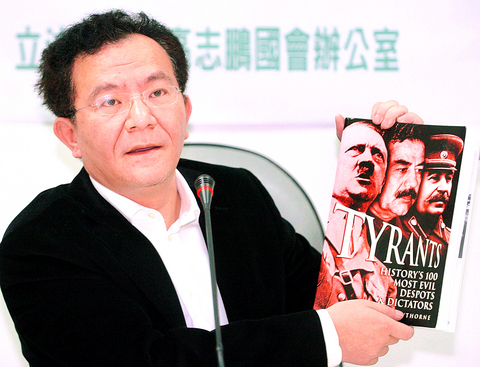
PHOTO: FANG PIN-CHAO, TAIPEI TIMES
The city council decided on Monday to convene an impromptu session next Monday and Tuesday to look into whether the city government violated regulations by removing the statues.
The city government will be required to tell the council how it executed the removal, which came after the city government passed a draft bill last Tuesday morning allowing it to rename the city's Chiang Kai-shek Culture Center and remove symbols of Chiang.
The statue was taken apart and shipped in 79 pieces to the Chiang Kai-shek Statue Park in Tashi (
Kaohsiung City Council Speaker Chuang Chi-wang (
Chen yesterday said she was hoping to explain the decision-making process to the council, because it was difficult to deal with historical legacy.
In related news, DPP Legislator Gao Jyh-peng (
Gao presented an English-language book, Tyrants: History's 100 Most Evil Despots & Dictators, published in 2004, and said that Chiang was listed in the book along with Fascist dictators Benito Mussolini of Italy and Adolf Hitler of Germany.
Gao said this demonstrated that "from the perspective of foreign academics, Chiang, Mussolini and Hitler were equally cruel."
"Academics do not have any personal bias when doing research on history. This therefore shows that Chiang was purely and simply a despot," Gao said.
The book was written by Nigel Cawthorne, a long-time writer and editor with a bachelor's degree in physics from the University College, London.
Other despots listed in the book are Alexander the Great and Peter the Great of Russia.
Cawthorne's resume on his official Web site says his writing topics range widely and include skiing, computing, finance, fashion, sex, war and politics.
Cawthorne writes, however: "I am certainly most famous for my Sex Lives series."
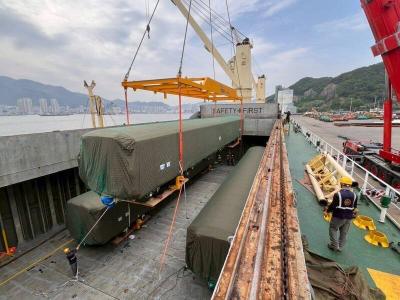
The first of 10 new high-capacity trains purchased from South Korea’s Hyundai Rotem arrived at the Port of Taipei yesterday to meet the demands of an expanding metro network, Taipei Rapid Transit Corp (TRTC) said yesterday. The train completed a three-day, 1,200km voyage from the Port of Masan in South Korea, the company said. Costing NT$590 million (US$18.79 million) each, the new six-carriage trains feature a redesigned interior based on "human-centric" transportation concepts, TRTC said. The design utilizes continuous longitudinal seating to widen the aisles and optimize passenger flow, while also upgrading passenger information displays and driving control systems for a more comfortable
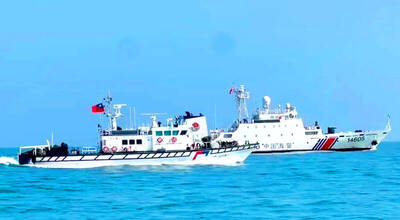
Instead of focusing solely on the threat of a full-scale military invasion, the US and its allies must prepare for a potential Chinese “quarantine” of Taiwan enforced through customs inspections, Stanford University Hoover fellow Eyck Freymann said in a Foreign Affairs article published on Wednesday. China could use various “gray zone” tactics in “reconfiguring the regional and ultimately the global economic order without a war,” said Freymann, who is also a nonresident research fellow at the US Naval War College. China might seize control of Taiwan’s links to the outside world by requiring all flights and ships entering or leaving Taiwan
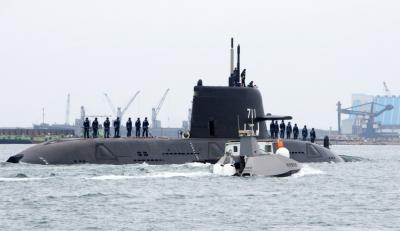
Taiwan's first indigenous defense submarine, the SS-711 Hai Kun (海鯤, or Narwhal), departed for its 13th sea trial at 7am today, marking its seventh submerged test, with delivery to the navy scheduled for July. The outing also marked its first sea deployment since President William Lai (賴清德) boarded the submarine for an inspection on March 19, drawing a crowd of military enthusiasts who gathered to show support. The submarine this morning departed port accompanied by CSBC Corp’s Endeavor Manta (奮進魔鬼魚號) uncrewed surface vessel and a navy M109 assault boat. Amid public interest in key milestones such as torpedo-launching operations and overnight submerged trials,
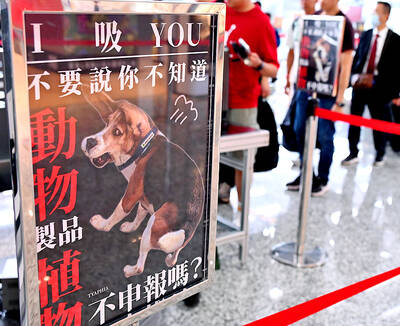
Quarantine awareness posters at Taiwan Taoyuan International Airport have gone viral for their use of wordplay. Issued by the airport branch of the Animal and Plant Health Inspection Agency, the posters feature sniffer dogs making a range of facial expressions, paired with advisory messages built around homophones. “We update the messages for holidays and campaign needs, periodically refreshing materials to attract people’s attention,” quarantine officials said. “The aim is to use the dogs’ appeal to draw focus to quarantine regulations.” A Japanese traveler visiting Taiwan has posted a photo on X of a poster showing a quarantine dog with a


 RSS
RSS