


South Korean Sara Choi wasn't planning to stay in Taiwan when she came to study Mandarin years ago, but her love for cats and frustration about the treatment of stray cats here eventually led her to settle down in Taipei and launch a campaign to help them.
At first she took in stray cats she found in her neighborhood, some of which had never lived with humans.
Eventually, she came upon the idea of founding the Taipei Feral Cat Protection Association last year and was happy when the Taipei City Government recently started handling the stray cat issue through the Trap-Neuter-Release (TNR) method.
TNR, which has been promoted as a humane alternative to euthanasia for managing and reducing stray cat populations in other countries, was introduced to Taiwan a couple of years ago by animal rights groups, and the city government initiated a trial TNR program last year in Da-an District with the help of Meetpets.com, a Web site dedicated to building a network for helping stray animals.
Instead of capturing stray cats and impounding them, the city government now traps and neuters them and returns them to where they were found.
Yen I-feng (
After a successful trial at Ching-an and Hsinlung boroughs in Daan District last year, the city government is expanding the experiment to six more boroughs in Wenshan, Daan, Lungyuan and Shilin districts this year with a goal of neutering 200 stray cats.
More than 12,500 stray cats currently roam the streets of Taipei City, and the number exceeds the estimated 4,000 stray dogs on the city's streets, according to the institute.
The boroughs chosen by the institute suffered from serious stray cat problems, Yen said.
"The TNR approach has proven effective for controlling the number of stray cats successfully. Stray cats pose no threat to the general public. In fact, they can benefit a neighborhood by decreasing the number of rats," he added.
Although many residents have been cooperating with the TNR method, Yen said that many borough chiefs had declined to join the trial project and attributed this to the idea being a new concept.
With a budget of NT$950,000 this year for the TNR project, the city government will focus its efforts on training volunteers, informing residents about the program and inviting veterans to join, Yen said.
"Most importantly, we don't want our good motives to inadvertently upset people. We need to educate volunteers to feed stray cats with only cat food and clean up, so that residents can tolerate stray cats in their neighborhoods," he added.
While agreeing to cooperate with the city government on the TNR project, borough chief of Hsinchang Borough Chang Hsiao-yuan (
It would be easier to promote the TNR method if the city government provided some subsidies for volunteers to encourage their hard work, Chang said.
Choi, whose association has neutered hundreds of cats and aims at finding homes for part of them, lauded the city government for adopting the approach, noting that the TNR method had become an international trend.
"The TNR concept is a humane method to control the number of stray cats while respecting their lives. People in Taiwan tend to either spoil their pets or else hate animals. They should learn that the best way to treat animals is to respect them and live with them peacefully," she said.
While continuing to expand the TNR project, Yen said the institute was planning to adopt the approach to solve the stray dog issue.
Because stray dogs are more likely to attack people after being released, Yen said the institute might initiate a TNR trial involving training dogs as neighborhood watch dogs and releasing them in closed communities first.

FUKUOKA SITUATION: Japanese media reported that the pathogen is expected to be identified by the summer, while the CDC downplayed the idea that it was hMPV A “mysterious cold-like illness” reported in Japan’s Fukuoka Prefecture does not seem to be a new disease, but Japanese authorities have been asked about the situation, the Centers for Disease Control (CDC) said yesterday. The Fukuoka Prefectural Medical Association on Wednesday told a news conference that a “mystery cold” that has become a hot topic on social media is “highly likely to be caused by some kind of viral infection,” Japan’s KBC News reported. “Many people are experiencing symptoms starting with a sore throat, followed by a runny nose, phlegm and a severe cough,” KBC News reported, citing association officials. Health authorities are

Nvidia Corp CEO Jensen Huang (黃仁勳) arrived in Taiwan yesterday ahead of upcoming AI and technology events, saying he plans to meet with clients and Taiwan Semiconductor Manufacturing Co Chairman C.C. Wei (魏哲家) during his visit. After landing at Taipei Songshan Airport, Huang posed for photos with fans and handed out Yakult drinks to reporters and supporters waiting at the scene, saying he has “a lot to do” during the trip. Asked about reports that Nvidia’s planned headquarters site in Taipei’s Beitou Shilin Technology Park could break ground on May 27, Huang said that if the company holds an event, he would

The Ministry of Finance this afternoon announced the winning numbers for the March-April uniform invoice lottery. The winning number for the NT$10 million (US$318,060) special prize is 19531471, and the winning number for the NT$2 million grand prize is 85941329. Three numbers were drawn for the NT$200,000 first prize: 07225810, 20231230 and 83518781. Those with receipts matching the last seven digits of any of the first-prize numbers will win the NT$40,000 second prize, while those matching the last six digits will win the NT$10,000 third prize. Those whose receipts match the last five digits of the first-prize numbers can claim the NT$4,000 fourth prize,
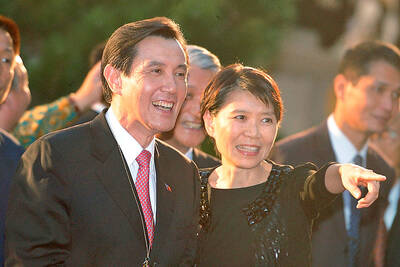
Former president Ma Ying-jeou (馬英九) yesterday expressed “shock and regret” over a statement issued by his wife without his consent, and rejected her assertion that his eldest sister, Ma Yi-nan (馬以南), would manage his medical care or act as his spokesperson amid an ongoing embezzlement probe into his foundation. Ma Ying-jeou in a statement said he was shocked by a statement by his wife, Chou Mei-ching (周美青), regarding his affairs. Ma Yi-nan “must not” be in charge of his healthcare and other personal affairs, nor can she be allowed to represent the Ma family, the former president said. He said he was also


 RSS
RSS