


Despite his controversial remark that "someone in a skirt would not make a good commander-in-chief," former presidential adviser Koo Kwang-ming (
Koo said his comment was made on the basis of China's military threat and possibility of military confrontations.
"But there won't be a war in the Taiwan Strait," Koo said, "because China wouldn't want to drive away foreign investors and risk an economic collapse."
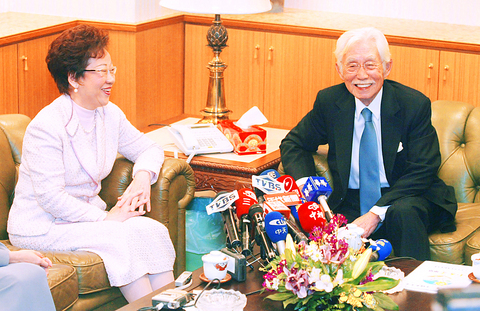
PHOTO: CNA
In the worst-case scenario, Koo said: "I would welcome [a war]."
"Taiwan's biggest crisis is the lack of a national consensus on the nation's future despite the military threat from China," he said. "But if China were to launch a military attack against Taiwan, a consensus would be formed within a week."
Koo made the remarks while meeting with Lu at his office in Taipei yesterday morning.
Denying his notorious remark was targeted at Lu and that he had changed his tune, Koo said he admired Lu's determination to run for president.
"She is a very special woman," he said. "It is not easy to be consistent all these years and I wish her all the best."
If all the female voters supported her, Lu would easily be elected, Koo said, adding that if Taiwan had a female president, he believed there would be a "big change" in the nation's politics.
Koo said he expected future national leaders to be strong-minded, reliable and capable of responding in time of crisis.
Dressed formally in a pink top and skirt, Lu joked she should probably have worn trousers.
She said she did not visit Koo to discuss her presidential bid, but rather to raise funds for an after-school educational program she initiated.
Lu, however, complimented herself as the first female politician to advocate the twin concepts of "connecting with the international community" and "preventive diplomacy."
"Taiwan's democracy is the best line of defense," she said. "That's what I call preventive diplomacy.'"
Hailing herself as an "all-round" national leader, Lu criticized her male contenders for hiring specialists to map out their election platforms, while she came up with her own.
Lu is competing with former premier Frank Hsieh (
Meanwhile, Hsieh yesterday visited a pro-independence group and promised to participate in the TV debate being organized by the group on March 24.
Saying that politicians must accept constant challenges, Hsieh said he accepted the invitation right after the organization announced its plan and before the DPP decided to hold one of its own.
While the party's presidential hopefuls are obliged to attend debates organized by the party, they should also take advantage of other events hosted by other institutions to publicize their position.
Hsieh said President Chen Shui-bian (
In a separate setting yesterday, Su said the party primary would not be necessary if the president's attempts to mediate a solution succeeded.
After a second round of mediation between Chen and the four presidential hopefuls on Tuesday night, the four agreed to hold negotiations to select the party's presidential candidate, vowing that they would neither withdraw from the DPP nor run on their own if they did not secure the party's nomination.
Additional reporting by Jimmy Chuang

Yangmingshan National Park authorities yesterday urged visitors to respect public spaces and obey the law after a couple was caught on a camera livestream having sex at the park’s Qingtiangang (擎天崗) earlier in the day. The Shilin Police Precinct in Taipei said it has identified a suspect and his vehicle registration number, and would summon him for questioning. The case would be handled in accordance with public indecency charges, it added. The couple entered the park at about 11pm on Thursday and began fooling around by 1am yesterday, the police said, adding that the two were unaware of the park’s all-day live

Fast food chain McDonald's is to raise prices by up to NT$5 on some products at its restaurants across Taiwan, starting on Wednesday next week, the company announced today. The prices of all extra value meals and sharing boxes are to increase by NT$5, while breakfast combos and creamy corn soup would go up by NT$3, the company said in a statement. The price of the main items of those meals, if ordered individually, would remain the same. Meanwhile, the price of a medium-sized lemon iced tea and hot cappuccino would rise by NT$3, extra dipping sauces for chicken nuggets would go up
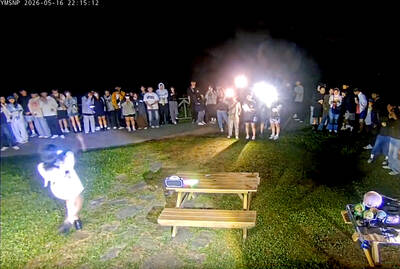
Yangmingshan National Park’s Qingtiangang (擎天崗) nature area has gone viral after a park livestream camera observed a couple in the throes of intimate congress, which was broadcast live on YouTube, drawing large late-night crowds and sparking a backlash over noise, bright lights and disruption to wildlife habitat. The area’s livestream footage appeared to show a couple engaging in sexual activity on a picnic table in the park on Friday last week, with the uncensored footage streamed publicly online. The footage quickly spread across social media, prompting a tide of visitors to travel to the site to “check in” and recreate the

Minister of Digital Affairs Lin Yi-ching (林宜敬) yesterday cited regulatory issues and national security concerns as an expert said that Taiwan is among the few Asian regions without Starlink. Lin made the remarks on Facebook after funP Innovation Group chief executive officer Nathan Chiu (邱繼弘) on Friday said Taiwan and four other countries in Asia — China, North Korea, Afghanistan and Syria — have no access to Starlink. Starlink has become available in 166 countries worldwide, including Ukraine, Malaysia, the Philippines and Vietnam, in the six years since it became commercial, he said. While China and North Korea block Starlink, Syria is not


 RSS
RSS