


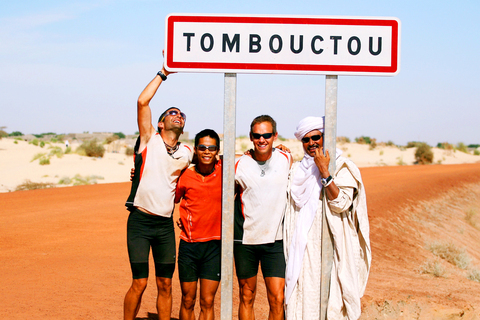
A once ordinary young man from Taipei has become the nation's new hero after completing the first coast-to-coast run across the Sahara in history.
Together with American Charlie Engle and Canadian Ray Zahab, Taiwanese ultramarathon runner Kevin Lin (
The adventure began last November on Africa's Atlantic coast and finished on Feb. 20 as the three runners reached Egypt's Red Sea coast.
PHOTOS COURTESY OF KEVIN LIN
Lin shared his story with the Taipei Times during an interview on Friday.
"I grew up like any other ordinary child in Taipei," Lin said.
Before moving to Taipei, Lin's parents were farmers in Yunlin County, he said.
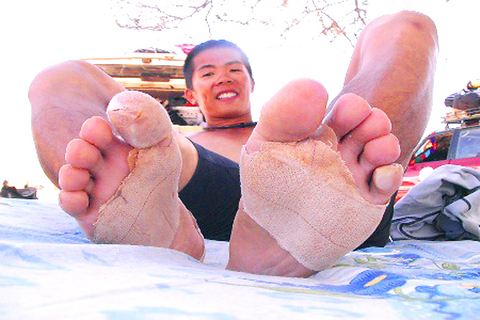
A handshake with former Olympic medalist Chi Cheng (
"Chi Cheng was everyone's heroine at the time, and on one occasion, I was able to shake her hand," Lin said. "I was like, wow, it would be great if I could run like her one day."
He did not forget his dream. Lin received basic athletic training by participating in extracurricular activities throughout his elementary and junior high school years. He then attended a high school known for its athletic programs.
"I met Coach Pan there," Lin said. "He is the most important person in my life."
"Kevin didn't run very fast, but endurance was his particular strength," said Pan Jui-ken (潘瑞根), who accompanied his star to the interview.
As soon as Pan discovered Lin's strength, he put Lin through formal training and gave him full support.
"Coach Pan made me a real athlete," Lin said.
After completing studies at Taipei Physical Education College, Lin worked at various jobs, including as a teacher and a contract athlete for a sports marketing firm.
Finally, Lin had an opportunity to run in a marathon in 1998.
"It was a 100km ultra-marathon race hosted by Road Running Association. Originally I signed up just for fun," Lin said.
"But unexpectedly, I found myself actually interested in the sport," he said.
"So I continued. After the 100km in Taiwan, I ran a 24-hour marathon in Taiwan and moved on to a 24-hour marathon overseas. Then I completed the so-called `king of marathons' -- Marathon des Sables," he said.
Marathon des Sables -- an annnual race across the Moroccan Sahara -- means "marathon of the sands" in French. Lin took the challenge in 2002.
"I finished in 12th place, which was the best record ever by a runner from Asia," he said, with a proud smile on his face.
"I really have no idea how I did it," he said.
After demonstrating what he could accomplish, Lin became more convinced he should keep running. However, as his career in ultra-marathon began to take off, his relationship with his parents became troubled.
"Who would want their child to become a runner? It's impossible," he said.
His parents, like all others, wanted him to succeed in school and become a "useful person." They did not consider athletics an option.
"But I liked sports, it's my passion, it's my life," Lin said.
He decided to follow his own heart and prove to his parents that his choice was a justified one.
"I decided to go my own way to prove that I wasn't doing anything bad," he said.
In 2003 he ran across the Gobi Desert in China. In 2004 he won first place in an ultramarathon across the Atacama Desert in Chile. The same year he also ran across the Amazon rainforest. The following year, he finished in second place in a run across the Egyptian Sahara. Last year, he took on another challenge and ran across Antarctica.
His accomplishments finally brought him back into contact with his family.
"For six or seven years, I was completely out of touch with my family," he said. "But after seeing all my accomplishments, my parents realized that I wasn't doing something bad."
"Especially when my father saw that I brought a positive force to society by inspiring many young people to pursue their dreams," he said.
Last November Lin took on the greatest challenge of his life -- the coast-to-coast cross-Sahara run.
The run was recorded by a documentary team funded by Hollywood stars Matt Damon and Ben Affleck. The documentary, entitled Running the Sahara, will be shown at the Toronto Film Festival in September.
To Lin, the Sahara run was an adventure.
"It's different from other marathons. It's not a race, it's an adventure," Lin said.
The only thing he had in mind before and during the run was "keep running, finish it."
"I didn't expect anything or have other thoughts, because during an adventure, there's too much uncertainty," Lin said.
"We weren't even sure if we could finish it when we started," he added.
It was more than a physical challenge. The climate in the Sahara was challenging.
"You could be running in the extreme hot sun, in heavy rain and in strong wind in the space of two hours," Lin said.
The Sahara is a challenge psychologically.
"It's really lonely and painful to run without knowing where the end is," Lin said. "We first planned to run 6,000 km in 80 days ... but we ended up running 7,500km in 111 days."
Lin had his first emotional breakdown when he called Pan for the first time from the Sahara 11 days into the journey.
"Coach told me, `there's still a long way, keep going,' and I cried," Lin said.
Politics was a main reason behind delays and detours in the trip.
"We had to take detours that added hundreds of kilometers to the trip to avoid going into landmine zones," Lin said.
Landmines exploded as an expedition checked the routes for the Sahara run, killing three and severely wounding another, Lin said.
To guarantee security for the three runners and the documentary team, they were escorted by different security teams composed of local militiamen.
The greatest political obstacle was when the three runners and the documentary team received the news that Libya refused to issue them visas, Lin said. At the time, the team was in Agadez, Niger, the midpoint of the trip, and the team had planned to enter Libya seven days later.
"They [the Libyians] said they didn't want Americans in their country. Well, that was impossible because most of the team was composed of Americans," Lin said.
After trying everything possible, "we finally asked Libyan President [Muammar] Qaddafi for help," Lin said.
Some members of the team had connections with Qaddafi's family members, Lin explained.
"So finally, with a phone call from Qaddafi himself, we were granted entry into Libya," Lin said.
The three runners were welcomed by Lin's supporters from Taiwan at the Egyptian border. A few days later, the three runners reached the Red Sea coast.
"It was great to sleep in my own bed," Lin said, describing how he felt after he returned from Egypt.
So what does Lin plan to do after having conquered the Sahara?
"I'll finish my master's degree, which should be completed in May," he said. "Then I'll apply for a doctoral program in the US."
He plans to apply to Harvard,Yale, Standford and the University of California at Berkley.
"As for my next marathon, it will be to the North Pole," he said. "In 2008, I'm planning to start from the edge of the Arctic Circle in Scandinavia and run to the geographic North Pole."
Lin will depart for Canada on March 14 to begin training for next year's adventure
"I'll also start training new people for the sport," Lin said. "Right now I already have an ideal candidate in mind, but I'm not ready to make his name public yet."

A group of Taiwanese-American and Tibetan-American students at Harvard University on Saturday disrupted Chinese Ambassador to the US Xie Feng’s (謝鋒) speech at the school, accusing him of being responsible for numerous human rights violations. Four students — two Taiwanese Americans and two from Tibet — held up banners inside a conference hall where Xie was delivering a speech at the opening ceremony of the Harvard Kennedy School China Conference 2024. In a video clip provided by the Coalition of Students Resisting the CCP (Chinese Communist Party), Taiwanese-American Cosette Wu (吳亭樺) and Tibetan-American Tsering Yangchen are seen holding banners that together read:

UNAWARE: Many people sit for long hours every day and eat unhealthy foods, putting them at greater risk of developing one of the ‘three highs,’ an expert said More than 30 percent of adults aged 40 or older who underwent a government-funded health exam were unaware they had at least one of the “three highs” — high blood pressure, high blood lipids or high blood sugar, the Health Promotion Administration (HPA) said yesterday. Among adults aged 40 or older who said they did not have any of the “three highs” before taking the health exam, more than 30 percent were found to have at least one of them, Adult Preventive Health Examination Service data from 2022 showed. People with long-term medical conditions such as hypertension or diabetes usually do not

POLICE INVESTIGATING: A man said he quit his job as a nurse at Taipei Tzu Chi Hospital as he had been ‘disgusted’ by the behavior of his colleagues A man yesterday morning wrote online that he had witnessed nurses taking photographs and touching anesthetized patients inappropriately in Taipei Tzu Chi Hospital’s operating theaters. The man surnamed Huang (黃) wrote on the Professional Technology Temple bulletin board that during his six-month stint as a nurse at the hospital, he had seen nurses taking pictures of patients, including of their private parts, after they were anesthetized. Some nurses had also touched patients inappropriately and children were among those photographed, he said. Huang said this “disgusted” him “so much” that “he felt the need to reveal these unethical acts in the operating theater
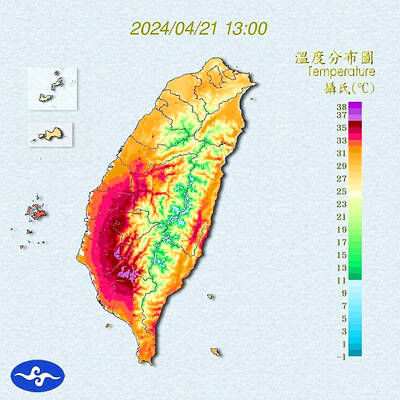
Heat advisories were in effect for nine administrative regions yesterday afternoon as warm southwesterly winds pushed temperatures above 38°C in parts of southern Taiwan, the Central Weather Administration (CWA) said. As of 3:30pm yesterday, Tainan’s Yujing District (玉井) had recorded the day’s highest temperature of 39.7°C, though the measurement will not be included in Taiwan’s official heat records since Yujing is an automatic rather than manually operated weather station, the CWA said. Highs recorded in other areas were 38.7°C in Kaohsiung’s Neimen District (內門), 38.2°C in Chiayi City and 38.1°C in Pingtung’s Sandimen Township (三地門), CWA data showed. The spell of scorching


 RSS
RSS