


Women weighing the pros and cons of hormone replacement therapy (HRT) now have one additional factor to consider -- a new generation of HRT treatments containing drospirenone are touted as beneficial for lowering the blood pressure of hypertensive post-menopausal women.
Santiago Palacios, the director of the Palacios Institute of Women's Health, said drospirenone is a Progestogen with Aldosterone Receptor Antagonism (PARA).
"The PARA effect is what differentiates drospirenone from other progestines," Palacios said.
Progestines are chemicals that mimic the action of the hormone progesterone. Drospirenone's property as an aldosterone-receptor agonist also means that it does not cause patients to retain water like previous HRT treatments, Palacios said, speaking at a Taipei press conference yesterday, sponsored by Bayer.
Bayer is the manufacturer of a drospirenone-containing HRT treatment that will be launched in Taiwan later this month.
Not available
According to John Wheatley, a strategic business unit manager with Schering Taiwan, the low price ceiling for HRT drugs offered by Taiwan's National Health Insurance (NHI) means that the new drospirenone-containing HRT drug will not be available on Taiwan's NHI.
"We didn't even consider it, the price for that whole group is too low," Wheatley said. "If we did not introduce it on a a self-pay basis we would not be introducing it to this market at all."
HRT use declined worldwide, including in Taiwan, when a Women's Health Initiative study found that HRT did not lower the risk for coronary heart disease but did cause a 26 percent increase in breast cancer and a 41 percent increase in strokes.
"The WHI study definitely had a big impact in Taiwan," said Horng Shiow-shiun (
Horng said the latest study of over 6,000 older Taiwanese women conducted by the bureau in 2005 showed that only 14.4 percent of women suffering from menopausal and post-menopausal symptoms are taking HRT, a decrease from the previous study.
Perspective
"There is a downside for every drug," said Hsu Ming-I (許明義), the director of the division of reproductive medicine at Wangfang Hospital. "But the important thing is to look at the dangers in perspective."
"To replace HRT, a woman might have to take multiple drugs -- painkillers, anti-depressants, sleep medications -- each with their own side effects," Hsu said.
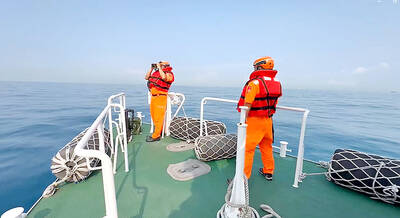
An increase in Taiwanese boats using China-made automatic identification systems (AIS) could confuse coast guards patrolling waters off Taiwan’s southwest coast and become a loophole in the national security system, sources familiar with the matter said yesterday. Taiwan ADIZ, a Facebook page created by enthusiasts who monitor Chinese military activities in airspace and waters off Taiwan’s southwest coast, on Saturday identified what seemed to be a Chinese cargo container ship near Penghu County. The Coast Guard Administration went to the location after receiving the tip and found that it was a Taiwanese yacht, which had a Chinese AIS installed. Similar instances had also

GOOD DIPLOMACY: The KMT has maintained close contact with representative offices in Taiwan and had extended an invitation to Russia as well, the KMT said The Chinese Nationalist Party (KMT) would “appropriately handle” the fallout from an invitation it had extended to Russia’s representative to Taipei to attend its international banquet last month, KMT Chairman Eric Chu (朱立倫) said yesterday. US and EU representatives in Taiwan boycotted the event, and only later agreed to attend after the KMT rescinded its invitation to the Russian representative. The KMT has maintained long-term close contact with all representative offices and embassies in Taiwan, and had extended the invitation as a practice of good diplomacy, Chu said. “Some EU countries have expressed their opinions of Russia, and the KMT respects that,” he

VIGILANCE: The military is paying close attention to actions that might damage peace and stability in the region, the deputy minister of national defense said The People’s Republic of China (PRC) might consider initiating a hack on Taiwanese networks on May 20, the day of the inauguration ceremony of president-elect William Lai (賴清德), sources familiar with cross-strait issues said. While US Secretary of State Anthony Blinken’s statement of the US expectation “that all sides will conduct themselves with restraint and prudence in the period ahead” would prevent military actions by China, Beijing could still try to sabotage Taiwan’s inauguration ceremony, the source said. China might gain access to the video screens outside of the Presidential Office Building and display embarrassing messages from Beijing, such as congratulating Lai
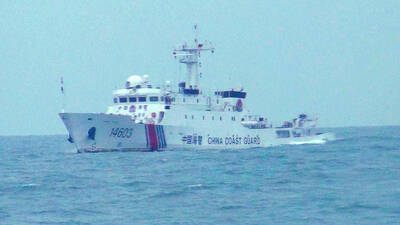
Four China Coast Guard ships briefly sailed through prohibited waters near Kinmen County, Taipei said, urging Beijing to stop actions that endanger navigation safety. The Chinese ships entered waters south of Kinmen, 5km from the Chinese city of Xiamen, at about 3:30pm on Monday, the Coast Guard Administration said in a statement later the same day. The ships “sailed out of our prohibited and restricted waters” about an hour later, the agency said, urging Beijing to immediately stop “behavior that endangers navigation safety.” Ministry of National Defense spokesman Sun Li-fang (孫立方) yesterday told reporters that Taiwan would boost support to the Coast Guard


 RSS
RSS