


Taiwan's current battles against political corruption will benefit the country in the future, an official from Transparency International (TI) said.
Liao Ran, the program coordinator for Transparency International Asia Pacific who helped establish Taiwan's chapter of the international non-governmental organization, TI-Taiwan, in September 2002, has been monitoring the country for years.
The Taipei Times interviewed Liao when he was in Taipei from Berlin to attend a recent conference on fighting corruption.
Liao said TI-Taiwan has become one of the most active chapters among the more than 160 TI chapters.
He said he was opposed to President Chen Shui-bian (
"The TI sees presidential immunity as a backward law and a relic from the days of kings, and is launching a campaign to persuade nations to drop it," Liao said.
He criticized British Prime Minister Tony Blair for recently asking the UK's judicial system to stop a criminal investigation into alleged corruption by an arms company that is suspected to have bribed Saudi officials.
Blair claimed the probe would endanger Britain's security if allowed to continue, Liao said.
However, Liao said such actions allow corruption to flourish and jeopardize democracy.
He said bureaucratic corruption in this country has been reduced, but political corruption remains serious.
"The democratization of the country has helped it to clean up bureaucratic corruption and it will help eliminate political corruption in the future," he said.
He said, however, that it is not democracy itself, but the establishment of an anti-corruption system under democracy, that is crucial to the elimination of corruption.
Liao also praised the recent empowerment of the nation's top prosecutor to form and lead a special investigative team probing allegations of wrongdoing involving high-ranking government officials.
He said he was impressed by Taiwan's prosecutorial system's determination to fight political corruption.
"Although a crackdown would affect perceptions of corruption both at home and abroad, it would be advantageous to the country in the long run," he said.
Asked to comment on last December's mayoral polls in Taipei and Kaohsiung, which saw the Democratic Progressive Party's best performance since the 2004 presidential election despite a series of high-profile scandals, Liao said corruption is only one factor that can influence elections, along with political parties' policies and performance.
For instance, he said, although US president Bill Clinton was allegedly involved in the Whitewater scandal and other scandal, he easily won a second term.
However, Liao warned that Taiwan's court system is ineffective, which hampers prosecutors' efforts to stamp out crime.
"Corrupt officials and white-collar criminals do not go to jail [for years] because of delayed or prolonged trials, or they flee the country during the trial," he said.
Taiwanese legislators came in last place -- 20th -- in terms of integrity, according to a recent TI-Taiwan survey.
Last November TI-Taiwan published its Corruption Perception Index (CPI) for last year, drawing on 16 polls and surveys from 10 independent institutions. Taiwan was ranked No. 34 out of 163 countries in the index, making it a "middle integrity" country.
Liao said Taiwan should continue to battle its serious vote-buying problem, which has affected the integrity of elected officials.
He noted that among Taiwan's neighbors, South Korea and the Philippines had also suffered from vote-buying problems and related side effects.
TI is an organization devoted to combating corruption by bringing civil society, business and governments together, Liao said.
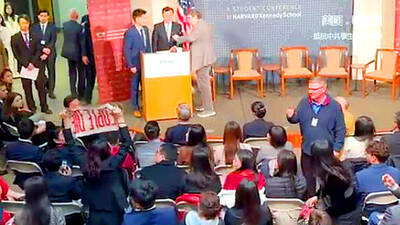
A group of Taiwanese-American and Tibetan-American students at Harvard University on Saturday disrupted Chinese Ambassador to the US Xie Feng’s (謝鋒) speech at the school, accusing him of being responsible for numerous human rights violations. Four students — two Taiwanese Americans and two from Tibet — held up banners inside a conference hall where Xie was delivering a speech at the opening ceremony of the Harvard Kennedy School China Conference 2024. In a video clip provided by the Coalition of Students Resisting the CCP (Chinese Communist Party), Taiwanese-American Cosette Wu (吳亭樺) and Tibetan-American Tsering Yangchen are seen holding banners that together read:

UNAWARE: Many people sit for long hours every day and eat unhealthy foods, putting them at greater risk of developing one of the ‘three highs,’ an expert said More than 30 percent of adults aged 40 or older who underwent a government-funded health exam were unaware they had at least one of the “three highs” — high blood pressure, high blood lipids or high blood sugar, the Health Promotion Administration (HPA) said yesterday. Among adults aged 40 or older who said they did not have any of the “three highs” before taking the health exam, more than 30 percent were found to have at least one of them, Adult Preventive Health Examination Service data from 2022 showed. People with long-term medical conditions such as hypertension or diabetes usually do not
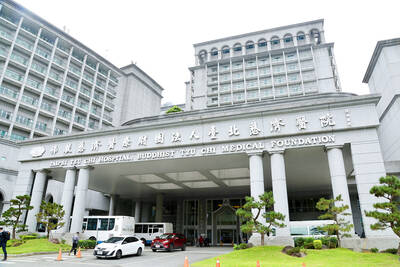
POLICE INVESTIGATING: A man said he quit his job as a nurse at Taipei Tzu Chi Hospital as he had been ‘disgusted’ by the behavior of his colleagues A man yesterday morning wrote online that he had witnessed nurses taking photographs and touching anesthetized patients inappropriately in Taipei Tzu Chi Hospital’s operating theaters. The man surnamed Huang (黃) wrote on the Professional Technology Temple bulletin board that during his six-month stint as a nurse at the hospital, he had seen nurses taking pictures of patients, including of their private parts, after they were anesthetized. Some nurses had also touched patients inappropriately and children were among those photographed, he said. Huang said this “disgusted” him “so much” that “he felt the need to reveal these unethical acts in the operating theater
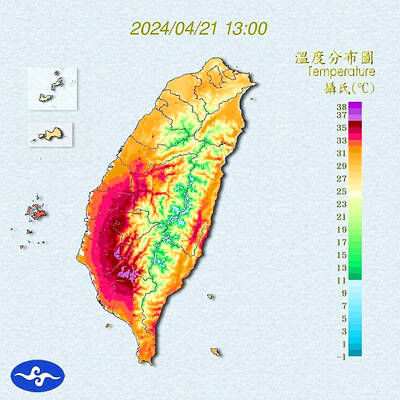
Heat advisories were in effect for nine administrative regions yesterday afternoon as warm southwesterly winds pushed temperatures above 38°C in parts of southern Taiwan, the Central Weather Administration (CWA) said. As of 3:30pm yesterday, Tainan’s Yujing District (玉井) had recorded the day’s highest temperature of 39.7°C, though the measurement will not be included in Taiwan’s official heat records since Yujing is an automatic rather than manually operated weather station, the CWA said. Highs recorded in other areas were 38.7°C in Kaohsiung’s Neimen District (內門), 38.2°C in Chiayi City and 38.1°C in Pingtung’s Sandimen Township (三地門), CWA data showed. The spell of scorching


 RSS
RSS