


President Chen Shui-bian (陳水扁) has accused China of "provoking" his government by targeting Taiwan with nearly 1,000 missiles, stepping up the rhetoric against Beijing.
In a wide-ranging interview with CNN broadcast over the weekend, Chen insisted that China had put Taiwan on the defensive with its provocative acts, rejecting Beijing's claims that he was to blame for cross-strait tensions.
"It is China that is provoking Taiwan," Chen said.
"It passed the `Anti-Secession' law. It never formally renounced the use of force against Taiwan," the president told the cable news channel.
"[The Chinese government] has also begun to complete three-stage preparation work to invade Taiwan in the future," Chen said during the interview.
"What this government, the people of Taiwan, and this administration have been doing is merely defending the sovereignty, dignity, and security of our country," he said.
Chen said he was merely trying to maintain the peaceful status quo in the Taiwan Strait, and he lashed out at China over what he called a massive increase in the number of missiles pointing at the country.
Chen told CNN there were now 988 short and medium-range ballistic missiles pointed at the country.
"Back in the year 2000, when I first became president, the missiles deployed along the southeastern coast of China were about 200, and now they are almost 1,000. They have increased almost by fivefold," the president told CNN.
Last week, the Ministry of National Defense said that Beijing had built up a huge arsenal of missiles facing Taiwan, up from 160 ballistic missiles in place in 1996.
"As of now, the Chinese communists have stockpiled 880 ballistic missiles and more than 100 cruise missiles, placing the whole of Taiwan under their range," Taiwan air force Major General Wang Cheng-hsiao told reporters in a regular press conference in Taipei.
"These missiles indeed pose a serious threat to Taiwan," he said.
Taiwan has deployed three US-made Patriot PAC-2 anti-missile batteries to defend the densely populated greater Taipei area.
The Chen administration has long sought to purchase more batteries to beef up Taiwan's defenses, but its efforts have so far been stalled by the Chinese Nationalist Party (KMT) and the People First Party.
The opposition parties assert that a vaguely worded failed referendum held in 2004 in conjunction with the presidential election has made it "illegal" for the government to purchase three Patriot PAC-3 anti-missile batteries from the US.
Chen also pledged to continue his drive for a new constitution and to join international bodies like the UN and WHO -- goals which are strongly opposed by Beijing.
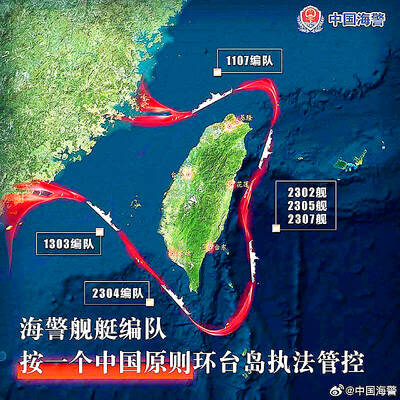
Taiwan would benefit from more integrated military strategies and deployments if the US and its allies treat the East China Sea, the Taiwan Strait and the South China Sea as a “single theater of operations,” a Taiwanese military expert said yesterday. Shen Ming-shih (沈明室), a researcher at the Institute for National Defense and Security Research, said he made the assessment after two Japanese military experts warned of emerging threats from China based on a drill conducted this month by the Chinese People’s Liberation Army’s (PLA) Eastern Theater Command. Japan Institute for National Fundamentals researcher Maki Nakagawa said the drill differed from the
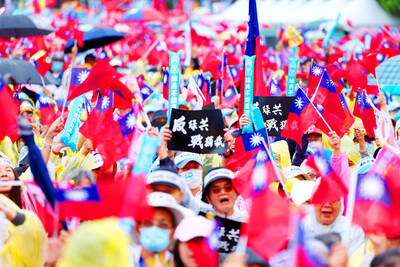
‘WORSE THAN COMMUNISTS’: President William Lai has cracked down on his political enemies and has attempted to exterminate all opposition forces, the chairman said The legislature would motion for a presidential recall after May 20, Chinese Nationalist Party (KMT) Chairman Eric Chu (朱立倫) said yesterday at a protest themed “against green communists and dictatorship” in Taipei. Taiwan is supposed to be a peaceful homeland where people are united, but President William Lai (賴清德) has been polarizing and tearing apart society since his inauguration, Chu said. Lai must show his commitment to his job, otherwise a referendum could be initiated to recall him, he said. Democracy means the rule of the people, not the rule of the Democratic Progressive Party (DPP), but Lai has failed to fulfill his
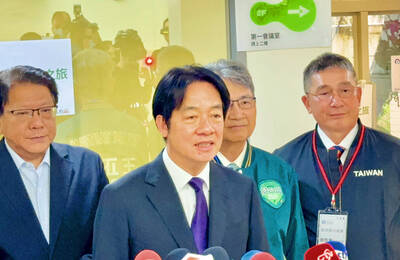
A rally held by opposition parties yesterday demonstrates that Taiwan is a democratic country, President William Lai (賴清德) said yesterday, adding that if opposition parties really want to fight dictatorship, they should fight it on Tiananmen Square in Beijing. The Chinese Nationalist Party (KMT) held a protest with the theme “against green communists and dictatorship,” and was joined by the Taiwan People’s Party. Lai said the opposition parties are against what they called the “green communists,” but do not fight against the “Chinese communists,” adding that if they really want to fight dictatorship, they should go to the right place and face
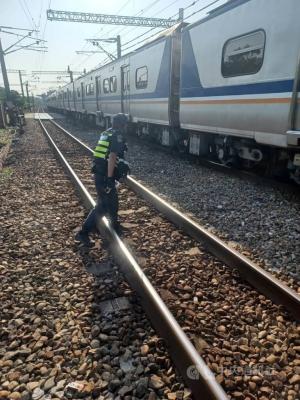
A 79-year-old woman died today after being struck by a train at a level crossing in Taoyuan, police said. The woman, identified by her surname Wang (王), crossed the tracks even though the barriers were down in Jhongli District’s (中壢) Neili (內壢) area, the Taoyuan Branch of the Railway Police Bureau said. Surveillance footage showed that the railway barriers were lowered when Wang entered the crossing, but why she ventured onto the track remains under investigation, the police said. Police said they received a report of an incident at 6:41am involving local train No. 2133 that was heading from Keelung to Chiayi City. Investigators


 RSS
RSS