


Any mention of an insulated society on the Korean Peninsula is likely to evoke images of a brutal regime run by a pudgy, screwball dictator.
Sure, North Korea could be fairly described as an insulated society, but what about "English Village" in Paju, South Korea? Located just a few miles east of the 38th Parallel, English Village is a world onto itself.
Like any small town USA, English Village boasts a main street flanked by Western shopfronts.
Ironically, the town also resembles North Korea in some respects. For example, English Village imposes what some might consider to be bizarre, draconian laws on its schoolage inhabitants: They are barred from speaking their mother tongue.
Luckily, "punishment" for speaking anything but English ranges from a friendly reminder to a gentle scolding from a teacher. For now, the Disneylandesque "language immersion camp" has decided against gulags and summary executions.
Inspiration
"We visited English Village twice in South Korea. It is basically a theme park, and we were so inspired that we had to set up our own English Village in Taiwan," said Morgan Sun (
A non-government organization (NGO) devoted to improving the quality of education in Taiwan, the foundation recently announced plans to open the Happy Global English Village in Taoyuan County in September next year.
Modeled after English Village in South Korea, Taiwan's village will accommodate 140 elementary and middle school students per day.
Although much smaller in scale than English Village, Taoyuan County Commissioner Chu Li-lun (
"To date, the King Car Education Foundation has invested NT$30 million (US$910,752) in the camp and we will have more infrastructure and software in place by the summer," Sun said.
Boasting additional funding and other material support from the Taoyuan County Government, the camp will simulate a tiny town in the West for Taiwanese children to lose themselves in.
A post office, airport customs, a Western restaurant, a hospital and, of course, classrooms galore will comprise the "town," according to a foundation press release.
Foreign staff will provide the finishing touches by fostering an English language environment, foundation and Taoyuan County Government representatives said.
"In addition to attracting retired teachers from the US for the camp, we want to offer teaching internships to native English-speaking college students," Sun said.
Jeffrey Lamb, a graduate student in the Graduate Institute of Teaching Chinese as a Second Language at National Taiwan Normal University, said that language immersion camps are all the rage worldwide.
Immersion
"We know that immersion is a good way to teach [foreign languages]," Lamb said, adding that camps and theme parks like English Village are popping up all over the US for Chinese and Arabic.
An expert on foreign language pedagogy, Lamb said such camps provide youth with more exposure to foreign cultures and languages than they can receive in the typical classroom.
"The camps are an effective way to teach language and broaden kids' global vision," Lamb said.
Attached to the Happy Elementary School in Taoyuan County, Taiwan's first language immersion camp boasts new buildings and plenty of public and private support: signs that the camp is a project with strong legs and the potential to be duplicated nationwide.
"We don't want this camp to be the only one of its kind in Taiwan," Chu said.
"We want it to be the first of many," he said.

FUKUOKA SITUATION: Japanese media reported that the pathogen is expected to be identified by the summer, while the CDC downplayed the idea that it was hMPV A “mysterious cold-like illness” reported in Japan’s Fukuoka Prefecture does not seem to be a new disease, but Japanese authorities have been asked about the situation, the Centers for Disease Control (CDC) said yesterday. The Fukuoka Prefectural Medical Association on Wednesday told a news conference that a “mystery cold” that has become a hot topic on social media is “highly likely to be caused by some kind of viral infection,” Japan’s KBC News reported. “Many people are experiencing symptoms starting with a sore throat, followed by a runny nose, phlegm and a severe cough,” KBC News reported, citing association officials. Health authorities are

Nvidia Corp CEO Jensen Huang (黃仁勳) arrived in Taiwan yesterday ahead of upcoming AI and technology events, saying he plans to meet with clients and Taiwan Semiconductor Manufacturing Co Chairman C.C. Wei (魏哲家) during his visit. After landing at Taipei Songshan Airport, Huang posed for photos with fans and handed out Yakult drinks to reporters and supporters waiting at the scene, saying he has “a lot to do” during the trip. Asked about reports that Nvidia’s planned headquarters site in Taipei’s Beitou Shilin Technology Park could break ground on May 27, Huang said that if the company holds an event, he would

The Ministry of Finance this afternoon announced the winning numbers for the March-April uniform invoice lottery. The winning number for the NT$10 million (US$318,060) special prize is 19531471, and the winning number for the NT$2 million grand prize is 85941329. Three numbers were drawn for the NT$200,000 first prize: 07225810, 20231230 and 83518781. Those with receipts matching the last seven digits of any of the first-prize numbers will win the NT$40,000 second prize, while those matching the last six digits will win the NT$10,000 third prize. Those whose receipts match the last five digits of the first-prize numbers can claim the NT$4,000 fourth prize,
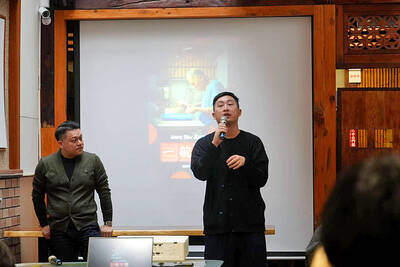
Taiwan Travelogue (臺灣漫遊錄), which earlier this week became the first Taiwanese novel to win the International Booker Prize, is to be adapted into a television series through a Taiwan-Japan coproduction, producer Chang Chen-yu (張辰漁) said yesterday. Chang, a producer at World Softest Production Film Co, wrote on Facebook that the company had been searching for projects with international appeal that retain a strong Taiwanese identity after colleagues and Japanese partners strongly recommended the novel. After reading the book, Chang said he immediately decided to pursue the screen rights. “A great story has the power to transcend time and borders, and connect countless people,”


 RSS
RSS