

The Ministry of the Interior has come up with a draft table of quotas for various categories of Chinese citizens to be allowed to stay or settle in Taiwan annually as part of efforts to control population growth, officials said yesterday.
They said the quota table was drawn up under Article 17 of the Statute Governing the Relations Between the People of the Taiwan Area and the Mainland Area (兩岸人民關係條例), which authorizes the ministry to set annual caps on Chinese citizens to be allowed to come to Taiwan for reunions with their next of kin, long-term stays, or permanent settlement.
Johnnason Liu (
Taiwan has the world's second highest population density.
"Both Hong Kong and Macau have enacted clear-cut regulations to govern the immigration of Chinese citizens," Liu said, adding that the quota regulations have nothing to do with ideology.
According to the table, the number of Chinese citizens to be allowed to come to Taiwan to stay with their next of kin for a specified period of time is capped at 12,000 per year.
The ministry has not set any limit on the number of Chinese citizens to be allowed to come to Taiwan for long-term stays under special economic, educational, cultural or technological exchange programs, with a view to attracting Chinese with professional skills or expertise to immigrate to Taiwan.
The quota for Chinese citizens eligible to come to Taiwan for long-term stays for humanitarian reasons is set at 36 per year. This category of people includes Chinese citizens who have to stay in Taiwan to care for their elderly parents-in-law after their Taiwanese spouses die, or children of Chinese spouses.
Officials said the quota for this group of people should be restricted because they tend to be dependent and their entry may squeeze social resources.
Meanwhile, the ministry set an annual cap of 6,000 on Chinese spouses obtaining permanent settlement status or Taiwanese citizenship. The quota was decided after evaluating a combination of factors, including the number of Chinese spouses who were granted permanent residency in the previous three years, the officials said.
`Derived' population
To prevent a rapid expansion of "derived" population, the ministry is also imposing ceilings on various categories of Chinese next of kin to be granted permanent residency each year. This includes 60 for Chinese aged 70 or over who are blood relatives or spouses of Taiwanese citizens; 24 for Chinese grandchildren or great-grandchildren aged under 12; and 12 for children of Chinese spouses from previous marriages younger than 12 years old.
The list also stipulates that Chinese immigrants cannot apply for their next of kin to come to Taiwan for a reunion or long-term stay until after they have held permanent residency or Taiwanese citizenship for five years.
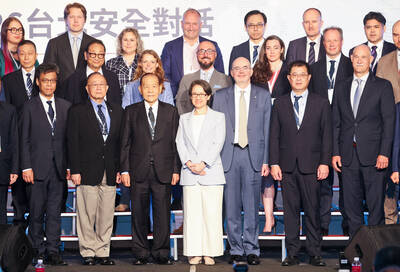
Taiwan’s growing defense preparations might be sending a stronger signal to the US than to Beijing, highlighting the need for Taipei to tailor its deterrence efforts to different audiences, a US security academic said yesterday. Stanford University Freeman Spogli Institute for International Studies fellow Oriana Skylar Mastro made the comment during a Taipei Security Dialogue panel examining lessons Taiwan could draw from the wars in Ukraine and the Middle East. Mastro said she was impressed by Taiwan’s increased defense spending, emphasis on asymmetric capabilities and efforts to prepare society for conflict, but questioned whom those initiatives were influencing. She said when she asked
A total of 400 foreign “high- level” professionals have been naturalized as Republic of China (Taiwan) citizens over the past decade as the government has eased nationality rules to attract talent from a wider range of fields, the Ministry of the Interior said yesterday. The 400th high-level professional, who works in the electronics industry, was approved for ROC citizenship on Aug. 26, the MOI said. The MOI quoted the newly naturalized citizen as saying that Taiwan is a leader in fields such as semiconductors, electronics manufacturing, artificial intelligence development and energy technology. He also said
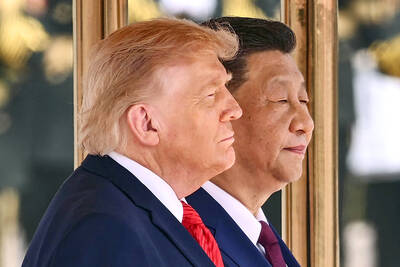
China has warned that it could cancel a planned US-China leaders’ summit if Washington approves new arms sales to Taiwan, a Japanese media outlet quoted sources as saying yesterday. US President Donald Trump, “apparently eager to showcase some diplomatic achievements ahead of November’s midterm congressional elections, places great importance on holding the summit with Chinese President Xi Jinping (習近平),” Japan’s Kyodo News reported. “While preparing for Xi’s upcoming trip, China has restated its position that the Taiwan issue is a ‘red line’ in bilateral relations,” the report said. The report said that when Xi met with Trump in Beijing in May, Xi said
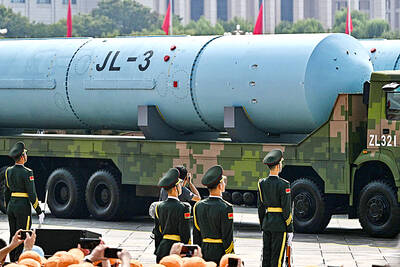
SUB-LAUNCHED SUBOPTIMAL: The JL-3, an upgraded version of the missile test-fired earlier in the summer, would have the range to strike at much of the country Refits to Chinese nuclear submarines to carry JL-3 intercontinental ballistic missiles would put much of the US in striking distance, Taiwanese defense analysts said in a report commissioned by the Mainland Affairs Council. Researchers from National Defense University’s Graduate Institute of China Military Affairs Studies said that the Chinese People’s Liberation Army Navy (PLAN) in July test-fired a missile with a training warhead. Chinese state media reported without elaborating that a PLAN nuclear-powered ballistic missile submarine (SSBN) launched a missile with a training warhead, which accurately hit the designated target area in the Pacific, the report said. The launch was a rare display


 RSS
RSS