


The political furore over the president's "state affairs fund" and the Taipei mayor's "special allowance fund" illustrates the need for constitutional reform, said the former vice chairman of the Mainland Affairs Council.
"Political infighting targeting the president would be less brutal if the government system were changed to a parliamentary system," said Chen Ming-tong (陳明通), a professor at National Taiwan University's Graduate Institute of National Development. "It is equally important that the administration establishes a better system to tackle problems caused by justice in transition."
Chen made the remarks at a forum held by the Taiwan Thinktank to discuss the controversies involving President Chen Shui-bian's (
The forum is the fourth of a series of panel discussions on problems caused by transitional justice.
As Taiwan has transformed itself from an authoritarian to a democratic state, Chen Ming-tong said the problem caused by the president's and Ma's expense funds were a perfect example of justice in transition.
During a transitional period, Chen Ming-tong said justice does not necessarily have to be "absolutely fair" but can reach the level that is "unsatisfactory but acceptable."
He proposed that those involved in the fund controversies apologize to defuse political tensions. Those guilty of inappropriate accounting, but who did not pocket any money, must be granted amnesty, he said.
Democratic Progressive Party Legislator Kuan Bi-ling (管碧玲) said that the controversy involving the two political leaders' expense funds should be handled at the same time and with the same standards.
In the national interest, Kuan called on Ma to treat the controversy involving his "special allowance fund" as a case of transitional justice rather than a personal legal matter.
She was referring to Ma's donation of funds to charities on Friday. Ma said he had decided to donate a sum equal to a portion of his special allowance in order to quell criticism that he had embezzled funds.
Meanwhile, Kenneth Lin (林向愷), an economics professor at National Taiwan University, criticized the Cabinet's new measure requiring receipts detailing all expenditures from the funds as "inflexible" and "a step backward."
Chen Chun-kai (
It is important to establish a system that prevents officials from engaging in corruption, but it is equally important to keep the system practical, feasible and efficient, he said.
"You spend so much time collecting receipts that you have very little time left to do other things," he said. "It is an unbelievable waste of time."

The Ministry of Finance this afternoon announced the winning numbers for the March-April uniform invoice lottery. The winning number for the NT$10 million (US$318,060) special prize is 19531471, and the winning number for the NT$2 million grand prize is 85941329. Three numbers were drawn for the NT$200,000 first prize: 07225810, 20231230 and 83518781. Those with receipts matching the last seven digits of any of the first-prize numbers will win the NT$40,000 second prize, while those matching the last six digits will win the NT$10,000 third prize. Those whose receipts match the last five digits of the first-prize numbers can claim the NT$4,000 fourth prize,
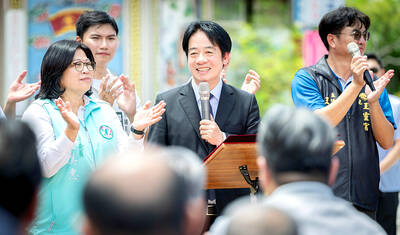
SIX SUBSIDIES: The monthly allowance for older farmers is to increase to NT$10,000, and NT$5,000 is to be given to homemakers under the national pension system, Lai said The government is to implement major welfare policies for disadvantaged groups, including raising the monthly allowance for older farmers to NT$10,000 and providing homemakers with NT$5,000 per month, President William Lai (賴清德) said yesterday. Lai made the remarks during a visit to Wangling Temple in Chiayi County, saying that the planned increases were being introduced amid economic growth and an increase in tax revenue. Touting a policy, in which the government plans to provide a monthly allowance of NT$5,000 for every child under the age of 18 in a bid to address Taiwan’s low birthrate, Lai said that if received for the
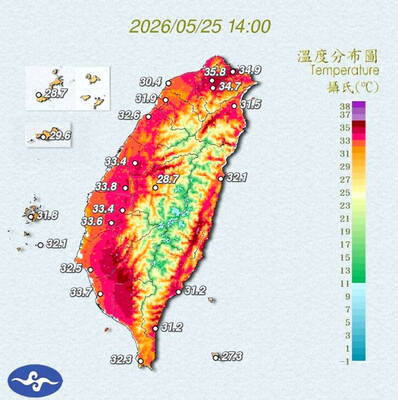
STAY COOL: The HPA recommended that people stay hydrated, use air-conditioning or fans while indoors, wear loose-fitting clothes and walk in the shade while outdoors Employers must implement measures such as installing cooling equipment, and providing drinking water and rest breaks for outdoor workers starting from Monday next week, the Taipei Department of Labor said on Sunday. Employers who fail to comply could face fines of NT$30,000 to NT$300,000 under the Occupational Safety and Health Act (職業安全衛生法), the department said. Businesses in Taipei employing fewer than 100 workers, as well as registered self-employed workers with labor insurance coverage, could receive on-site assessments and guidance from occupational safety consultants to help them apply for central government subsidies to implement or improve heat-protection measures, it said. Under the Ministry of
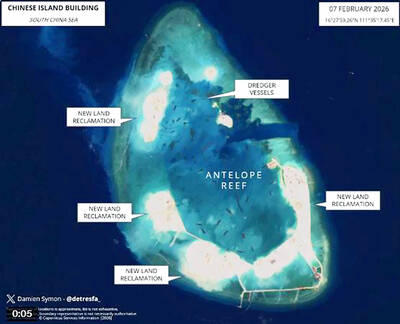
ISOLATION: The outposts would serve as support and backup bases, forcing US forces to either face China head-on or reroute, increasing travel time and operational costs China’s outposts in the South China Sea could be used to delay and constrain foreign forces during a conflict in the Taiwan Strait, giving Beijing a critical window to carry out amphibious landing and blockade operations, a report said. The Chinese Communist Party’s (CCP) forward operating bases on islands and reclaimed features in the South China Sea could delay foreign forces long enough for the Chinese People’s Liberation Army (PLA) to secure a key 48-to-72-hour window in the Taiwan Strait, a report commissioned by the Mainland Affairs Council found. The report, conducted by the Institute for National Defense and Security Research, examined


 RSS
RSS