


The policy of the Environmental Protection Administration (EPA) prohibiting the use of plastic containers and trays for eggs, produce and pastries may face another delay as environmentalists, retailers and representatives for the plastic industry said the policy needed to be suspended.
Last month, the administration announced that it would begin enforcing the policy next month.
"This is the wrong policy," said Chang Feng-chih (
The hearing was hosted by Democratic Progressive Party Legislator Huang Sue-ying (
"The EPA has never considered if a policy would be viable before they executed it," Chang said.
Liou Ming-long (劉銘龍), chairman of the Environmental Quality Protection Foundation, criticized the policy, saying it has deviated from its original legislative purpose.
"The purpose should be to limit the use of non-recyclable plastic packaging materials, rather than limiting the use of plastic or even plastic bags," Liou said.
Liou said a similar policy in South Korea only forbids restaurants that are larger than 45 pings from using plastic utensils because they should be capable of installing large dish-washing facilities, rather than forbidding all retailers to provide plastic products.
Some at the event suggested the government had failed to consider the policy's impact on other industries.
Chang Yuan (
Chang said that the EPA drafted the policy without first seeking a consensus from other government departments.
Ho Soong-chin (
The EPA announced last year that the use of plastic containers made of polyvinyl chloride (PVC), polyethylene terephthalate (PET), polystyrene (PS), polyethylene (PE) and polypropylene (PP) would be banned starting in February.
Since these plastic containers are easily contaminated by residues left by the products they contain, often making them unrecyclable, the administration decided to ban their use completely.
If enforced, the policy will apply to government organizations, department stores, shopping malls, hypermarkets, mid-size supermarkets, retail chain stores and fast food restaurants.
To replace the banned materials, the EPA said it would permit the use of containers made of biodegradable materials like polylactic acid, paper or bamboo.
The administration decided, however, to postpone the implementation of the policy as it failed to secure support from the private sector.
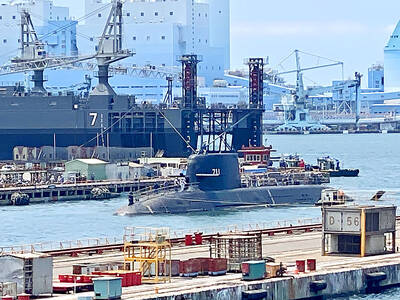
AGING: While Japan has 22 submarines, Taiwan only operates four, two of which were commissioned by the US in 1945 and 1946, and transferred to Taiwan in 1973 Taiwan would need at least 12 submarines to reach modern fleet capabilities, CSBC Corp, Taiwan chairman Chen Cheng-hung (陳政宏) said in an interview broadcast on Friday, citing a US assessment. CSBC is testing the nation’s first indigenous defense submarine, the Hai Kun (海鯤, Narwhal), which is scheduled to be delivered to the navy next month or in July. The Hai Kun has completed torpedo-firing tests and is scheduled to undergo overnight sea trials, Chen said on an SET TV military affairs program. Taiwan would require at least 12 submarines to establish a modern submarine force after assessing the nation’s operational environment and defense
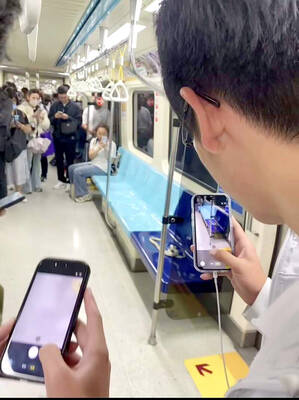
A white king snake that frightened passengers and caused a stir on a Taipei MRT train on Friday evening has been claimed by its owner, who would be fined, Taipei Rapid Transit Corp (TRTC) said yesterday. A person on Threads posted that he thought he was lucky to find an empty row of seats on Friday after boarding a train on the Bannan (Blue) Line, only to spot a white snake with black stripes after sitting down. Startled, he jumped up, he wrote, describing the encounter as “terrifying.” “Taipei’s rat control plan: Release snakes on the metro,” one person wrote in reply, referring
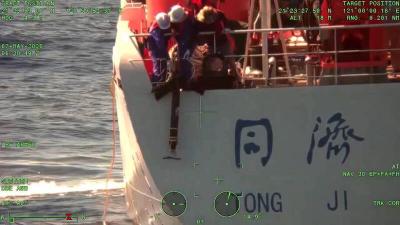
The coast guard today said that it had disrupted "illegal" operations by a Chinese research ship in waters close to the nation and driven it away, part of what Taipei sees a provocative pattern of China's stepped up maritime activities. The coast guard said that it on Thursday last week detected the Chinese ship Tongji (同濟號), which was commissioned only last year, 29 nautical miles (54km) southeast of the southern tip of Taiwan, although just outside restricted waters. The ship was observed lowering ropes into the water, suspected to be the deployment of scientific instruments for "illegal" survey operations, and the coast
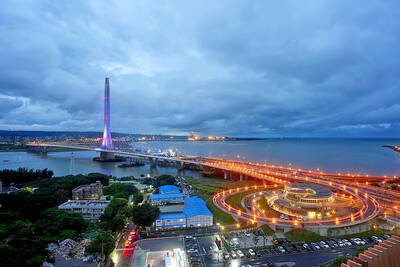
An inauguration ceremony was held yesterday for the Danjiang Bridge, the world’s longest single-mast asymmetric cable-stayed bridge, ahead of its official opening to traffic on Tuesday, marking a major milestone after nearly three decades of planning and construction. At the ceremony in New Taipei City attended by President William Lai (賴清德), Premier Cho Jung-tai (卓榮泰), Minister of Transportation and Communications Chen Shih-kai (陳世凱) and New Taipei City Mayor Hou Yu-ih (侯友宜), the bridge was hailed as both an engineering landmark and a long-awaited regional transport link connecting Tamsui (淡水) and Bali (八里)


 RSS
RSS