


Facing mounting criticism over its use of millions of dollars in donations, the campaign to oust President Chen Shui-bian (
Since former Democratic Progressive Party (DPP) chairman Shih Ming-teh (施明德) initiated the campaign in early August and received donations totaling NT$111 million (US$3.36 million), a total of NT$41.7 million has been spent as of Oct. 2, with NT$62.62 million left in the account, according to Lu Tai-nien (呂台年), a deputy coordinator of the campaign.
A closer look at the expense list revealed that advertising and promotional materials, including balloons, banners and stickers, accounted for the largest share of expenditure (NT$21.47 million).
This was followed by big-ticket items such as stage and location fees (NT$13.15 million), deposits for the use of public places (NT$390,000), and workers' salaries (NT$406,000).
Lu dismissed criticism that the campaign has not been transparent about its finances, saying it balanced its account every week.
"Our financial record is very transparent. We are not afraid to provide detailed information and allow the public to check [our finances]," Lu told a press conference last Friday, adding that it would make public a more detailed financial record in the near future.
While Lu maintained that its financial records were transparent, Democratic Progressive Party (DPP) Spokesman Meng Yi-chao (
receipts
"Where are the receipts of the `allowance?' How many people are paid `salaries'? And how much did each receive? The `moving fee' and `transportation' fee are even more confusing," Meng said.
Moreover, the balance should be NT$69.4 million (assuming NT$111 million in donations less NT$41.7 million in expenses), rather than NT$62.62 million, Meng said.
In response to the accusations, Lu simply said that the campaign would provide receipts in the near future, while acknowledging a NT$6.86 million difference.
"The amount of money was already spent, but hasn't been entered into the account books because we have not received the receipts yet," he said.
Aside from the financial discrepancy, members of the campaign's decision-making body offered contradictory statements when asked how much the campaign has spent.
Chang Fu-chung (
Another deputy coordinator, Lee Hsin (李新), said that the donations would be used up soon, and that the campaign would not rule out the possibility of launching another fundraiser in the future.
Campaign spokeswoman Wang Li-ping (王麗萍), however, dismissed Lee's remarks and said the committee did not discuss the possibility of another fundraising.
"We have been so busy with the sit-ins and the national tour, and really don't have time to calculate all the expenses and collect all the receipts," Wang told the Taipei Times.
"But we will control our expenses and won't waste the donation," she said, adding that there was no definite timeline on when the campaign would provide its detailed financial report.
According to Lu, the rental fee for audio equipment was about NT$70,000 per day, while the stage cost about NT$85,000 per day.
When asked about the transportation fee during its eight-day nationwide tour, Wang declined to comment on the rental fee for 20 tour buses.
The average rental fee for a tour bus is at least NT$10,000 per day, which adds up to NT$1.6 million for the eight-day tour from Sept. 29 to Oct. 6.
Lu said that the campaign's headquarters was still calculating the expenses of its nationwide tour, reiterating his comment that it would make public further details as soon as possible.
Commenting on the the campaign's contradictory statements on its finances, Yang Tai-shun (
negative impact
"The money comes from public donations. The campaign is aimed at fighting corruption. As such, any financial problem could pose a negative impact on the campaign," he said.
Lee Ting-tsan (李丁讚), a sociology professor at National Tsinghua University, agreed that the campaign had to release its financial report in response to public concerns.
"As so many people are involved in the campaign with different objectives in mind, it is not unreasonable to cast doubt on its finances," he said.
"Besides, people who made the donations have the right to know how their money was spent," he said.
In addition to questions about its expenses, campaign spokesman Jerry Fan (
The magazine accused Fan, a well-known advertising executive, and Hsu, a composer and founder of a cultural association in the country, of giving the campaign's advertising and stage projects to their agencies.
Both Fan and Hsu dismissed the allegations, but declined to clarify the allegations until the campaign offers what it claimed would be a more detailed financial report.
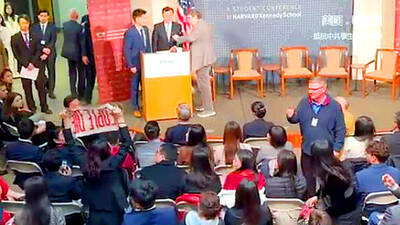
A group of Taiwanese-American and Tibetan-American students at Harvard University on Saturday disrupted Chinese Ambassador to the US Xie Feng’s (謝鋒) speech at the school, accusing him of being responsible for numerous human rights violations. Four students — two Taiwanese Americans and two from Tibet — held up banners inside a conference hall where Xie was delivering a speech at the opening ceremony of the Harvard Kennedy School China Conference 2024. In a video clip provided by the Coalition of Students Resisting the CCP (Chinese Communist Party), Taiwanese-American Cosette Wu (吳亭樺) and Tibetan-American Tsering Yangchen are seen holding banners that together read:

UNAWARE: Many people sit for long hours every day and eat unhealthy foods, putting them at greater risk of developing one of the ‘three highs,’ an expert said More than 30 percent of adults aged 40 or older who underwent a government-funded health exam were unaware they had at least one of the “three highs” — high blood pressure, high blood lipids or high blood sugar, the Health Promotion Administration (HPA) said yesterday. Among adults aged 40 or older who said they did not have any of the “three highs” before taking the health exam, more than 30 percent were found to have at least one of them, Adult Preventive Health Examination Service data from 2022 showed. People with long-term medical conditions such as hypertension or diabetes usually do not
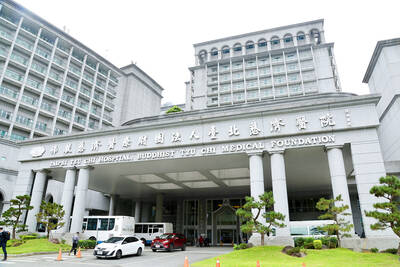
POLICE INVESTIGATING: A man said he quit his job as a nurse at Taipei Tzu Chi Hospital as he had been ‘disgusted’ by the behavior of his colleagues A man yesterday morning wrote online that he had witnessed nurses taking photographs and touching anesthetized patients inappropriately in Taipei Tzu Chi Hospital’s operating theaters. The man surnamed Huang (黃) wrote on the Professional Technology Temple bulletin board that during his six-month stint as a nurse at the hospital, he had seen nurses taking pictures of patients, including of their private parts, after they were anesthetized. Some nurses had also touched patients inappropriately and children were among those photographed, he said. Huang said this “disgusted” him “so much” that “he felt the need to reveal these unethical acts in the operating theater
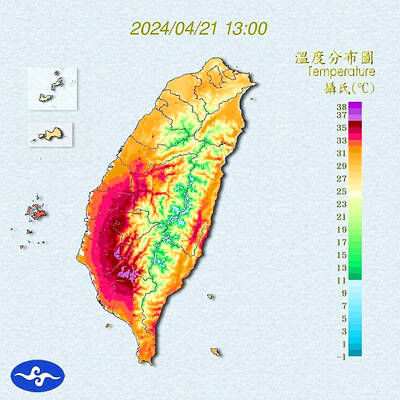
Heat advisories were in effect for nine administrative regions yesterday afternoon as warm southwesterly winds pushed temperatures above 38°C in parts of southern Taiwan, the Central Weather Administration (CWA) said. As of 3:30pm yesterday, Tainan’s Yujing District (玉井) had recorded the day’s highest temperature of 39.7°C, though the measurement will not be included in Taiwan’s official heat records since Yujing is an automatic rather than manually operated weather station, the CWA said. Highs recorded in other areas were 38.7°C in Kaohsiung’s Neimen District (內門), 38.2°C in Chiayi City and 38.1°C in Pingtung’s Sandimen Township (三地門), CWA data showed. The spell of scorching


 RSS
RSS