


National security officials yesterday said that there was no evidence that China was playing a role in the campaign to oust President Chen Shui-bian (陳水扁).
"We have been gathering in-depth intelligence for a long time. As of now, we have not found any linkage [between China and the anti-Chen campaign]," said Yang Kuo-chiang (
Yang made the remarks after a closed-door meeting on the issue with Taiwan Solidarity Union (TSU) lawmakers.
Organizers of the anti-Chen campaign have complained that Chen and Formosa TV Station slandered them by suggesting that their efforts were supported by Beijing.
The campaign has threatened to file lawsuits.
The Presidential Office has denied that Chen suggested any such thing, and Formosa TV has replied that it merely aired a segment in which an academic pointed out the links between the campaign's slogans and classic Chinese songs.
However, Democratic Progressive Party Chairman Yu Shyi-kun has appealed several times to pro-Chen supporters to back Chen with rhetoric that "the [anti-Chen] campaign is a move by the Chinese to bully Taiwanese."
But despite the intelligence officials' briefing yesterday, TSU lawmakers remained dubious, insisting that Beijing had a hand in the campaign, if only indirectly.
"China has spent some NT$5 billion [US$152 million] to financially support Taiwan's media. That's why so many have shown their bias by promoting the anti-Chen campaign," Legislator Liao Pen-yen (
Legislator Ho Min-hao (何敏豪) asked the officials to investigate whether the Chinese government had sent agents to Taiwan under the guise of tourists to attend the anti-Chen campaign.
"On Sept. 14, 467 Chinese tourists came to Taiwan, which was higher than the average of about 100 people. This made me wonder whether they actually came for the `915 Siege,'" Ho said, referring to the anti-Chen campaign's massive march on Sept. 15.
Yang responded by saying there was no evidence of this.
Meanwhile, Vice Chief of the Military Intelligence Bureau Shen Shih-chih (
Vice Minister of National Defense Ko Cheng-heng (柯承亨) said that China had good reason to avoid any military movements.
"China might worry that any military movement would spark concerns from the US and Japan. Also, China wouldn't want to take the risk that Taiwan might try to shift the [public's] focus away from the anti-Chen campaign and toward a cross-strait crisis by seizing on its military movements," Ko said.

Yangmingshan National Park authorities yesterday urged visitors to respect public spaces and obey the law after a couple was caught on a camera livestream having sex at the park’s Qingtiangang (擎天崗) earlier in the day. The Shilin Police Precinct in Taipei said it has identified a suspect and his vehicle registration number, and would summon him for questioning. The case would be handled in accordance with public indecency charges, it added. The couple entered the park at about 11pm on Thursday and began fooling around by 1am yesterday, the police said, adding that the two were unaware of the park’s all-day live

Fast food chain McDonald's is to raise prices by up to NT$5 on some products at its restaurants across Taiwan, starting on Wednesday next week, the company announced today. The prices of all extra value meals and sharing boxes are to increase by NT$5, while breakfast combos and creamy corn soup would go up by NT$3, the company said in a statement. The price of the main items of those meals, if ordered individually, would remain the same. Meanwhile, the price of a medium-sized lemon iced tea and hot cappuccino would rise by NT$3, extra dipping sauces for chicken nuggets would go up
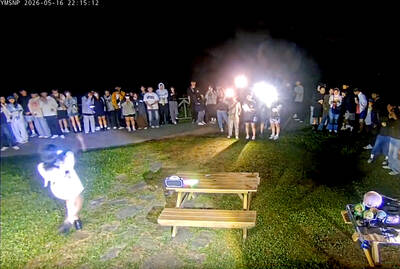
Yangmingshan National Park’s Qingtiangang (擎天崗) nature area has gone viral after a park livestream camera observed a couple in the throes of intimate congress, which was broadcast live on YouTube, drawing large late-night crowds and sparking a backlash over noise, bright lights and disruption to wildlife habitat. The area’s livestream footage appeared to show a couple engaging in sexual activity on a picnic table in the park on Friday last week, with the uncensored footage streamed publicly online. The footage quickly spread across social media, prompting a tide of visitors to travel to the site to “check in” and recreate the

Minister of Digital Affairs Lin Yi-ching (林宜敬) yesterday cited regulatory issues and national security concerns as an expert said that Taiwan is among the few Asian regions without Starlink. Lin made the remarks on Facebook after funP Innovation Group chief executive officer Nathan Chiu (邱繼弘) on Friday said Taiwan and four other countries in Asia — China, North Korea, Afghanistan and Syria — have no access to Starlink. Starlink has become available in 166 countries worldwide, including Ukraine, Malaysia, the Philippines and Vietnam, in the six years since it became commercial, he said. While China and North Korea block Starlink, Syria is not


 RSS
RSS