


Former army honor guard Chu Chao-kang (
But the response of the Ministry of National Defense, which initially branded his act as being "mere personal conduct" has drawn criticism.
Chu, who will finish his military service at the end of this year, posted the message online in March, but it was not exposed until two weeks ago.
Chu is a graduate of the department of Japanese at Soochow University. He had been planning to devote himself to a military career.
Chu left a message in a Yahoo chatroom identifying himself as an army honor guard. He wrote that when President Chen Shui-bian (
The M-1 rifles carried by the guards are unloaded, but they are fitted with bayonets.
Internet surfers reported the matter to the army.
The army immediately relieved Chu of his duties as an honor guard.
When first approached by the press for comments on June 30, army spokesman Chou Yen-chung (
The army regarded Chu's post as "comments from outside the military" because Chu posted his messages during his vacation.
As such, Chu "did not distribute the wrong message as a soldier," Chou said.
However, some critics panned the ministry's response.
Branding Chu's act as "personal conduct" sent out the wrong message to other people doing military service, critics said.
Chang Chia-lun (張家倫), public affairs secretary-general at a non-profit group called Taiwan Youth which advocates on issues concerning young people, said the ministry should not have so casually dismissed the case.
"If Chu is forgiven, will it mean that any soldier will be allowed to threaten his superior officers if he hates them?" Chang said. "How will they [superior officers] lead their soldiers in the future?"
Chou said that Chu earlier this month was charged under Article 16 of the Military Criminal Code (
The ministry did not explain why the military initially regarded Chu's message as not violating the Military Criminal Code.
People First Party (PFP) Legislator Lu Hsueh-chang (呂學樟) said that the military had been wrong to indict Chu.
"I am not saying that Chu's remarks are absolutely OK. But, he simply posted a message, and didn't `distribute the message and encourage' fellow soldiers to assassinate the president. Article 16 of the Military Criminal Code does not apply to his case at all," Lu said.
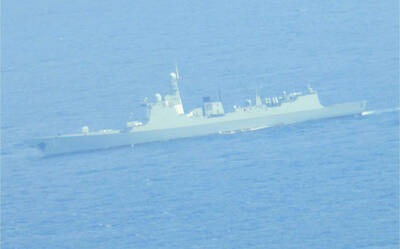
The military has spotted two Chinese warships operating in waters near Penghu County in the Taiwan Strait and sent its own naval and air forces to monitor the vessels, the Ministry of National Defense (MND) said. Beijing sends warships and warplanes into the waters and skies around Taiwan on an almost daily basis, drawing condemnation from Taipei. While the ministry offers daily updates on the locations of Chinese military aircraft, it only rarely gives details of where Chinese warships are operating, generally only when it detects aircraft carriers, as happened last week. A Chinese destroyer and a frigate entered waters to the southwest

A magnitude 6.1 earthquake struck off the coast of Yilan County at 8:39pm tonight, the Central Weather Administration (CWA) said, with no immediate reports of damage or injuries. The epicenter was 38.7km east-northeast of Yilan County Hall at a focal depth of 98.3km, the CWA’s Seismological Center said. The quake’s maximum intensity, which gauges the actual physical effect of a seismic event, was a level 4 on Taiwan’s 7-tier intensity scale, the center said. That intensity level was recorded in Yilan County’s Nanao Township (南澳), Hsinchu County’s Guansi Township (關西), Nantou County’s Hehuanshan (合歡山) and Hualien County’s Yanliao (鹽寮). An intensity of 3 was

Japanese Prime Minister Sanae Takaichi’s comment last year on Tokyo’s potential reaction to a Taiwan-China conflict has forced Beijing to rewrite its invasion plans, a retired Japanese general said. Takaichi told the Diet on Nov. 7 last year that a Chinese naval blockade or military attack on Taiwan could constitute a “survival-threatening situation” for Japan, potentially allowing Tokyo to exercise its right to collective self-defense. Former Japan Ground Self-Defense Force general Kiyofumi Ogawa said in a recent speech that the remark has been interpreted as meaning Japan could intervene in the early stages of a Taiwan Strait conflict, undermining China’s previous assumptions
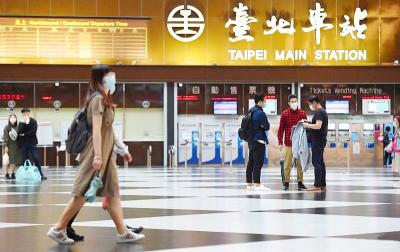
Taiwan Railways Corp (TRC) today announced that Shin Kong Mitsukoshi has been selected as the preferred bidder to operate the Taipei Railway Station shopping mall, replacing the current operator, Breeze Development Co Ltd. Among eight qualified firms that delivered presentations and were evaluated by a review committee, Shin Kong Mitsukoshi was ranked first, while Breeze was named the runner-up, the rail company said in a statement. Contract negotiations are to proceed in accordance with regulations, it said, adding that if negotiations with the top bidder fail, it could invite the second-ranked applicant to enter talks. Breeze in a statement today expressed doubts over


 RSS
RSS