


Human rights advocates yesterday asked the Democratic Progressive Party (DPP) government to put more effort into uncovering the truth behind murders and other crimes that occurred during the martial-law era under the former Chinese Nationalist Party (KMT) government.
The appeal came on the 25th anniversary of the murder of Chen Wen-chen (陳文成). Chen's bruised and battered body was discovered on July 2, 1981 on the campus of National Taiwan University after he had been taken away by the Taiwan Garrison General Headquarters (TGGH) the day before.
Chen was an assistant professor at Carnegie Mellon University who was involved in the Taiwan democracy movement. He had returned to Taiwan from the US to visit his family. His murder attracted significant attention and pressure from the international community.
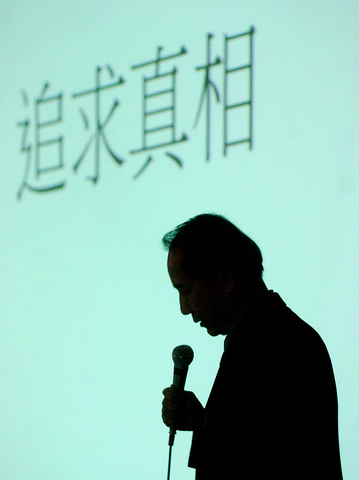
PHOTO: LO PEI-DER, TAIPEI TIMES
At a conference yesterday held to discuss achieving "transitional justice," human-rights lawyer Kenneth Chiu (
The garrison headquarters initially claimed that Chen had committed suicide because he feared being arrested for crimes, but changed its account the following day, saying that he had died in an accident.
US forensic pathologist Cyril Wecht, who traveled to Taiwan to investigate the case, concluded that Chen's death was caused by his being dropped from the fifth floor while unconscious, and that his death was a homicide.
Chiu cited the names of prosecutors and judges in charge of the Kaohsiung Incident (
He said that those responsible for White Terror incidents such as the murder of former DPP party leader Lin I-hsiung's (林義雄) family have neither been identified nor punished.
"Is the denial of justice a social value of Taiwan?" Chiu asked.
Writer Lin Shih-yu (林世煜) also asked the government not to drag its feet in declassifying documents related to Chen's murder and other incidents in order to uncover the truth and provide justice for the victims and their families.
Meanwhile, Taipei Prosecutor Chuang Chun-jen (莊俊仁), who is currently in charge of the investigation of Chen's murder, was quoted yesterday in a Central News Agency (CNA) report saying that it had been difficult to collect new evidence and find the perpetrators in the case.
"Because the materials relating to Chen's questioning at the TGGH are missing, and key TGGH officials in charge of Chen's case have emigrated to foreign countries, it is hard to make any breakthrough in the case," the CNA story quoted him as saying.
Chen's elder sister Chen Pao-yueh (陳寶月), who has sought an explanation from the government on her brother's murder for more the 25 years, filed a lawsuit in 2001 against former TGGH head Wang Ching-hsu (汪敬煦) and four other officials, in the hope of finding an explanation for his mysterious death.
Chen Pao-yueh said she was disappointed that there had been no progress in the lawsuit. She also said that her family had expected that President Chen Shui-bian (陳水扁) would help after he took office, but that they had been disappointed, and so decided to find the truth by themselves.

FUKUOKA SITUATION: Japanese media reported that the pathogen is expected to be identified by the summer, while the CDC downplayed the idea that it was hMPV A “mysterious cold-like illness” reported in Japan’s Fukuoka Prefecture does not seem to be a new disease, but Japanese authorities have been asked about the situation, the Centers for Disease Control (CDC) said yesterday. The Fukuoka Prefectural Medical Association on Wednesday told a news conference that a “mystery cold” that has become a hot topic on social media is “highly likely to be caused by some kind of viral infection,” Japan’s KBC News reported. “Many people are experiencing symptoms starting with a sore throat, followed by a runny nose, phlegm and a severe cough,” KBC News reported, citing association officials. Health authorities are

Nvidia Corp CEO Jensen Huang (黃仁勳) arrived in Taiwan yesterday ahead of upcoming AI and technology events, saying he plans to meet with clients and Taiwan Semiconductor Manufacturing Co Chairman C.C. Wei (魏哲家) during his visit. After landing at Taipei Songshan Airport, Huang posed for photos with fans and handed out Yakult drinks to reporters and supporters waiting at the scene, saying he has “a lot to do” during the trip. Asked about reports that Nvidia’s planned headquarters site in Taipei’s Beitou Shilin Technology Park could break ground on May 27, Huang said that if the company holds an event, he would

The Ministry of Finance this afternoon announced the winning numbers for the March-April uniform invoice lottery. The winning number for the NT$10 million (US$318,060) special prize is 19531471, and the winning number for the NT$2 million grand prize is 85941329. Three numbers were drawn for the NT$200,000 first prize: 07225810, 20231230 and 83518781. Those with receipts matching the last seven digits of any of the first-prize numbers will win the NT$40,000 second prize, while those matching the last six digits will win the NT$10,000 third prize. Those whose receipts match the last five digits of the first-prize numbers can claim the NT$4,000 fourth prize,
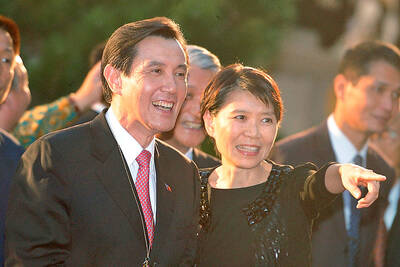
Former president Ma Ying-jeou (馬英九) yesterday expressed “shock and regret” over a statement issued by his wife without his consent, and rejected her assertion that his eldest sister, Ma Yi-nan (馬以南), would manage his medical care or act as his spokesperson amid an ongoing embezzlement probe into his foundation. Ma Ying-jeou in a statement said he was shocked by a statement by his wife, Chou Mei-ching (周美青), regarding his affairs. Ma Yi-nan “must not” be in charge of his healthcare and other personal affairs, nor can she be allowed to represent the Ma family, the former president said. He said he was also


 RSS
RSS