


On the eve of the legislature's presidential recall vote, President Chen Shui-bian (
"I have total respect for the constitutional system and have faith in Taiwan's democracy and rule of law," he said yesterday afternoon. "I believe the people of Taiwan have the wisdom, courage and capability to resolve adversity."
Chen made the remarks while receiving 14 Democratic Progressive Party (DPP) legislators at the Presidential Office.
Chen told the lawmakers that this was not the first time opposition parties had tried to recall him. In 2000, they initiated a motion to recall him less than six months into his presidency because of a controversy over the construction of the Fourth Nuclear Power Plant.
In 2001, the legislature threatened to cast a no-confidence vote against the premier in an attempt to topple the Cabinet.
"Over the past six years, the opposition camp has been trying to do everything it can to seize power," Chen said.
"Even after I won re-election in 2004, the opposition camp claimed that the assassination attempt was staged and that the presidential election was fixed," he said.
As for two election lawsuits filed by his rivals, Chen said that he agreed to a recount of the ballots because he did not have anything to hide. Although the two suits were eventually thrown out of court, the opposition camp still had not been satisfied, he said.
On whether the recall motion made any sense if it could not be passed with a needed two-thirds majority, Chen said he would leave it to the public to make its own judgment.
Although presidential recall is a normal part of a democratic structure and partisan politics, he said, there was room for discussion over the use of this means to obtain power.
"The battle of the 2008 presidential election has started prematurely," he said. "Don't think it won't begin until next year or the year after. It began, in fact, in 2004."
Chen admitted that his party had lost some of its soul compared with when it was founded 20 years ago, and that some party members had failed to uphold the party's fundamental values -- localization, honesty and reform.
"As president, I must bear full responsibility," he said.
"I must reflect ... and repent. Whether the party will get back on its feet again is a matter for the people of Taiwan," he said.
In addition to expressing appreciation for the concern expressed by DPP lawmakers, Chen said that there was a limit to a person's willpower and determination under pressure.
Chen said his wife Wu Shu-jen (
He said Wu had been planning to attend the welcoming ceremony for Dominican President Leonel Antonio Fernandez Reyna yesterday afternoon, but later canceled her attendance because she developed a fever on Sunday and was still under the weather.
"When I got home around noon on [Sunday], she was lying in bed," Chen said. "I told her to be strong because if she fell, I would fall too."

Taipei and Kaohsiung have extended an open invitation to Japanese pop star Ayumi Hamasaki after Chinese authorities abruptly canceled her scheduled concert in Shanghai. Hamasaki, 47, had been slated to perform on Saturday before organizers pulled the show at the last minute, citing “force majeure,” a move widely viewed as retaliation for Japanese Prime Minister Sanae Takaichi’s recent remark that a Chinese attack on Taiwan could draw a military response from Tokyo. Taipei Mayor Chiang Wan-an (蔣萬安) yesterday said the city “very much welcomes” Hamasaki’s return and would continue to “surprise” her. Hamasaki, who has a large global fan base, including

PROCEDURE: Although there is already a cross-strait agreement in place for the extradition of criminals, ample notice is meant to be given to the other side first Ten Taiwanese who were involved in fraud-related crimes in China were extradited back to Taiwan via Kinmen County on Wednesday, four of whom are convicted fraudsters in Taiwan. The 10 people arrived via a ferry operating between Xiamen and Kinmen, also known as the “small three links.” The Kinmen County Prosecutors’ Office yesterday said that four of the 10 extradited people were convicted in Taiwan for committing fraud and contravening the Money Laundering Control Act (洗錢防制法), and were on the wanted list. They were immediately arrested upon arrival and sent to Kinmen Prison to serve their sentences following brief questioning, the office said.
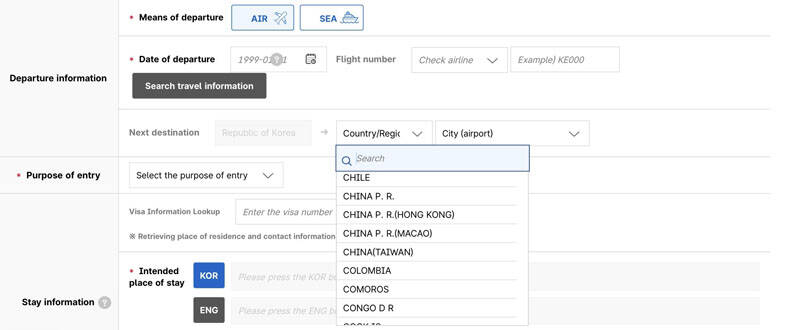
‘REGRETTABLE’: Travelers reported that Seoul’s online arrival card system lists Taiwan as ‘China (Taiwan),’ the Ministry of Foreign Affairs said The Ministry of Foreign Affairs yesterday urged South Korea to correct the way Taiwan is listed in its newly launched e-Arrival card system, saying the current designation downgrades the nation’s status. South Korea rolled out the online system on Feb. 24 to gradually replace paper arrival cards, which it plans to phase out by next year. Travelers must complete the electronic form up to 72 hours before entering the country. The ministry said it has received multiple complaints from Taiwanese travelers saying that the system lists Taiwan as “China (Taiwan)” in dropdown menus for both “place of departure” and “next
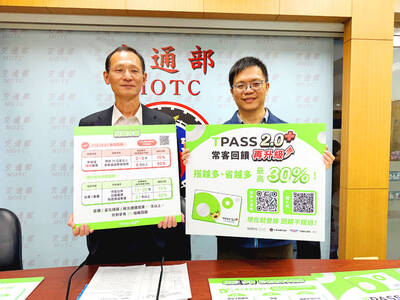
Starting next month, people who signed up for the TPass 2.0 program can receive a 15 percent rebate for trips on mid to long-distance freeway buses or on buses headed to the east coast twice every month, the Highway Bureau said. Bureau Director-General Lin Fu-shan (林福山) said the government started TPass 2.0 to offer rebates to frequent riders of public transportation, or people who use city buses, highway buses, trains or MRTs at least 11 times per month. As of Nov. 12, 265,000 people have registered for TPass 2.0, and about 16.56 million trips between February and September qualified for


 RSS
RSS