


President Chen Shui-bian's (
While the Chinese Nationalist Party (KMT) and People First Party (PFP) fail to see eye to eye on the means, they both agree that Chen should step down in order to assume responsibility for the recent string of allegations of corruption involving government officials and Chen's in-laws.
Likening the recall campaign to a shooting game, KMT Chairman Ma Ying-jeou (馬英九) said that "it's time to load the gun, but not yet time to pull the trigger, because you only get one shot at recalling a president."
Ma has so far rejected the proposal to recall Chen, citing the relatively high legal threshold, but instead urged Chen to resign. In order to pass, a recall motion would require approval from two-thirds of the legislature and a majority of eligible voters in a nationwide referendum.
Ma also expressed misgivings over seeing Vice President Annette Lu (
Although Ma recognizes that a no-confidence vote against the premier would be an easier route, he voiced concern over the legislative re-election that could follow such a move. If a no-confidence vote were successful, Chen could either appoint a new premier to replace Su, or disband the legislature and call snap elections.
Legislative Speaker Wang Jin-pyng (
PFP Chairman James Soong (
Determined to prove that his inaction was not a sign of weakness, Ma, who had said that he would not attend an anti-Chen protest in front of the Presidential Office on Saturday, had a last-minute change of heart and went to the rally.
While Chen's strategy of stepping back from power has successfully consolidated his leadership within his party, the KMT and PFP are now competing with each other for the backing of pan-blue supporters, said Hsu Yung-ming (
"While Chen is embroiled in the crisis plaguing his administration, Ma is facing a challenge to his leadership," he said.
Although opposition parties stand a better chance of success with a no-confidence vote, Hsu said that he does not think it would be an easy move, because the KMT would have to make sure it had sufficient support from the PFP, or pan-green and independent lawmakers.
A no-confidence vote against the premier would require the signatures of one third of lawmakers and the consent of half of the legislature.
According to the 1997 additional articles to the Constitution, the premier is directly appointed by the head of state without the need for the legislature's consent. The legislature has the power to pass a no-confidence vote against the premier, but the head of state has the power to dissolve the legislature if that happens.
If opposition parties managed to boot Su out of office, they would face a new set of problems, including a possible new legislative elections.
"Either way, the ball is in President Chen's court," Hsu said.
Chen's delegation of power also limits Lu's power, which whittles down the major contenders for the Democratic Progressive Party presidential candidate in 2008 to just two: Su and DPP Chairman Yu Shyi-kun, he said.
There has never been a coalition government in Taiwan, but Wang Yeh-li (
"It has very little meaning to appoint a new premier from the DPP because he or she is bound to face a no-confidence vote again if the person cannot win the approval of opposition parties," he said.
Wang Yeh-li said that Ma would be a more suitable candidate for the premier post. While Ma would be pre-occupied with the new job and held accountable for the performance of the new government, Wang Yeh-li said that the DPP could use that time to cultivate its presidential candidate.
Commenting on Soong's persistence in pushing for a recall campaign, Wang Yeh-li said that Soong won't lose politically, despite the campaign's slim chance of success.
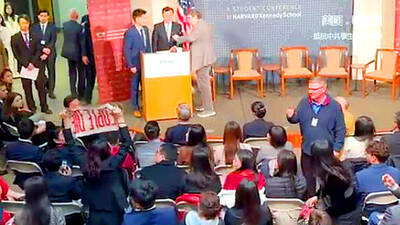
A group of Taiwanese-American and Tibetan-American students at Harvard University on Saturday disrupted Chinese Ambassador to the US Xie Feng’s (謝鋒) speech at the school, accusing him of being responsible for numerous human rights violations. Four students — two Taiwanese Americans and two from Tibet — held up banners inside a conference hall where Xie was delivering a speech at the opening ceremony of the Harvard Kennedy School China Conference 2024. In a video clip provided by the Coalition of Students Resisting the CCP (Chinese Communist Party), Taiwanese-American Cosette Wu (吳亭樺) and Tibetan-American Tsering Yangchen are seen holding banners that together read:

UNAWARE: Many people sit for long hours every day and eat unhealthy foods, putting them at greater risk of developing one of the ‘three highs,’ an expert said More than 30 percent of adults aged 40 or older who underwent a government-funded health exam were unaware they had at least one of the “three highs” — high blood pressure, high blood lipids or high blood sugar, the Health Promotion Administration (HPA) said yesterday. Among adults aged 40 or older who said they did not have any of the “three highs” before taking the health exam, more than 30 percent were found to have at least one of them, Adult Preventive Health Examination Service data from 2022 showed. People with long-term medical conditions such as hypertension or diabetes usually do not
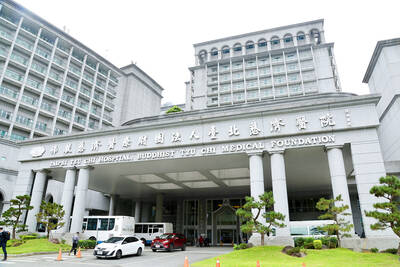
POLICE INVESTIGATING: A man said he quit his job as a nurse at Taipei Tzu Chi Hospital as he had been ‘disgusted’ by the behavior of his colleagues A man yesterday morning wrote online that he had witnessed nurses taking photographs and touching anesthetized patients inappropriately in Taipei Tzu Chi Hospital’s operating theaters. The man surnamed Huang (黃) wrote on the Professional Technology Temple bulletin board that during his six-month stint as a nurse at the hospital, he had seen nurses taking pictures of patients, including of their private parts, after they were anesthetized. Some nurses had also touched patients inappropriately and children were among those photographed, he said. Huang said this “disgusted” him “so much” that “he felt the need to reveal these unethical acts in the operating theater
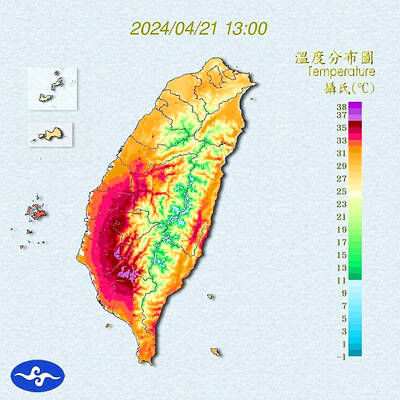
Heat advisories were in effect for nine administrative regions yesterday afternoon as warm southwesterly winds pushed temperatures above 38°C in parts of southern Taiwan, the Central Weather Administration (CWA) said. As of 3:30pm yesterday, Tainan’s Yujing District (玉井) had recorded the day’s highest temperature of 39.7°C, though the measurement will not be included in Taiwan’s official heat records since Yujing is an automatic rather than manually operated weather station, the CWA said. Highs recorded in other areas were 38.7°C in Kaohsiung’s Neimen District (內門), 38.2°C in Chiayi City and 38.1°C in Pingtung’s Sandimen Township (三地門), CWA data showed. The spell of scorching


 RSS
RSS