


Former president Lee Teng-hui (
"It is regretful that pro-unification forces are gaining steam. What is more frustrating is that the administration is weak in upholding national consciousness and its policies are inconsistent," he said.
The best weapon with which to defy China, Lee said, is unity and the cultivation of more young talent who are competent and honest.
"We must deepen democracy and boost the economy. The country's democratic and economic development must be so strong that we can resist China's `united-front' tactic and its ambition to annex Taiwan," he said. "In addition, politicians must have a strong sense of Taiwan consciousness so they can withstand the pressure exerted by Beijing and the pro-unification forces."
Lee made the remarks in a speech to some 2,000 graduates of the Lee Teng-hui Academy at the auditorium of the Aletheia University in Tamsui, Taipei County.
Yesterday marked the third anniversary of the academy.
Since falling ill in March, Lee had not attended any public function. But yesterday, wearing his trademark smile, Lee looked healthy and well-spirited. However, he did not answer any questions from the media.
Pointing out that the nation's biggest crisis is China's ambition to annex Taiwan, Lee said that Taiwan could have been a normal country a long time ago if it were not for China's interference.
"While it is the common responsibility of all Taiwanese to resist China's incursions, it is distressing to see a few pro-unification politicians and media organizations ignore the national interest and collude with Beijing," he said.
Lee cited the examples of former Chinese Nationalist Party chairman (KMT) Lien Chan's (連戰) recent visit to China and the opposition pan-blue parties' plan to steamroll amendments to the Statute Governing the Relations Between the People of the Taiwan Area and the Mainland Area (兩岸人民關係條例) through the legislature.
Lien met with Chinese President Hu Jintao (胡錦濤) last month and led Taiwanese business leaders and businesspeople investing in China to the first "Chinese Nationalist Party (KMT)-Chinese Communist Party Economic and Trade Forum."
Beijing announced 15 favorable measures at the forum. The opposition camp has since been pushing for the opening of direct cross-strait flights and the deregulation of Chinese tourism to Taiwan, forcing the government into a difficult position.
As the amendments to the statute would allow direct transportation links with China, Lee said that the incident only reflected the pan-blue camp's true intention of working with Beijing to change "one country on either side of the Taiwan Strait" to "one country on both sides of the Taiwan Strait."
As cooperation between Beijing and the pan-blue alliance has affected Taiwan's survival, Lee called on the public to stand up against the pro-unification forces and the administration to map out a well-thought-out strategy to counter the problem.
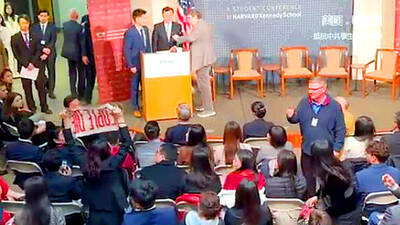
A group of Taiwanese-American and Tibetan-American students at Harvard University on Saturday disrupted Chinese Ambassador to the US Xie Feng’s (謝鋒) speech at the school, accusing him of being responsible for numerous human rights violations. Four students — two Taiwanese Americans and two from Tibet — held up banners inside a conference hall where Xie was delivering a speech at the opening ceremony of the Harvard Kennedy School China Conference 2024. In a video clip provided by the Coalition of Students Resisting the CCP (Chinese Communist Party), Taiwanese-American Cosette Wu (吳亭樺) and Tibetan-American Tsering Yangchen are seen holding banners that together read:

UNAWARE: Many people sit for long hours every day and eat unhealthy foods, putting them at greater risk of developing one of the ‘three highs,’ an expert said More than 30 percent of adults aged 40 or older who underwent a government-funded health exam were unaware they had at least one of the “three highs” — high blood pressure, high blood lipids or high blood sugar, the Health Promotion Administration (HPA) said yesterday. Among adults aged 40 or older who said they did not have any of the “three highs” before taking the health exam, more than 30 percent were found to have at least one of them, Adult Preventive Health Examination Service data from 2022 showed. People with long-term medical conditions such as hypertension or diabetes usually do not
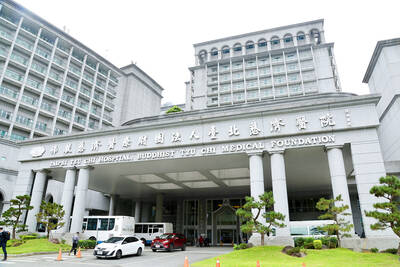
POLICE INVESTIGATING: A man said he quit his job as a nurse at Taipei Tzu Chi Hospital as he had been ‘disgusted’ by the behavior of his colleagues A man yesterday morning wrote online that he had witnessed nurses taking photographs and touching anesthetized patients inappropriately in Taipei Tzu Chi Hospital’s operating theaters. The man surnamed Huang (黃) wrote on the Professional Technology Temple bulletin board that during his six-month stint as a nurse at the hospital, he had seen nurses taking pictures of patients, including of their private parts, after they were anesthetized. Some nurses had also touched patients inappropriately and children were among those photographed, he said. Huang said this “disgusted” him “so much” that “he felt the need to reveal these unethical acts in the operating theater
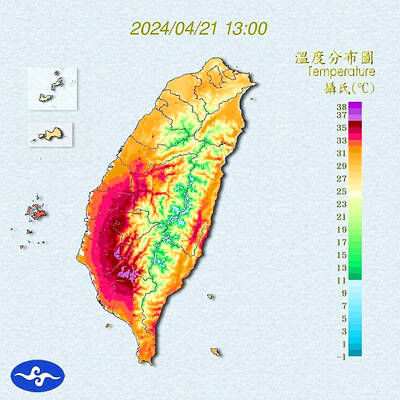
Heat advisories were in effect for nine administrative regions yesterday afternoon as warm southwesterly winds pushed temperatures above 38°C in parts of southern Taiwan, the Central Weather Administration (CWA) said. As of 3:30pm yesterday, Tainan’s Yujing District (玉井) had recorded the day’s highest temperature of 39.7°C, though the measurement will not be included in Taiwan’s official heat records since Yujing is an automatic rather than manually operated weather station, the CWA said. Highs recorded in other areas were 38.7°C in Kaohsiung’s Neimen District (內門), 38.2°C in Chiayi City and 38.1°C in Pingtung’s Sandimen Township (三地門), CWA data showed. The spell of scorching


 RSS
RSS