


To Yukiko, life on the street as a prostitute is never easy.
Not only does she suffer the physical pain caused by hours of standing, she also faces the danger of being caught by "fishers" -- prostitutes slang for policemen who pretend to be patrons and seek to arrest suspects engaging in illegal sexual transactions.
"I have been in the business for 30 years," she said. "When two people come into the alley, act like they are drunk, and start asking questions such as `How much do you charge, lady?' I know they are [fishers]."
Yukiko added that once she was betrayed by one of her patrons, who cooperated with a police officer. As soon as she sat down with the patron the police came in and caught them "in the act."
Today, Yukiko will join her peers, representatives from the Collective of Sex Workers and Supporters and other social groups to appeal to the government to decriminalize sex workers.
Participants, who will share scooters, plan to ride from Longshan Temple to the Council of Labor Affairs (CLA).
Besides a parade, the organizers will also put on shows, dances, a short documentary film and a seminar to reinforce their message. Toward the end of the parade, participants will jointly sing a song titled "Trashy Government" and announce the formation of a labor union for sex workers.
The legislation was passed in 1997 when Chen was mayor, but was not implemented until 2001, by which time he was president.
Since then, approximately 60 percent of formerly legal prostitutes have resumed their careers as illegal prostitutes, according to Chien Chia-ying (
Chien and other volunteers routinely walk the streets near the Wanhua area of Taipei at night distributing condoms and giving advice to sex workers on how to avoid contracting sexual diseases.
Chien noted that in her experience these women were not born to be criminals.
Each has a story to tell about how they become what they are now, she said.
The nation's lackluster economy has forced many to go back on the streets, she added, and hardly anyone is concerned about the safety of their working conditions.
"The police simply try to catch an unfortunate few to meet their quota," Chien said, adding that this has created tremendous pressure on many prostitutes.
Chung Chun-chu (鍾君竺), executive director for the Collective of Sex Workers and Supporters, said that Taipei Mayor Ma Ying-jeou (馬英九) conducted an assessment of the sex industry in 2002, in which it was proposed that a public hearing should be held about how prostitution could be regulated. Meanwhile, it suggested that the government strengthen its communication with sex workers.
Although the organization's appeals have received a sympathetic response from legislators and officials, Chung noted that many have been hesitant to endorse them.

More than half of the bamboo vipers captured in Tainan in the past few years were found in the city’s Sinhua District (新化), while other districts had smaller catches or none at all. Every year, Tainan captures about 6,000 snakes which have made their way into people’s homes. Of the six major venomous snakes in Taiwan, the cobra, the many-banded krait, the brown-spotted pit viper and the bamboo viper are the most frequently captured. The high concentration of bamboo vipers captured in Sinhua District is puzzling. Tainan Agriculture Bureau Forestry and Nature Conservation Division head Chu Chien-ming (朱健明) earlier this week said that the
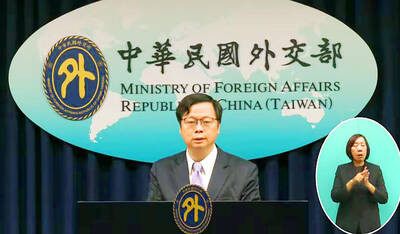
NAMING SPAT: The foreign ministry called on Denmark to propose an acceptable solution to the erroneous nationality used for Taiwanese on residence permits Taiwan has revoked some privileges for Danish diplomatic staff over a Danish permit that lists “Taiwan” as “China,” Eric Huang (黃鈞耀), head of the Ministry of Foreign Affairs’ Department of European Affairs, told a news conference in Taipei yesterday. Reporters asked Huang whether the Danish government had responded to the ministry’s request that it correct the nationality on Danish residence permits of Taiwanese, which has been listed as “China” since 2024. Taiwan’s representative office in Denmark continues to communicate with the Danish government, and the ministry has revoked some privileges previously granted to Danish representatives in Taiwan and would continue to review
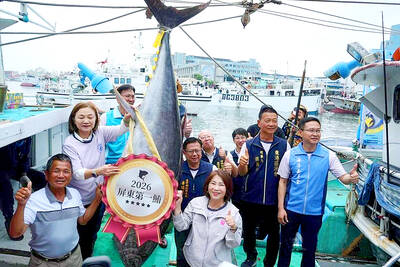
The first bluefin tuna of the season, brought to shore in Pingtung County and weighing 190kg, was yesterday auctioned for NT$10,600 (US$333.5) per kilogram, setting a record high for the local market. The auction was held at the fish market in Donggang Fishing Harbor, where the Siaoliouciou Island-registered fishing vessel Fu Yu Ching No. 2 delivered the “Pingtung First Tuna” it had caught for bidding. Bidding was intense, and the tuna was ultimately jointly purchased by a local restaurant and a local company for NT$10,600 per kilogram — NT$300 ,more than last year — for a total of NT$2.014 million. The 67-year-old skipper
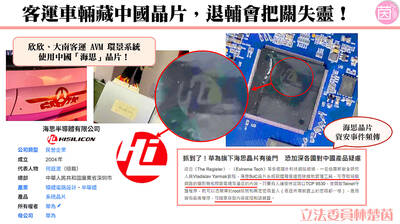
BREACH OF CONTRACT: The bus operators would seek compensation and have demanded that the manufacturer replace the chips with ones that meet regulations Two bus operators found to be using buses with China-made chips are to demand that the original manufacturers replace the systems and provide compensation for breach of contract, the Veterans Affairs Council said yesterday. Democratic Progressive Party Legislator Michelle Lin (林楚茵) yesterday said that Da Nan Bus Co and Shin-Shin Bus Co Ltd have fielded a total of 82 buses that are using Chinese chips. The bus models were made by Tron-E, while the systems provider was CYE Electronics, Lin said. Lin alleged that the buses were using chips manufactured by Huawei subsidiary HiSilicon Co, which presents a national security risk if the


 RSS
RSS