


The Taipei City Zoo has developed a formula substitute for the diet of Taiwan's indigenous anteater, the Formosa Pangolin, allowing it to raise anteaters in captivity.
The Formosa Pangolin is a protected species, and the law prohibits it from being fed in the wild or in captivity by sightseers.
Pangolins feed only on termites and ants, which makes raising them in captivity especially challenging.
The Taipei City Zoo developed its formula, which provides a viable ant and termite substitute, through years of treating the animals and other veterinary research.
Before the formula was perfected, 60 percent of Taipei City Zoo's anteaters suffered from ulcers in their digestive tracts, according to the zoo's top veterinarian, Chin Shi-chien (
It took two years of tinkering with the formula recipe -- which includes precise amounts of silkworm pupae, beetles, chitosan, vitamins, starch and eggs -- to create a winning concoction.
Endoscopic examinations last month revealed that the stomach ulcers had all healed, prompting the zoo to plan to release the healthy critters back into the wild.
Many attempts to raise anteaters in captivity have failed, Chin said.
The Taipei City Zoo is the only zoo that has been able to raise the animal in captivity, and is the only zoo that currently exhibits anteaters, he said. Both the Singapore zoo and the Bronx Zoo in New York City have expressed an interest in getting the formula.
The Taipei City Zoo has raised 14 anteaters, with the oldest being an 11-year-old female that gave birth nine years ago. Both mother and son are still going strong.
Most of the anteaters were sent to the zoo after being injured or falling ill in the wild, Chin said.
On average, 12 to 15 anteaters get sent to the zoo each year for treatment. X-rays often reveal the sick anteaters are suffering from pneumonia.
Treating them is no easy feat. Their thick scales preclude the use of stethoscopes, and anteaters' body temperatures average 33?Cto 34?C -- too low for regular thermometers to measure accurately.
Veterinarians must use fridge thermometers to take the animal's rectal temperature.
According to Chin, anteaters arriving at the zoo used to come mostly from Wugu (
Chin believed this shift is the result of development that has driven the anteaters from their traditional hunting grounds.
Fast-paced development in the mountains and low-lying areas, including the development of tea farms and orchids, has significantly impacted the creatures, which do not take well to high-altitude habitats -- the last place where they could largely escape the encroachment of mankind, Chin said.
Meanwhile, the Taiwan Forestry Research Institute is using electronic tracking devices to better understand the distribution and habits of the Formosa Pangolin. It is the first time electronic devices have been used in this country to study the indigenous anteaters.
Tagged anteaters have proven to be extremely peripatetic, switching homes weekly or even daily, with their yearly range of movement covering up to 70 hectares.

SHIPS, TRAINS AND AUTOMOBILES: The ministry has announced changes to varied transportation industries taking effect soon, with a number of effects for passengers Beginning next month, the post office is canceling signature upon delivery and written inquiry services for international registered small packets in accordance with the new policy of the Universal Postal Union, the Ministry of Transportation and Communications said yesterday. The new policy does not apply to packets that are to be delivered to China, the ministry said. Senders of international registered small packets would receive a NT$10 rebate on postage if the packets are sent from Jan. 1 to March 31, it added. The ministry said that three other policies are also scheduled to take effect next month. International cruise ship operators

NUMBERS IMBALANCE: More than 4 million Taiwanese have visited China this year, while only about half a million Chinese have visited here Beijing has yet to respond to Taiwan’s requests for negotiation over matters related to the recovery of cross-strait tourism, the Tourism Administration said yesterday. Taiwan’s tourism authority issued the statement after Chinese-language daily the China Times reported yesterday that the government’s policy of banning group tours to China does not stop Taiwanese from visiting the country. As of October, more than 4.2 million had traveled to China this year, exceeding last year. Beijing estimated the number of Taiwanese tourists in China could reach 4.5 million this year. By contrast, only 500,000 Chinese tourists are expected in Taiwan, the report said. The report
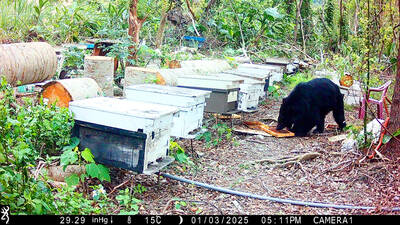
The Forestry and Nature Conservation Agency yesterday launched a gift box to market honey “certified by a Formosan black bear” in appreciation of a beekeeper’s amicable interaction with a honey-thieving bear. Beekeeper Chih Ming-chen (池明鎮) in January inspected his bee farm in Hualien County’s Jhuosi Township (卓溪) and found that more than 20 beehives had been destroyed and many hives were eaten, with bear droppings and paw prints near the destroyed hives, the agency said. Chih returned to the farm to move the remaining beehives away that evening when he encountered a Formosan black bear only 20m away, the agency said. The bear

Chinese embassy staffers attempted to interrupt an award ceremony of an international tea competition in France when the organizer introduced Taiwan and displayed the Republic of China flag, a Taiwanese tea farmer said in an interview published today. Hsieh Chung-lin (謝忠霖), chief executive of Juxin Tea Factory from Taichung's Lishan (梨山) area, on Dec. 2 attended the Teas of the World International Contest held at the Peruvian embassy in Paris. Hsieh was awarded a special prize for his Huagang Snow Source Tea by the nonprofit Agency for the Valorization of Agricultural Products (AVPA). During the ceremony, two Chinese embassy staffers in attendance


 RSS
RSS