


Export controls designed to keep sensitive technology from falling into the wrong hands are far from foolproof, the Bureau of Foreign Trade said on Friday, adding that the problem is one that many countries face.
The bureau acknowledged that there were difficulties in determining whether Taiwanese exporters of sensitive commodities had transferred technology that could be used for military purposes to China.
The bureau's Import/Export Administration Division Director Peter Ho (
"But this is not just a problem for Taiwan; many major exporters have this problem," Ho said.
The bureau issued a press release on Friday stating that it had been investigating Taiwanese exporters of high-precision machine tools since last year to determine if any had violated its Regulations Governing Export and Import of Strategic High-Tech Commodities.
Taiwanese tools
The release was issued after a report last Thursday by the Japanese-language daily Sankei Shimbun claiming that China has used sophisticated Taiwanese machine tools to service the more than 800 ballistic missiles targeting Taiwan, as well as attack helicopters that could be used in an invasion of the country.
Ho also disputed the accuracy of the report, saying, "Sankei Shimbun quoted the Ministry of National Defense in its report, but the ministry has never approached us about this problem."
Ho said that the machine tools most capable of fabricating weapons-grade parts were those outfitted with Computer Numerical Control (CNC) devices -- technology that significantly enhances the precision of the tools. Taiwan imports CNC technology mainly from Japan, he added.
"I talked with Japan's Ministry of Economy, Trade and Industry on the phone yesterday, and they don't know anything about [the Sankei Shimbun report], either," Ho said.
The trade bureau's investigation also seeks to determine whether Taiwanese manufacturers are capable of producing machine tools sophisticated enough to fabricate weapons components by themselves, he said.
"If the Sankei Shimbun report is accurate," Ho said, "then perhaps the Chinese military acquired Taiwanese machine tools that were exported to China after being equipped with imported Japanese or German CNC technology."
Ho said Taiwanese exporters must be certified to export high-precision machine tools and other strategic high-tech commodities, and that the bureau performs due diligence on the importer and end user as listed by the exporter.
Difficult to control
"However, it's very difficult for us to know if the [strategic high-tech] commodities ultimately end up with different end users than the ones first listed after they're exported," Ho said.
Despite this difficulty, Ho rates cooperation with exporters as high due to penalties that include fines and prison sentences for violators of export control regulations.
Ho said that the regulations and procedures were modeled after those in the US, and the bureau regularly consulted with such US government agencies as the defense and state departments in deciding whether to permit domestic exporters to export strategic high-tech commodities to certain end users.
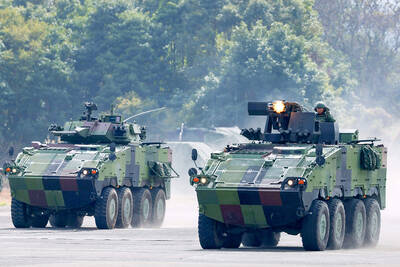
Taiwan must first strengthen its own national defense to deter a potential invasion by China as cross-strait tensions continue to rise, multiple European lawmakers said on Friday. In a media interview in Taipei marking the conclusion of an eight-member European parliamentary delegation’s six-day visit to Taiwan, the lawmakers urged Taipei to remain vigilant and increase defense spending. “All those who claim they want to protect you actually want to conquer you,” Ukrainian lawmaker Serhii Soboliev said when asked what lessons Taiwan could draw from Russia’s invasion of Ukraine. Soboliev described the Kremlin as a “new fascist Nazi regime” that justified

The US House of Representatives yesterday passed the PROTECT Taiwan Act, which stipulates that Washington would exclude China from participating in major global financial organizations if its actions directly threaten Taiwan’s security. The bill, proposed by Republican US Representative Frank Lucas, passed with 395 votes in favor and two against. It stipulates that if China’s actions pose any threat to Taiwan’s security, economic or social systems, the US would, “to the maximum extent practicable,” exclude China from international financial institutions, including the G20, the Bank for International Settlements and the Financial Stability Board. The bill makes it clear that China
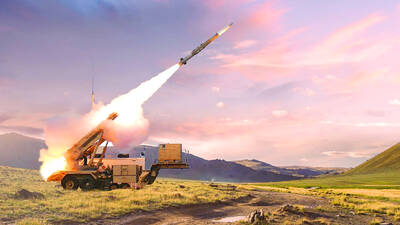
‘T-DOME’: IBCS would increase Taiwan’s defense capabilities, enabling air defense units to use data from any sensor system and cut reaction time, a defense official said A defense official yesterday said that a purported new arms sale the US is assembling for Taiwan likely includes Integrated Battle Command Systems (IBCS). The anonymous official’s comments came hours after the Financial Times (FT) reported that Washington is preparing a US$20 billion arms sale encompassing “Patriot missiles and other weapons,” citing eight sources. The Taiwanese official said the IBCS is an advanced command and control system that would play a key role in President William Lai’s (賴清德) flagship defense program, the “T-Dome,” an integrated air defense network to counter ballistic missiles and other threats. The IBCS would increase Taiwan’s

NOMINAL NEWLYWEDS: A man’s family and his wife — his long-term caregiver — are engaged in a legal dogfight over the propriety and validity of the recent union A centenarian’s marriage to his caregiver unbeknownst to his children has prompted legal action, as the caregiver accuses the man’s children of violating her personal liberty and damaging her reputation, while the children have sought a legal option to have the marriage annulled. According to sources, the 102-year-old man surnamed Wang (王) lives in Taipei’s Zhongshan District (中山) and previously worked as a land registration agent. Wang reportedly owns multiple properties and parcels of land worth several hundred million New Taiwan dollars and has ten children. His caregiver, a 69-year-old surnamed Lai (賴), has been caring for him since about 1999,


 RSS
RSS