


A group of Chinese Nationalist Party (KMT) legislators yesterday proposed the idea of a "two-in-one election," suggesting that next year's 2007 legislative election and the 2008 presidential election should be held at the same time, in January 2008.
Legislator Wu Yu-sheng (
However, some outside the KMT dismissed the proposal as a way for the pan-blue legislators to ride on the coattails of KMT Chairman Ma Ying-jeou (
Under the KMT's proposal, the two-in-one election would be held on Jan. 19, 2008. This would mean postponing the legislative election, currently scheduled for December next year, and advancing the date of the presidential election, currently scheduled for late March 2008.
"Although it is true that a two-in-one election would favor the KMT, this is not the motive behind the suggestion," Wu said.
Wu said that reducing the number of elections was in keeping the public's expectations.
"In addition to reducing costs, the proposal might also help the government to avoid having to reshuffle the Cabinet twice in a short space of time," he said.
The People First Party (PFP) legislative caucus said that it would not be against the idea as long as it was not specifically devised to favor a particular political party.
However, PFP caucus whip Lee Hung-chun (
Given that the PFP might not have its own presidential candidate in the 2008 election, Lee said that the change would have a negative influence on his party's chances in the legislative election.
Legislative Speaker Wang Jin-pyng (
"At the moment it seems that the proposal would benefit only the KMT, but it is difficult to predict which party might benefit from this idea in one year's time" Wang said.
Democratic Progressive Party (DPP) caucus whip Chen Chin-jun (
Chen Chin-jun said DPP Chairman Yu Shyi-kun recently canvassed party legislators for their opinions on the matter. As far as he knew, legislators had conflicting views on the proposal, he said.
"The legislative caucus will have the final say on the new electoral system," he said.
"It is still difficult to predict who will win the next presidential election and the KMT cannot believe that a two-in-one election will help it win," Chen Chin-jun said.
"As long as the DPP performs well in the next two years, we still have good chance to win the presidential election," he said.
The Taiwan Solidarity Union (TSU) said it opposed the two-in-one elections and suspected the KMT's motives.
"The pan-blue camp just wants to boost its legislators' campaign momentum through the presidential election, which it believes it is certain of winning," TSU caucus whip David Huang (黃適卓) said yesterday.
Huang said that although a two-in-one election might save some money, it could also cause some problems.
According to the constitutional system, the president is authorized to dismiss the legislature. Similarly, the legislature has the power to recall the president, Huang said.
"If the legislature was dismissed, a re-election would have to be held. Therefore I think it makes no sense to merge the two elections," Huang said.
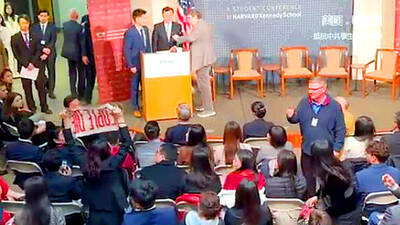
A group of Taiwanese-American and Tibetan-American students at Harvard University on Saturday disrupted Chinese Ambassador to the US Xie Feng’s (謝鋒) speech at the school, accusing him of being responsible for numerous human rights violations. Four students — two Taiwanese Americans and two from Tibet — held up banners inside a conference hall where Xie was delivering a speech at the opening ceremony of the Harvard Kennedy School China Conference 2024. In a video clip provided by the Coalition of Students Resisting the CCP (Chinese Communist Party), Taiwanese-American Cosette Wu (吳亭樺) and Tibetan-American Tsering Yangchen are seen holding banners that together read:

UNAWARE: Many people sit for long hours every day and eat unhealthy foods, putting them at greater risk of developing one of the ‘three highs,’ an expert said More than 30 percent of adults aged 40 or older who underwent a government-funded health exam were unaware they had at least one of the “three highs” — high blood pressure, high blood lipids or high blood sugar, the Health Promotion Administration (HPA) said yesterday. Among adults aged 40 or older who said they did not have any of the “three highs” before taking the health exam, more than 30 percent were found to have at least one of them, Adult Preventive Health Examination Service data from 2022 showed. People with long-term medical conditions such as hypertension or diabetes usually do not
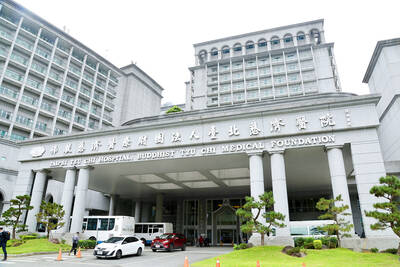
POLICE INVESTIGATING: A man said he quit his job as a nurse at Taipei Tzu Chi Hospital as he had been ‘disgusted’ by the behavior of his colleagues A man yesterday morning wrote online that he had witnessed nurses taking photographs and touching anesthetized patients inappropriately in Taipei Tzu Chi Hospital’s operating theaters. The man surnamed Huang (黃) wrote on the Professional Technology Temple bulletin board that during his six-month stint as a nurse at the hospital, he had seen nurses taking pictures of patients, including of their private parts, after they were anesthetized. Some nurses had also touched patients inappropriately and children were among those photographed, he said. Huang said this “disgusted” him “so much” that “he felt the need to reveal these unethical acts in the operating theater
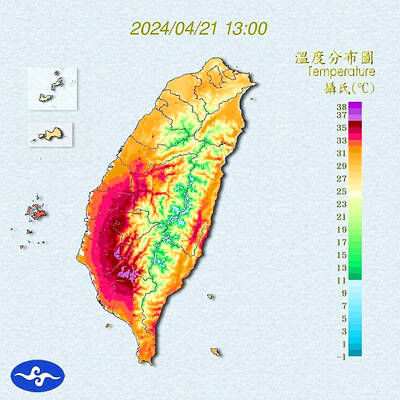
Heat advisories were in effect for nine administrative regions yesterday afternoon as warm southwesterly winds pushed temperatures above 38°C in parts of southern Taiwan, the Central Weather Administration (CWA) said. As of 3:30pm yesterday, Tainan’s Yujing District (玉井) had recorded the day’s highest temperature of 39.7°C, though the measurement will not be included in Taiwan’s official heat records since Yujing is an automatic rather than manually operated weather station, the CWA said. Highs recorded in other areas were 38.7°C in Kaohsiung’s Neimen District (內門), 38.2°C in Chiayi City and 38.1°C in Pingtung’s Sandimen Township (三地門), CWA data showed. The spell of scorching


 RSS
RSS