


With the cooperation of Philippine forces, Taiwan's military police recently tracked down two Taiwanese arms smugglers in the Philippines.
But the Ministry of National Defense's decision to reject an additional request for a manhunt for a notorious gunrunner believed to be hiding in Manila may jeopardize Taiwan's security, prosecutors said.
"Kaohsiung prosecutors have discovered that arms smugglers are sourcing weapons from the Philippine military and are of the opinion that the best way of cracking down on trafficking of illegal weapons in Taiwan is to start in the Philippines," a prosecutor at the Kaohsiung Bureau of the Taiwan High Court Prosecutors' Office, Chang Hsueh-ming (
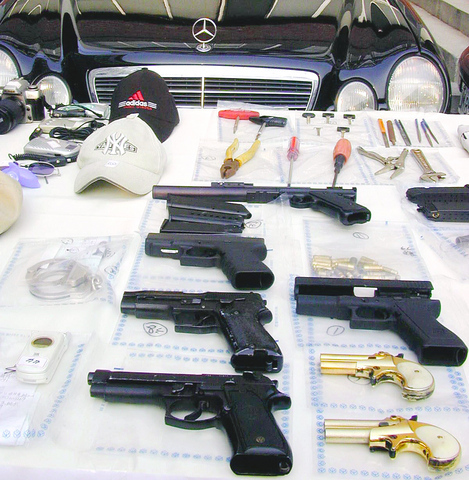
PHOTO: WANG CHUN-CHUNG, TAIPEI TIMES
Chang said that Ting Cheng-hsiang (
Chang said that prosecutors received intelligence late last year indicating that Ting was in the city and the National Security Bureau had agreed to provide NT$300,000 (US$9,250) to finance a manhunt. However, the military police had declined to undertake the mission, Chang said.
Real Admiral Yang Wen-hsien (
However, the military police successfully captured Chu Jui-teh (
Chang said that the arrest of two of his accomplices had not stopped Ting from continuing to smuggle weapons.
Ting, 50, was sentenced to life in prison and jailed in Taiwan, but escaped in 1989 and fled to the Philippines.
He has been involved in the illegal weapons trade for more than 15 years, according to Chang.
In February, the prosecutor said, a Taiwanese seafood trader surnamed Liou traveled with his wife on a business trip to Manila. On arrival at the Manila airport, Liou was kidnapped by a Taiwanese man and five Filipinos.
According to Taiwanese police, the kidnappers made phone calls to Liou's daughter in Taiwan, asking for a ransom of US$7.5 million. Four days later, Liou escaped from the house in which he was being held after his captors fell asleep.
Chang said that law enforcement officers investigating the crime believed that Ting was behind it.
When interviewed by Taiwanese police, Ting's former accomplice Chu said that the pair worked with a Japanese Filipino by the name of Nemoto Akira to smuggle arms procured from the Philippine military into Taiwan.
According to Chu, Akira had close ties with the Philippine military and frequently purchased rifles, pistols, submachine guns, grenades and ammunition outside a military base near the Manila airport.
Chang said that according to Chu, it was easy to procure even advanced weapons from the Philippine military.
In June, Philippine police, in cooperation with a Taiwanese taskforce, arrested Akira at his luxurious residence in Manila and seized a number of illegal weapons.
Chang said that Akira was a leading figure in the Manila arms smuggling underworld. In January last year, when Akira learned that Taiwanese and Philippine forces were looking for Chu in Manila, he ordered more than 30 Filipinos, armed with pistols and rifles, to "protect" him.
Chang said although Philippine and Taiwanese forces were forced to cancel the mission, they were finally able to arrest Chu and brought him back to Taiwan to face trial in March last year.
Chang said that although Akira was now in custody, Ting and other gangsters were still smuggling illegal weapons into Taiwan.
Prosecutors have vowed not to give up on capturing Ting and another of his accomplices by the name of Chao Pei-shen (趙培盛), a former resident of Kaohsiung who fled to the Philippines after he learned that police were after him.
Former Kaohsiung prosecutor Yeh Ching-tsai (
Shi said the arms were imported in cargo containing wood, coco leaves or palm trees, as well as seafood or other agricultural products.
Fishing boats were also used to smuggle weapons into the country, Yeh said.
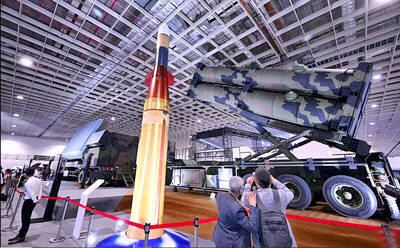
Taiwan is to commence mass production of the Tien Kung (天弓, “Sky Bow”) III, IV and V missiles by the second quarter of this year if the legislature approves the government’s NT$1.25 trillion (US$39.78 billion) special defense budget, an official said yesterday. Commenting on condition of anonymity, a defense official with knowledge of the matter said that the advanced systems are expected to provide crucial capabilities against ballistic and cruise missiles for the proposed “T-Dome,” an advanced, multi-layered air defense network. The Tien Kung III is an air defense missile with a maximum interception altitude of 35km. The Tien Kung IV and V
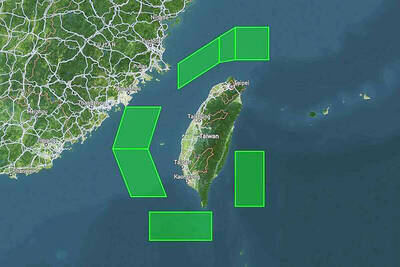
The disruption of 941 flights in and out of Taiwan due to China’s large-scale military exercises was no accident, but rather the result of a “quasi-blockade” used to simulate creating the air and sea routes needed for an amphibious landing, a military expert said. The disruptions occurred on Tuesday and lasted about 10 hours as China conducted live-fire drills in the Taiwan Strait. The Civil Aviation Administration (CAA) said the exercises affected 857 international flights and 84 domestic flights, affecting more than 100,000 travelers. Su Tzu-yun (蘇紫雲), a research fellow at the government-sponsored Institute for National Defense and Security Research, said the air
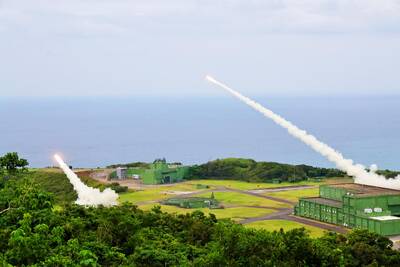
Taiwan lacks effective and cost-efficient armaments to intercept rockets, making the planned “T-Dome” interception system necessary, two experts said on Tuesday. The concerns were raised after China’s military fired two waves of rockets during live-fire drills around Taiwan on Tuesday, part of two-day exercises code-named “Justice Mission 2025.” The first wave involved 17 rockets launched at 9am from Pingtan in China’s Fujian Province, according to Lieutenant General Hsieh Jih-sheng (謝日升) of the Office of the Deputy Chief of the General Staff for Intelligence at the Ministry of National Defense. Those rockets landed 70 nautical miles (129.6km) northeast of Keelung without flying over Taiwan,
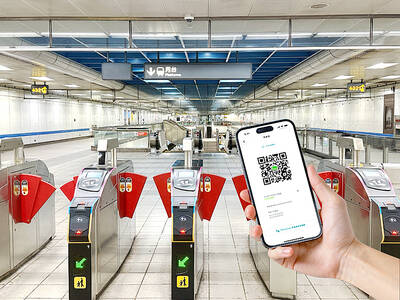
City buses in Taipei and New Taipei City, as well as the Taipei MRT, would on Saturday begin accepting QR code payments from five electronic payment providers, the Taipei Department of Transportation said yesterday. The new option would allow passengers to use the “transportation QR code” feature from EasyWallet, iPass Money, iCash Pay, Jkopay or PXPay Plus. Passengers should open their preferred electronic payment app, select the “transportation code” — not the regular payment code — unlock it, and scan the code at ticket readers or gates, General Planning Division Director-General Liu Kuo-chu (劉國著) said. People should move through the


 RSS
RSS