


The powerful Republican chairman of the US Senate Armed Services Committee has expressed dissatisfaction over President Chen Shui-bian's (
The comment underscores how deeply Washington feels about Chen's actions and how they have become the focus in Washington of US-Taiwan relations in recent weeks.
Republican Senator John Warner voiced his concern during a hearing of the committee on the Pentagon's budget for fiscal 2007.
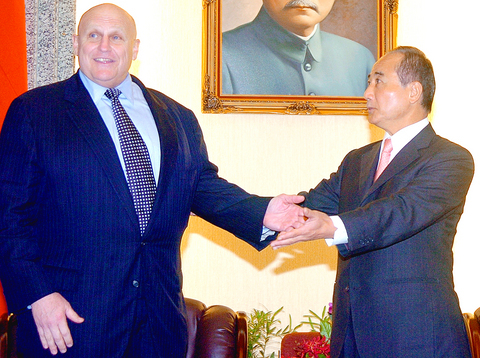
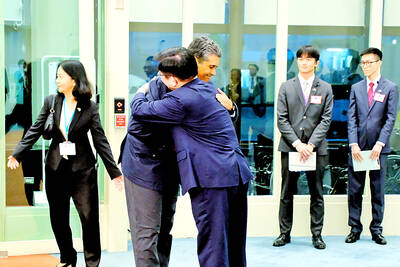
PHOTO: CHU PEI-HSIUNG, TAIPEI TIMES
"I think that if that conflict were precipitated by just inappropriate and wrongful politics generated by the Taiwanese elected officials, I'm not entirely sure that this nation would come full force to their rescue if they created the problem," Warner said.
The US' experiences in Asia do not "encourage us to go further into military action ... particularly if they're brought up" by "injudicious judgment in politics," Warner said.
Taiwan's de facto ambassador to the US, David Lee (李大維), called Warner's comments "friendly advice from a famous statesman who is a friend of Taiwan."
In his regular monthly "tea party" press conference with the Taiwanese press corps in Washington, Lee recalled that some months ago Warner expressed his "good feelings" toward Taiwan, borne of his experiences as a young Marine in the Pacific in World War II.
Warner had said that since US forces were stretched so thin by the US' involvement in Iraq and Afghanistan, as well as its war on terror, "he was afraid that in the case there is a military crisis in the Taiwan Strait ... the US may not be able to get involved," Lee told the Taipei Times after the press conference.
"So he urged us to be cautious, to be prudent," Lee said.
Warner's message, which Lee transmitted to the government in Taipei, had been well received, Lee said.
At the hearing, the commander of US military forces in Asia tried to downplay the impact of Chen's actions and their implications for the military situation in the Strait.
Admiral William Fallon, the commander of the US' Pacific forces, told the committee that Chen's move "has caused some concern." However, he added that China's reaction to Chen's statements "has been pretty muted."
US forces in the Pacific have "not seen any military movements" by China in response to Chen's actions, Fallon said, in contrast to earlier crises where Chinese military activities have closely followed developments in Taiwan.
As a result, Fallon said, "to me, at least so far, it is indicative of [China] taking this more in [its] stride than just reacting."
The US' Pacific commander conceded that Chen's actions are not completely understood in Washington.
"I've seen a number of interpretations of what actually transpired in Taipei," he said.
However, "diminishing the importance" of the National Unification Council, which "hasn't really done much in recent times," Fallon said, "exacerbates the challenge we have where rhetoric goes back and forth."
He called Chen's actions "unfortunate," but not "particularly damaging."
If Chen takes other steps indicating people are being stirred up in Taiwan, "I think this would be a real concern," Fallon said.
Overall, Fallon told the committee, cross-strait tensions have been "significantly reduced" from a year ago.
Meanwhile, upon his arrival in Taipei yesterday, former US deputy secretary of state Richard Armitage said that he would most likely discuss the National Unification Council issue with Chen, although he was not too concerned about the issue himself.
Armitage said he could understand the reasoning behind Chen's decision, and that he did not expect the move to have any significant impact on cross-strait relations in the long run.
Beijing did not seem to be overreacting to Chen's move, and its response had been "what we expected," he said.
Prior to visiting Legislative Speaker Wang Jin-pyng (
"Any democracy can change its constitution if it has the support of the people. If Taiwan wants it, they can do it," he said in response to a question from reporters.
Additional reporting by Shih Hsiu-chuan
also see story:
Editorial: Is the US asleep at the wheel?
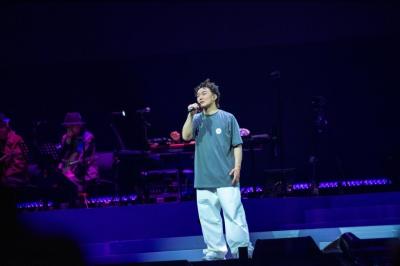
Hong Kong singer Eason Chan’s (陳奕迅) concerts in Kaohsiung this weekend have been postponed after he was diagnosed with Covid-19 this morning, the organizer said today. Chan’s “FEAR and DREAMS” concert which was scheduled to be held in the coming three days at the Kaohsiung Arena would be rescheduled to May 29, 30 and 31, while the three shows scheduled over the next weekend, from May 23 to 25, would be held as usual, Universal Music said in a statement. Ticket holders can apply for a full refund or attend the postponed concerts with the same seating, the organizer said. Refund arrangements would
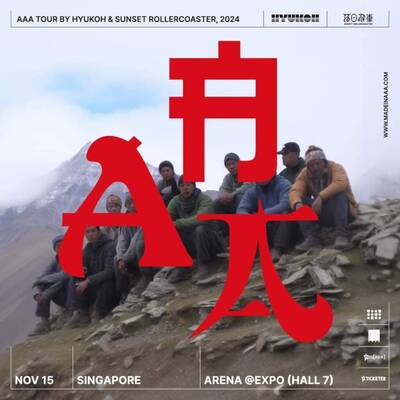
Taiwanese indie band Sunset Rollercoaster and South Korean outfit Hyukoh collectively received the most nominations at this year’s Golden Melody Awards, earning a total of seven nods from the jury on Wednesday. The bands collaborated on their 2024 album AAA, which received nominations for best band, best album producer, best album design and best vocal album recording. “Young Man,” a single from the album, earned nominations for song of the year and best music video, while another track, “Antenna,” also received a best music video nomination. Late Hong Kong-American singer Khalil Fong (方大同) was named the jury award winner for his 2024 album
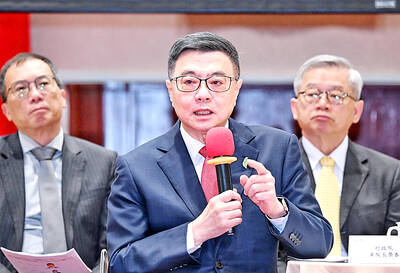
Premier Cho Jung-tai (卓榮泰) on Friday laid out the Cabinet’s updated policy agenda and recapped the government’s achievements ahead of the one-year anniversary of President William Lai’s (賴清德) inauguration. Cho said the government had made progress across a range of areas, including rebuilding Hualien, cracking down on fraud, improving pedestrian safety and promoting economic growth. “I hope the public will not have the impression that the Cabinet only asked the legislature to reconsider a bunch of legal amendments,” Cho said, calling the moves “necessary” to protect constitutional governance and the public’s interest. The Cabinet would work toward achieving its “1+7” plan, he said. The
Palauan President Surangel Whipps Jr arrived in Taiwan last night to kick off his first visit to the country since beginning his second term earlier this year. After arriving at Taoyuan International Airport at around 6:30 pm, Whipps and his delegation were welcomed by Minister of Foreign Affairs Lin Chia-lung (林佳龍). Speaking to gathered media, the Palauan leader said he was excited and honored to be back in Taiwan on his first state visit to Taiwan since he was sworn in this January. Among those traveling with Whipps is Minister of State Gustav N. Aitaro, Public Infrastructure


 RSS
RSS