


Crammed into a rectangular prison cell, more than 100 women sit listlessly behind bars awaiting an uncertain future.
Dressed in identical red T-shirts and blue shorts, these inmates are not petty criminals but the victims of a surging trade in human trafficking across the 270km stretch of water that separates Taiwan from China.
The women, some as young as 16, are either lured or persuaded to come to Taiwan in search of manual jobs. Others are kidnapped and forced to make the journey by human traffickers.
But dreams of riches often fail to materialize as the gangs of smugglers, often known as snakeheads, force many migrants into a life of prostitution.
It's what Little Wang, as she calls herself, had to endure for 6 months before being picked up by the police in Kaohsiung.
At only 17, a family friend persuaded her that Taiwan had plenty of need for girls to work in factories, with the pay and living conditions significantly better than those back home.
She was introduced to a broker and paid him US$500, a sum borrowed from family and friends, and was shipped over on a fishing boat during the night.
But as soon as she stepped off the boat her ordeal began. Little Wang and eight other girls were taken to a house and told they would have to work as prostitutes.
"I was trembling with fear and had no way to escape," she said while crying.
"At first I didn't want to do it, so they locked me in a room and told me I would stay in there for ever unless I did what they said," she added.
After about six months she got pregnant, a mixed blessing for her.
The brothel chief kicked her out onto the streets with no money, but soon a police car picked her up and eventually she was taken to the Hsinchu detention center.
The former military and police-training camp now acts as a holding place for women who share similar stories and the same fate.
More than 1,000 inmates are now packed into Hsinchu Detention Center for illegal Chinese migrants, 80km south of Taipei.
"The scale of human trafficking in Taiwan is expanding according to several studies and that Taiwan has become an important hub in international human trafficking," said Hsiao Bi-khim (
The inmates are not sent back to China immediately. Most languish for a minimum of 6 months in Hsinchu or one of the other two detention centers around Taiwan, because Chinese authorities are reluctant to take them back. Some have been waiting for more than a year.
This often causes the number of prisoners to stack up putting pressure on the authorities to look after their well-being.
The detention center had an original capacity of 840 inmates, but the scale of trafficking has reached such proportions that it now regularly has to accommodate 1,250.
The large numbers make it difficult for police, so women are often locked in for most of the day, many with small children: a by-product of their lives as prostitutes.
Thousands of Chinese from rural parts of the country try to enter Taiwan illegally every year, looking for work and better economic prospects.
Most are smuggled by boat from Fujian Province and pay brokers between US$400 and US$1,500.
Statistics from the Ministry of the Interior show that Taiwanese police intercepted 8,164 illegal immigrants from 2001 to the end of last year.
Of the 5,097 women arrested, 44 percent were engaged in prostitution. Hsiao says a review by the US State Department late last year said Taiwan's efforts to eliminate human trafficking were "unsatisfactory."
Hsiao said the problem is the Taiwan government hasn't passed a specific law to deal with human trafficking, and a dedicated government agency is needed to prevent it from escalating.
Even the Mainland Affairs Council Chairman Joseph Wu (
"The number of cases is on the rise but it is proving impossible to catch all the smugglers," he said.
The biggest problem is that Chinese police refuse to work with the Taiwan authorities to combat cross-strait crime, he added.

UPGRADE: The Kang Ding-class frigate is replacing its Chaparall missiles with Tien Chien II and Hua Yang VLS, which would provide it with long-range, 360° air defense Taiwan plans to produce 1,200 to 1,376 Hai Chien II missiles (海劍二, Sea Sword II) — also known as TC-2N — to serve as the standard air defense system of the navy’s surface combatant fleet, a source said yesterday. Last week, the Hai Chien II, the naval version of the Tien Kung II missile (天劍二, Sky Sword II), completed a live-fire test in waters off the National Chungshan Institute of Science and Technology’s Jiupeng facility (九鵬) in Pingtung County’s Manjhou Township (滿州). The MIM72 Chaparral and other dated air defense missiles that currently arm Taiwanese ships have inadequate range to combat Chinese

REASONS FOR TRAVEL: An assistant professor said that proposed amendments to penalize drivers if they used drugs overseas would not deter people from traveling People who operate a motor vehicle under the influence of marijuana would have their driver’s license revoked, even if they used the substance while overseas, the Ministry of Transportation and Communications said yesterday, citing proposed amendments to the Road Traffic Management and Penalty Act (道路交通管理處罰條例). The amendments would also authorize the government to revoke the licenses of people determined to have used Category 1 or Category 2 narcotics, even if they were not operating a vehicle while under the influence of drugs, as well as ban them from taking the license test for three years, the ministry said. People aged 18 or

HEAVY WEATHER: Typhoon Jangmi is due to crash straight into the Ryukyus as airlines look to shift flights to larger aircraft or cancel flights to Okinawa entirely Taiwan’s international air carriers announced flight adjustments over the weekend as Typhoon Jangmi is forecast to hit the Ryukyu Islands today and tomorrow. The Central Weather Administration (CWA) upgraded Jangmi from a tropical storm to a typhoon at 8am yesterday, with the eye located 580km south of Naha city. It was moving north at 19kph. Today, China Airlines’ CI-120, CI-121, CI-122 and CI-123 flights between Taoyuan and Naha, Okinawa, have been canceled as well as CI-132 and CI-133 between Kaohsiung and Naha. EVA Air’s BR-112, BR-113, BR-186 and BR-185 flights between Taoyuan and Naha are also canceled. Low-cost carrier Tigerair Taiwan canceled IT-230,
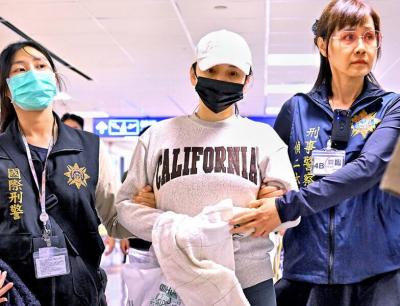
Johanne Liou (劉喬安), a Taiwanese woman who shot to unwanted fame during the Sunflower movement protests in 2014, returned to Taiwan last night after being deported from the US. She is to stand trial in Taiwan for charges involving embezzlement, fraud and drug crimes. The Criminal Investigation Bureau (CIB) said it took her into custody at Taiwan Taoyuan International Airport and would first question her before transferring her to the New Taipei District Prosecutors’ Office. She was arrested upon disembarking a flight from San Francisco that landed shortly before 7pm. Liou absconded to the US in 2019 after jumping bail


 RSS
RSS